

Modern Marriage Isn't Misery
Fewer people are marrying, but single young people are being fed myths about the misery of modern marriage that just aren't true.

This article used to be paid, but per my new tradition, I’m removing the paywall from one article per week. If you like what you see, consider becoming a free or paid subscriber, since I publish 5+ things like this every week!

One piece of news has hit Gender Discourse this week: according to a Pew survey, twelfth-grade girls are less likely than boys to want to get married, compared to being more interested in marriage than boys thirty years ago.
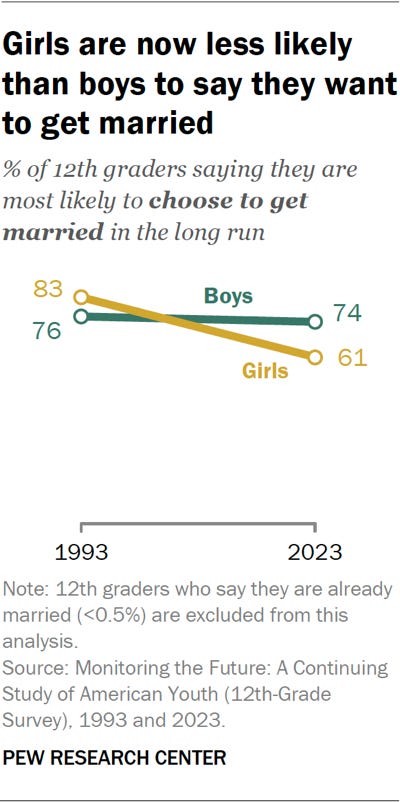
People weren’t concerned about teen boys wanting marriage less than teen girls thirty years ago—it was assumed marriage sucked for men, and only through a slog of nagging could men be convinced into matrimony. Perhaps it’s the declining birth rate that’s making people care now. Or perhaps people are just more bothered by women opting out than by men (although to be clear—these are seventeen-year-olds, and your views on marriage at seventeen could very well change.)
But if you were an alien from outer space and your only access to modern life on Earth was through the Internet, you might quickly assume that marriage was some kind of draft system that hoovered up poor, unfortunate children of Omelas and forced them into decades of torture against their will.
For women, marriage is apparently so unpleasant that having sex with their husbands is now considered a “full time job,” along with five other full time jobs with which modern husbands are all completely uninvolved, and this lack of involvement is forcing everyone to stop having children. Women will stop wanting to have sex with their husbands—which is fine, apparently—but the husbands will nag and pressure them into constant, backbreaking porn-star sex all while forgetting their birthdays and cheating on them.
For men: it’s either marriage or a nonstop pussy parade of college girls, and some dumb chumps inexplicably choose marriage. If you do make this ill-fated choice, your wife will never have sex with you again, for no reason other than the fact that she wants to emasculate you. She will, seemingly for sport, attempt to gain as much weight as possible, nag you constantly, and resent you for no reason. Men are told that only losers would even want marriage in the first place, because a man with enough money would vastly prefer the aforementioned rotating harem. Marriage is also something that only a rich man (who apparently wouldn’t want it) could achieve anyway, as men are told that women want absolutely nothing to do with men under 30 who haven’t yet acquired “resources.”
We are told that we are living in an age of unprecedented debauchery, and that infidelity is everywhere, even though infidelity is actually less common than it used to be.
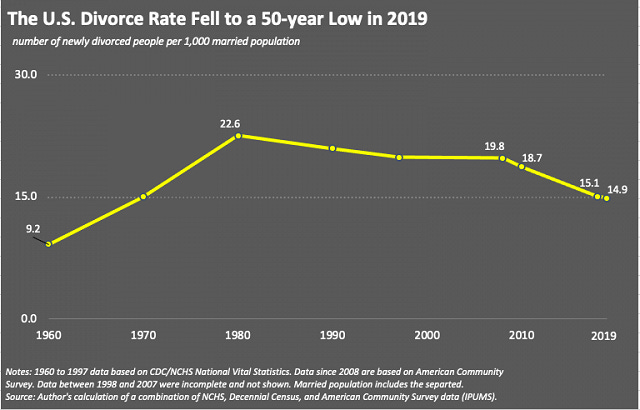
We are also told, repeatedly, that marriage is hard work, staying faithful is hard work, and that the “divorce rate is skyrocketing,” despite the fact that this is just patently untrue. Even keeping in mind the declining marriage rate and limiting your sample only to married people, a married couple in 2019 was significantly less likely to get divorced than a married couple in 1980.
Between self-indulgent divorce memoirs, op-eds in major publications (especially The Cut), embittered manosphere podcasts, and anonymous confessionals, we have been led to believe that your average modern-day marriage is horribly unpleasant, or at least boring and unfulfilling. And as I’ve written about before, it’s far more entertaining to read about people’s bad marriages than people’s good marriages, let alone people’s “we have our problems, but things are generally fine” marriages.
I find myself walking this messaging tight rope pretty often, because I write about my marriage, probably a lot more than I intended when I first started writing. Generally, I portray the positive sides of marriage, to the point that I’ve gotten criticism for being out of touch with what marriage is like for your average person. Then, occasionally I touch on the less flattering parts of my marriage, like how insane my husband is about sharing food in restaurants, or the fact that my husband put me on a PIP for being so terrible at cleaning, and people tell me that both of us sound insufferable.
The thing is, I don’t believe my marriage is that unique in either direction. Overall, I’d say my marriage is great, with a couple hiccups along the way like anyone else. But, hot take: I think your average marriage in 2025 is also pretty good.
First of all, let’s debunk the myth that people (not teenagers, but people overall) don’t really want to get married anymore. Despite all the negative press about marriage, they overwhelmingly do. A survey I ran earlier this year showed that never-married heterosexual singles over the age of 32 are actually pretty well-matched in the types of relationships that they want, and marriage with kids is the clear favorite. These aren’t all conservatives, either. If anything, my reader base (and the people most likely to take my surveys) lean liberal.
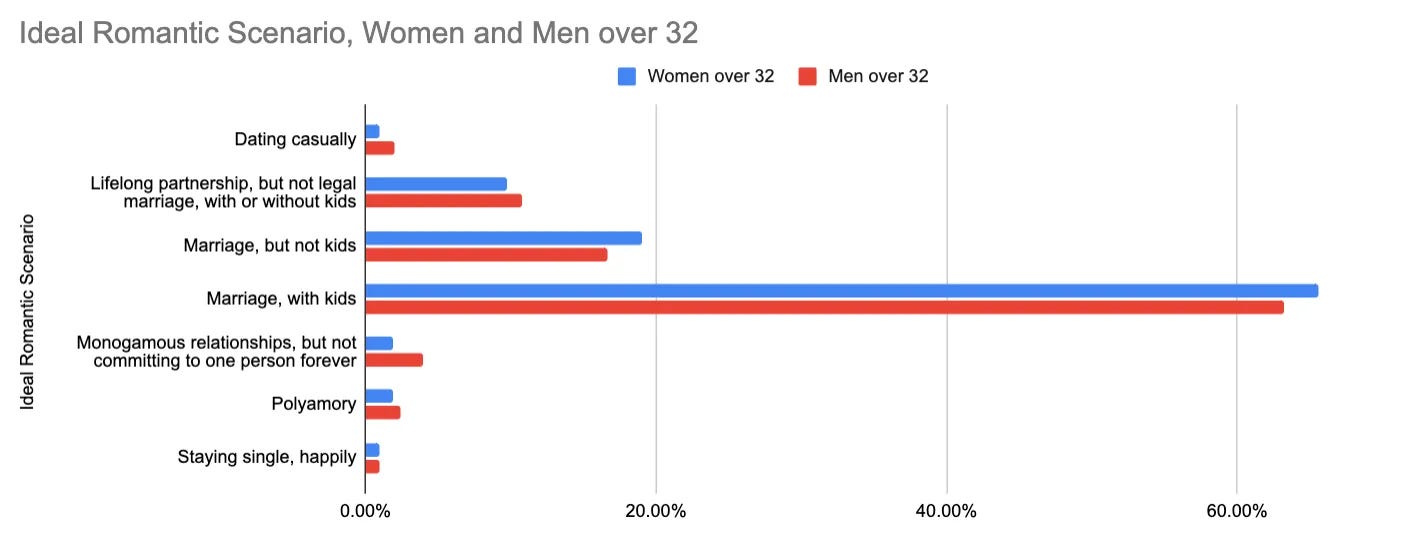
Examining all single adults over 18, over 90% of respondents said they wanted to get married “eventually.” This finding is backed up by other surveys from more reputatable sources, including Pew Research, which found that only 8% of never-married young singles didn’t want to get married (69% did, and 23% were undecided.)
The marriage is rate still isn’t what it used to be, though. This has less to do with young people truly not wanting marriage, and a lot more to do with young people having more options (or believing themselves to have more options) and being able to take longer to choose a spouse, and to date for longer before getting engaged. People are more selective about who they marry now, for better or worse. There’s also the fact that dating apps are becoming the default way to meet a partner, and dating apps are unfortunately designed to keep you scrolling for as long as possible, with fewer and fewer organic avenues to meet a partner. But none of this is a problem with marriage itself, or with today’s men or women not being good enough for each other.
The demographics of married people are also changing. Despite all the chatter about women having to choose between a college degree (and presumably, cats and wine) and a husband, marrying after age twenty-five and after attaining higher education is correlated with lower divorce rates. Marrying young (especially before age twenty) or marrying without a college degree correlate with higher divorce rates. And the marriage rate is dropping among less educated women far more than those with a bachelor’s or postgraduate degree, for whom the rate of marriage has been consistent since 2000.

Your “average” married couple in 2025 married later in life, has more money and more education than your average married couple in 1970. They are also less likely to get divorced. The divorce rate is not skyrocketing, and people are not walking away from marriage due to the aforementioned skyrocketing divorce rate. You have been tricked by Big Personal Essay.
So let’s debunk the rest of these claims one by one. The next one: the idea that wealthy, good looking men have no need for marriage and are simply opting out to avoid getting chained to one woman for life (unless that’s their kink, I guess) or getting ensnared by a gold digger.
This is also just…not true. Wealthy people in general are more likely, not less likely, to marry. When I did my survey of men making over $200K annually, I discovered that among high-earning single men, only 8% preferred casual dating, most had a preference for highly-educated women, and even attractive, wealthy single men were having far less sex than their married counterparts.
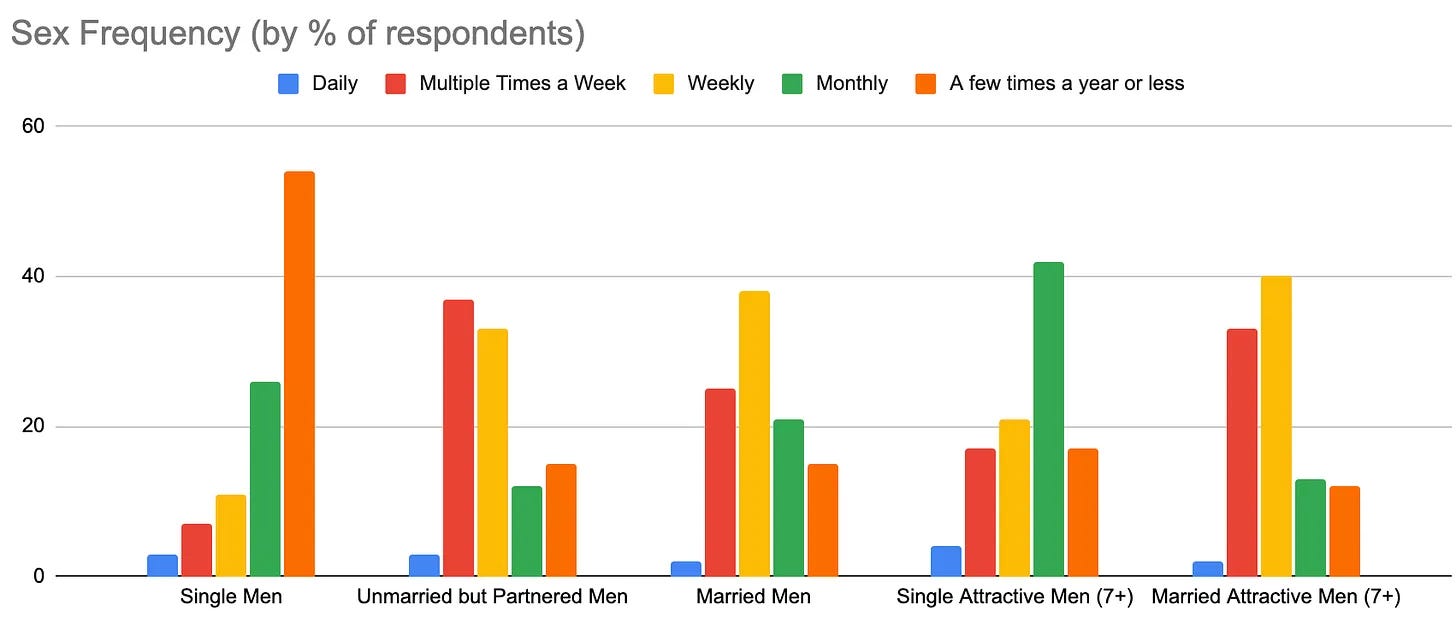
So now let’s discuss sex. There’s another oft-mentioned myth that if you’re married, you will either stop having sex (if you’re a man) or be pressured into terrible sex you don’t want (if you’re a woman.) Let’s see what’s really happening.
In a separate study I conducted, which covered almost 1,500 married couples, I saw more reassuring news about sex frequency. Most marriages are not remotely sexless—sex frequency declines over time (especially for those married more than twenty years) but couples are more likely to have sex weekly or multiple times a week than monthly or a few times a year.
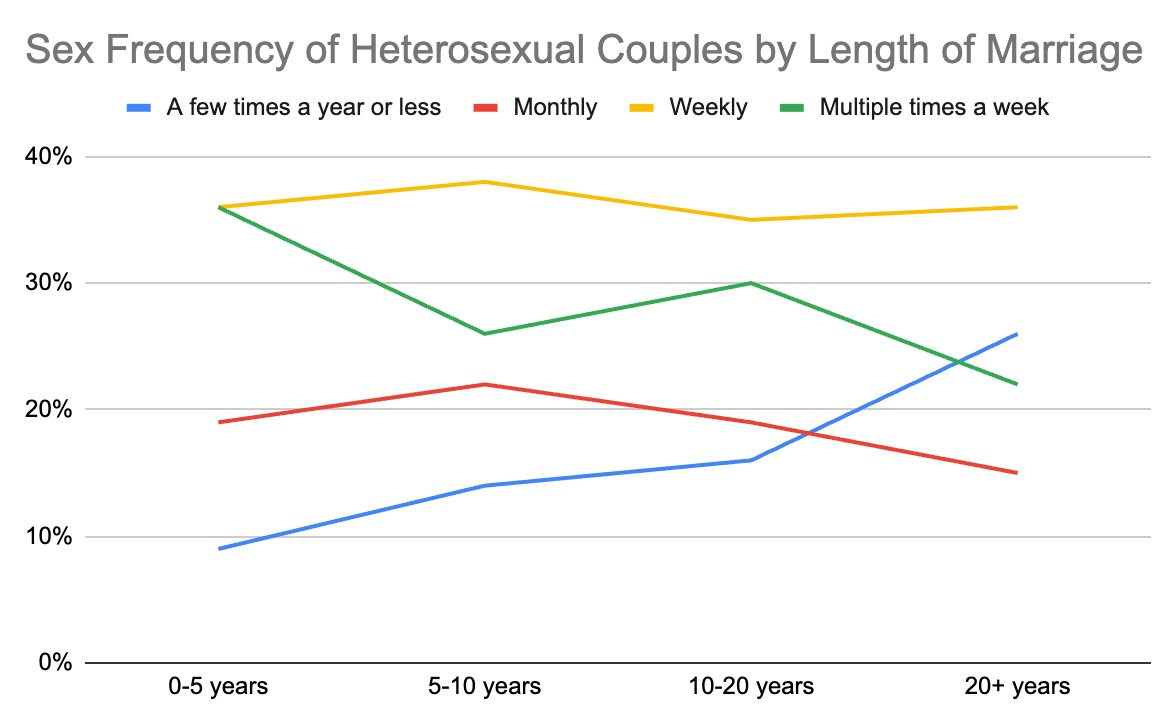
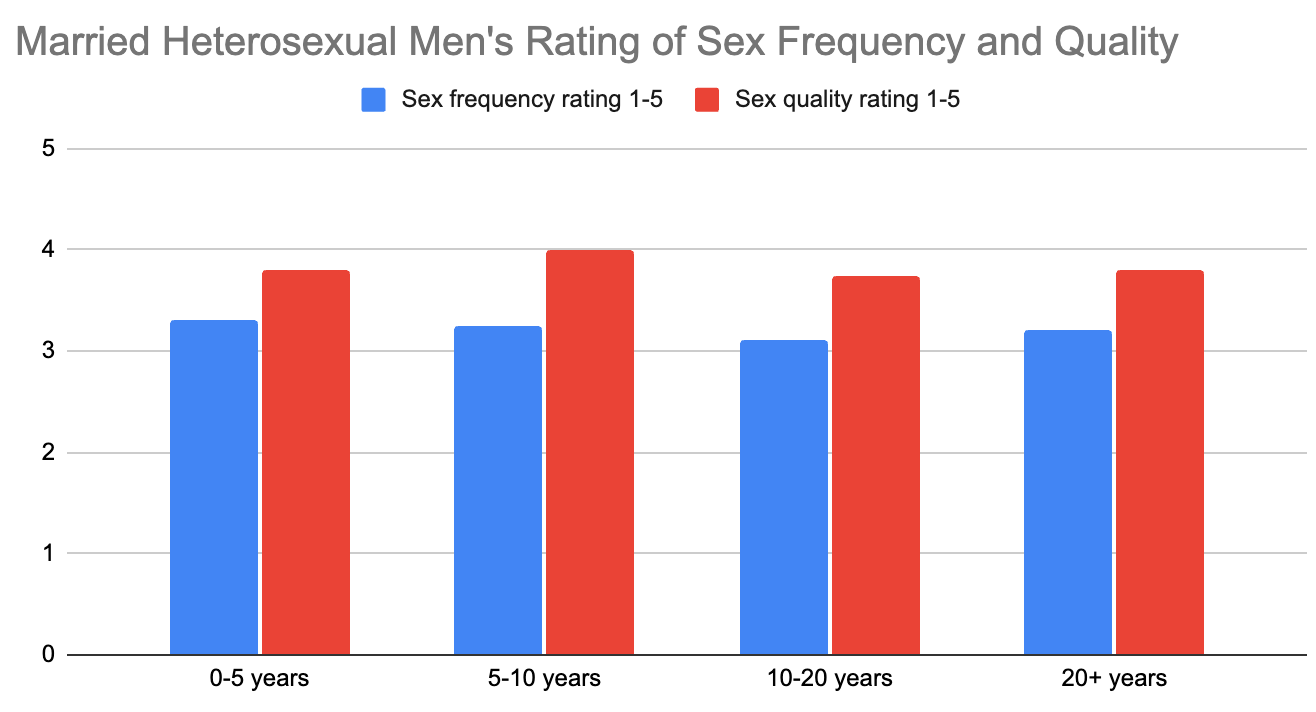
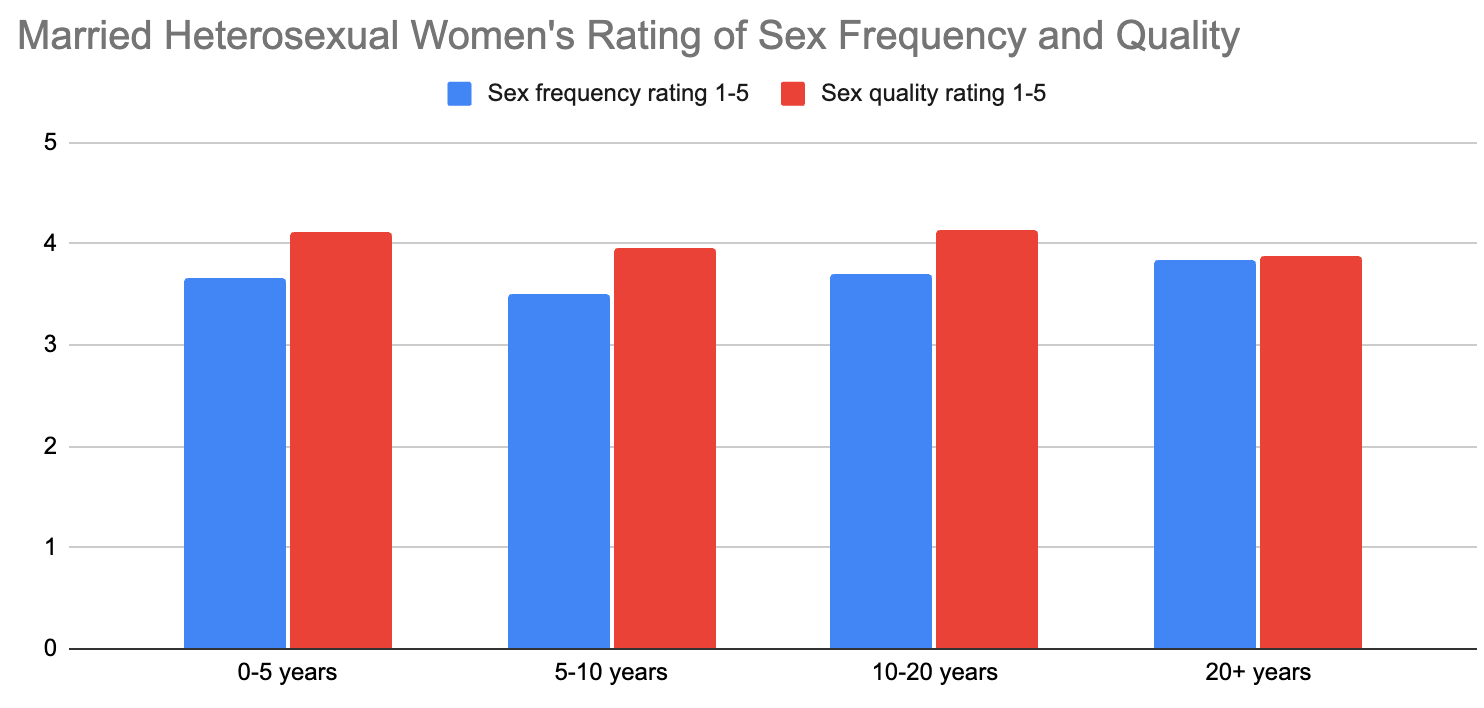
Another fact that might surprise you: for the most part, couples rate their frequency and quality of sex as desirable, with average (mean) ratings between 1-5 hovering around 3.7-4 across both men and women, regardless of how long they’ve been married. This indicates that the drop in sex frequency after 20+ years could largely be agreed upon by both parties, especially since it’s not unusual for your libido to drop after a certain age.
Then there is the myth that you will inevitably get bored of your spouse, especially the sub-myth that men tend to lose physical attraction to their wives, especially after children. First, like all the other myths I’ve covered, this is something that happens, but it’s just not the default. I asked the aforementioned 1,500 couples how their attraction has changed over time for both physical and mental attraction. Most commonly, even after 10+ years of marriage, this attraction did not change. It was more likely to change on the emotional/mental front, but for the better. Physically, it was roughly equally likely to improve or decline, but more likely to stay the same.
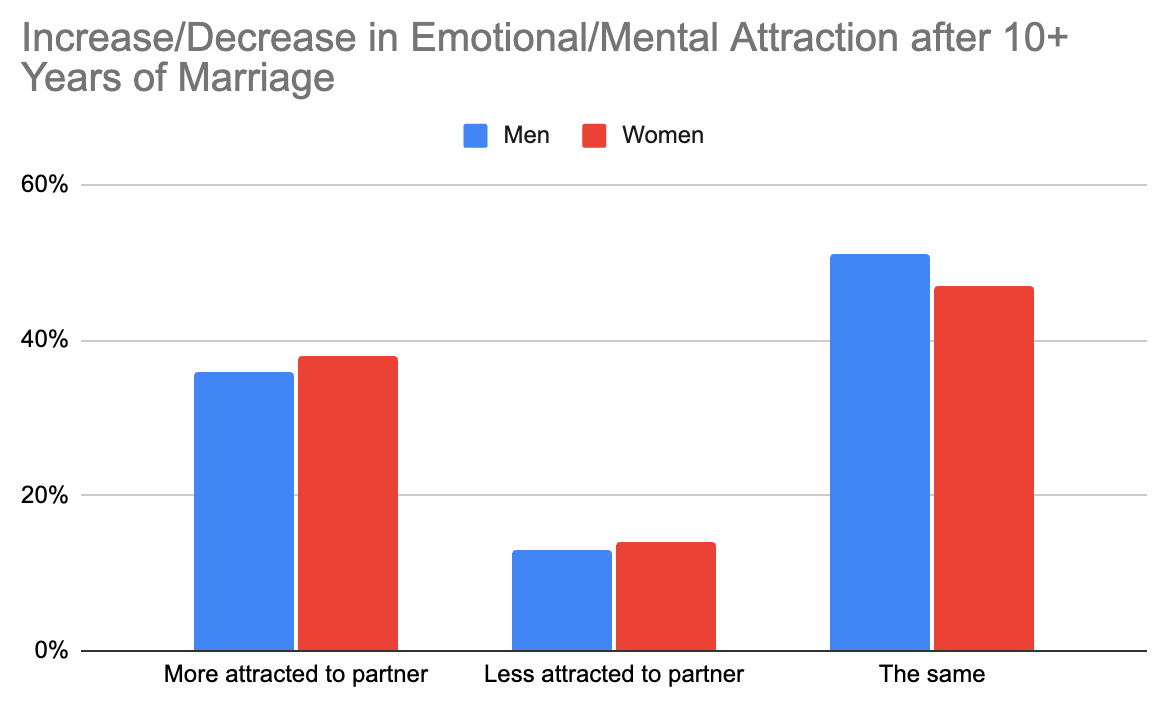
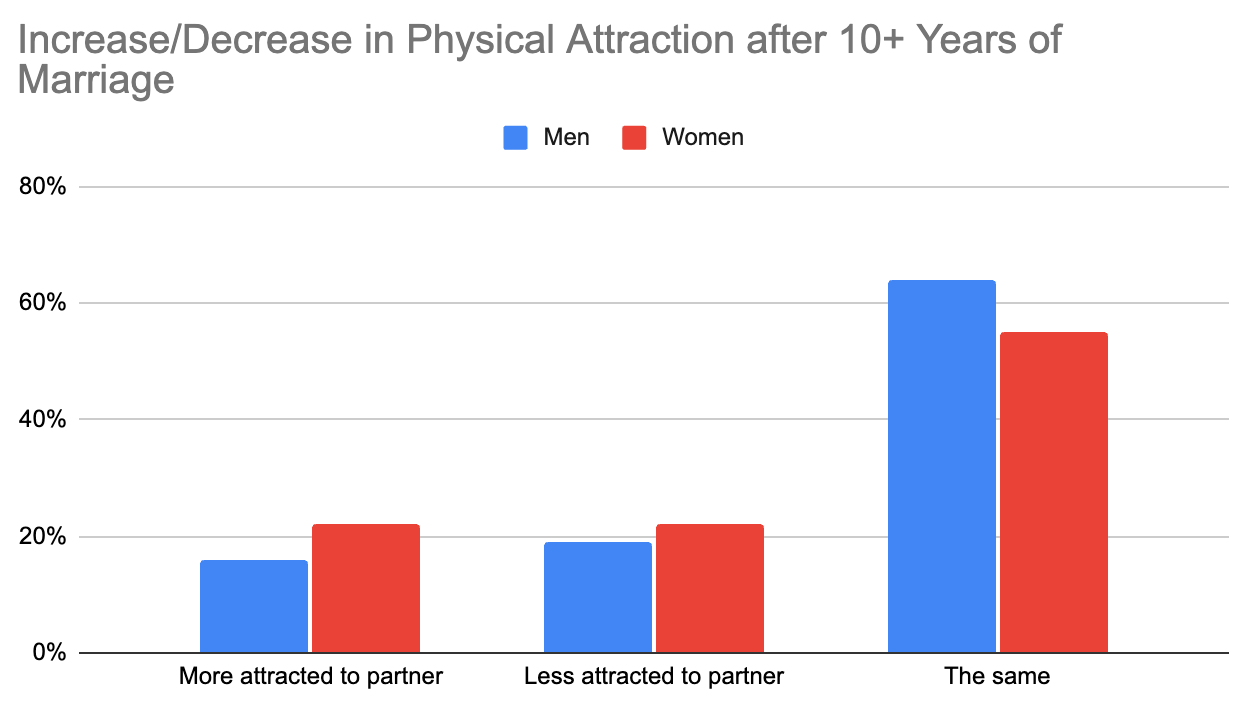
In case you’re wondering about postpartum changes in a woman’s body, or men losing attraction to their wives after children, filtering for parents did not significantly change these results in any direction.
In a separate study, I also covered physical self-ratings and ratings of a partner from 1-10 to see if these changed based on the age of the participant or their partners. Reassuringly, no matter how old the respondents got, they reliably rated their partners between a 7-8 out of 10.
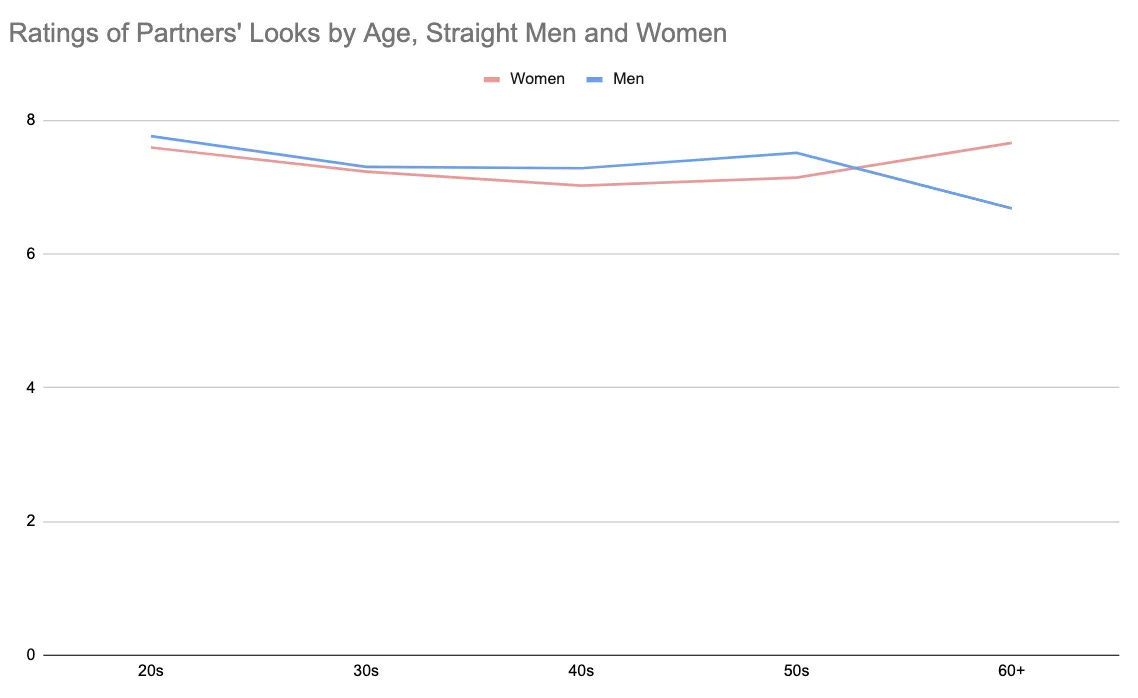
You might have gotten this far and decided that a 10% chance of a dead bedroom or a 20% chance of your partner’s physical attraction to you declining (or vice versa) is so unappealing that you’d rather just not get married. That’s okay. You don’t have to get married. Don’t put it in the papers that I said you had to get married! But I still think it’s important to note that the most likely scenario is pretty good, and likely not what you are seeing from all the personal essays about the slog and toil of marriage from both sides.
It’s not that I want those people to shut up. There are plenty of people I’d like to see shut up before people who are unhappy in their marriages. The problem is that these people have become the spokespeople for marriage and have set the stage around what a typical marriage is, despite openly admitting to having bad marriages. In fact, we are now at the point where being miserable in your marriage, or having been divorced, gives you more credibility about marriage because if things are going well for you, you’re “out of touch.”
I’ve seen countless comments from young people about why they’d never want to get married, depicting marriage exactly the way these disgruntled spouses write about it. I know I said earlier that most young people still want marriage regardless, but I think there’s a lot of gray area. How many young people wait years to propose or take their relationship seriously—sometimes breaking up before an engagement can happen—because of unfounded fears based on the bottom quartile of marriages? How many young people stay undecided about marriage when in fact, they would benefit from it if they found someone they liked? How many young people get married anyway, but with an exaggerated fear of how bad things are likely to be?
Obviously, I can’t account for everything that can go wrong with a marriage. I mostly focused on the issues of sex and attraction here, because that’s what I write about most often. But I think those things are generally a good barometer for how the entire marriage is going—certainly more than, say, how often you bicker (shocker: my husband and I bicker at least daily, usually over something mind-numbingly stupid, but I’d say our marriage is very good!) While you can love someone without wanting frequent sex with them, it’s pretty hard to deeply resent someone and still want frequent sex with them. So yeah, while not everything is about sex, sex is a fairly good indicator of issues within a marriage.
Another thing I’d like to mention is that I focused mostly on marriages between a man and a woman here, for two reasons, neither of which have anything to do with declarations that marriage should not be between “Adam and Steve.” First of all, most of the anti-marriage content is predicated on supposed fundamental differences between men and women, such as the stereotype that women stop wanting sex as soon as they get married, or that men lose attraction to their partners after kids and find every excuse possible to avoid childcare duties. While I did gather data on same-sex marriages for my surveys, my married reader base is overwhelmingly in opposite-sex marriages, and reporting on same-sex marital data would be fairly dishonest given the small dataset.
At the end of the day, people are welcome to complain about their bad marriages or voice their skepticism about what marriage would do (or not do) for them. But as long as the Internet is algorithmic, and as long as stories of resentment, infidelity and dead bedrooms are more interesting than stories about your spouse placing the Amazon delivery order without you having to ask, we will continue to see this PR problem for marriage, with everyone extrapolating from individual stories and determining that marriage is bad, only getting worse, and that nobody wants it anymore.
So allow me to assure you: loads of people still want it. Loads of people are still doing it! And most of those people—even if they have a few gripes here and there—are pretty happy with it.
The Loneliness Epidemic is Our Revealed Preference

Whether you’re on the Right or Left, gay, straight, a man, woman, or Biden’s mysterious third (and potentially fourth or beyond) gender, you probably agree with the statement that people are lonelier than they used to be.
My Permission to Be Horny

Viewer discretion is advised, especially for: my parents, my in-laws, my siblings, or my kids in 10 years.
When almost everyone gets married, there is going to be a higher percent of folks with miserable marriages. When only the most eager and privileged get married, there won't be as many. The question is, what's going on in the middle? Are there actually a lot of young men and women today who have the potential to have good matches with each other who are rejecting marriage? How much can the rate of marriage be increased before the rate of miserable marriages takes a big jump?
If you marry someone who is kind, good and intelligent whose company you enjoy, you will probably have a great marriage. If you choose someone for dumb, superficial reasons like looks, money or status, you shouldn’t expect much.