

Men Aren't "Worthless Until 30"
You've probably been told men don't acquire traits women find attractive until age 30 or later. The data shows this isn't true.


I like debunking sexual myths (first up: fellas, don’t worry about “finding the clitoris.” A bunch of mean feminists invented the clitoris to mess with you!)
In my quest to dispel sexual myths, I have regrettably gotten stuck on one in particular, probably because people keep parroting it no matter how many times I dispel it: the myth that the dropping marriage rate is because of frigid girlbosses who men don’t want to marry. While some older single women have prohibitively high standards and prefer to be single than to “settle,” there’s no evidence to suggest men are rejecting them because they’re intimidated or disgusted by their educational or career attainment. I wrote about that here. Despite all the freaking out about how choosing a college degree will doom you to a life of spinsterhood, going to college improves a woman’s chances of getting married, even if she just wants to be a tradwife. I wrote about that too. And when it comes to the higher-earning men who can support a comfortable lifestyle for a SAHM, almost all of them—97%—have a college-educated partner. The marriage crisis is primarily an issue for the lower classes and less educated, not the executives with Master’s degrees.
I’ve focused on debunking the “nobody wants a girlboss” so much that I almost forgot another sexual myth that drives me nuts—the idea that women aren’t attracted to men in their twenties, or that men only gain value in the dating arena after thirty.
I’m not talking about the separate but related myth that women are mostly attracted to men significantly older than them, although I’ve gone out of my way to dispel that too. Our willingness to date people of any age is probably different in practice than in theory (and age gaps do happen, more commonly with an older man and younger woman than the reverse) but for whatever reason, age at first marriage is reliably about 1-3 years older for men than for women over the past couple hundred years if not longer. I’m in such a scandalous age-gap relationship myself, come to think of it.
No, instead what I seek to debunk is something I often hear from young men, usually coming at it from a place of despair. They insist that the things women like in men are by default things that men don’t have until their thirties, so they should expect to be single until then. They’re talking about things like money/resources, emotional maturity, stability, and presumably, a subscription to the Bill Simmons Podcast. It doesn’t help that older men often chime in and agree with this sentiment, either because they were late bloomers themselves or because keeping younger men demoralized is intrasexual competition that allows them to go after the young women.
But it’s just not true—and that’s not just my opinion. The statistics back it up.
Earlier, I mentioned age at first marriage as a clue for the fact that twenty-something women are, in fact, dating men close to their own age. According to the woke feminazi organization known as the US Census, while the age at first marriage has risen considerably since the 1890s, the age gap between men and women hasn’t changed very much at all. In 2022, the average age at first marriage in the US was 28.6 for women and 30.5 for men. In 1920, it was 21.6 for women and 24.6 for men. Your average woman has always dated and married her peers, typically a few years older than herself. This is not great news for 19-year-old men, but doesn’t say anything bad about the prospects of 24-year-old men. Who wants to date them? 22-year-old women.
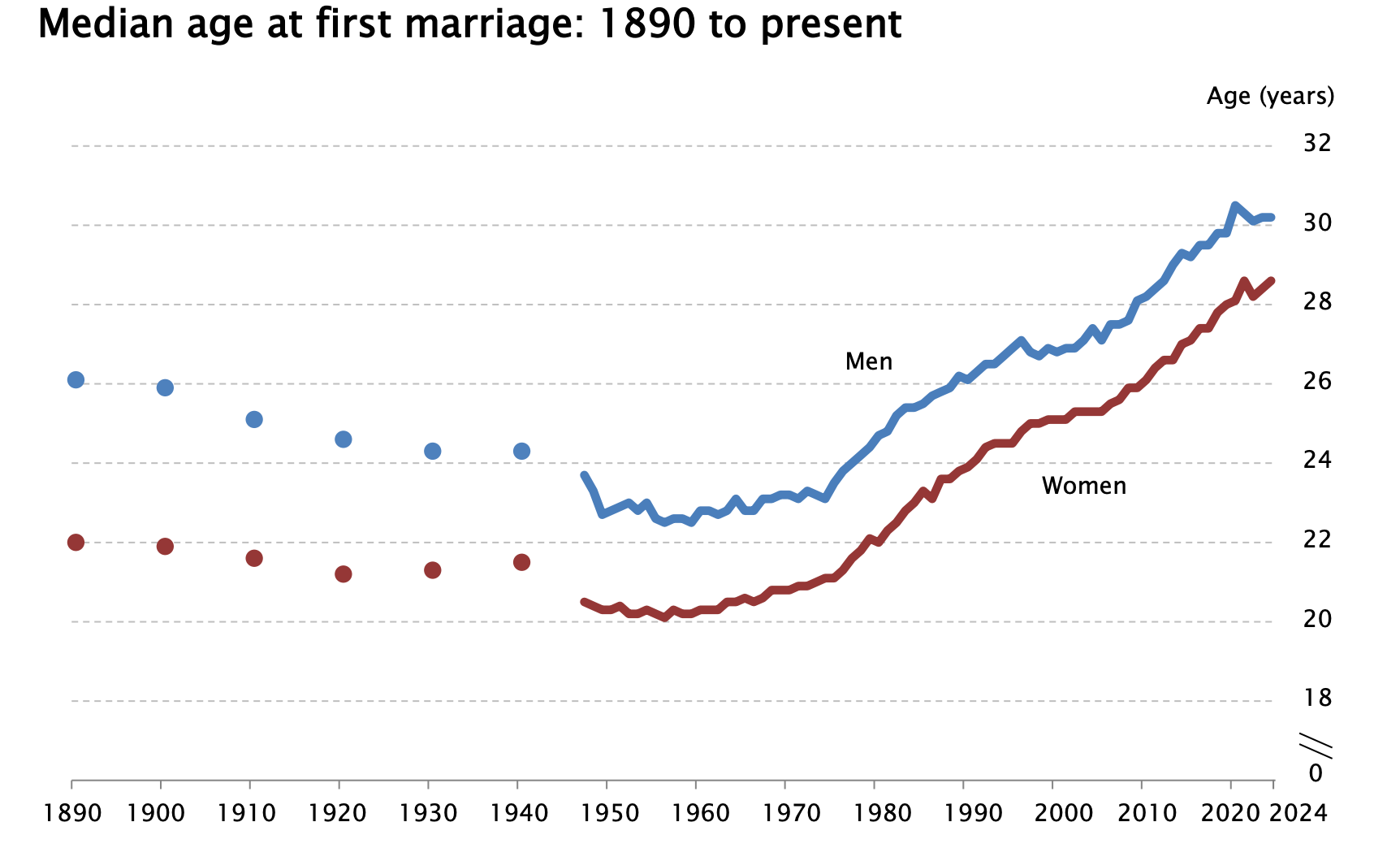
You might be noticing that the age at first marriage for men today is in the early thirties and concluding that women won’t agree to marry a man until then because only after thirty is when a man becomes desirable. This only makes sense if all people got married on reality shows within a few weeks of meeting. Let’s do the math.
According to wedding planning website The Knot, the average engagement is about 15 months long. Anecdotally, I’ve noticed longer engagements for younger couples and shorter engagements for older couples. This number doesn’t take into account whether it’s your first, second or third marriage.
According to a study done by an engagement ring company (sorry, this topic is not a hotly debated one in academia so I’ve had to seek out some strange sources) the average time to engagement after beginning a courtship is 2.5 years. Again, younger couples tend to wait longer (my husband and I didn’t get engaged until we had been together for 5 years) and older couples tend to move faster.
This means that your average couple (including older people on their second marriage in the dataset) are getting married almost four years after meeting. The thirty-year-old men who are getting married—the “average” married men—met their wives when they were about twenty-six, and their wives were about twenty-four. This means plenty of married men (half of them!) met their wives when both of them were even younger than that.
So why do I keep seeing this myth get repeated that women don’t want to date marry men in their twenties? Evidently, they do. All the time! And yet, the myth won’t quit.
This myth partially comes from an exaggeration of the truth. Yes, women like emotionally mature men. Yes, women like men with “resources.” But a small age gap is usually enough to account for any maturity differences between men and women, and the “resources” a man is projected to have is probably enough. Most women and men mate assortatively, so a 23-year-old woman who just graduated college is likely more interested in a 25-year-old college educated man just beginning his career than a 40-year-old electrician without a college degree, even if he technically has more resources. She doesn’t see the younger man as having inadequate resources, because he’s projected to remain in the same socioeconomic status as herself. As for whether or not she would be more interested in an older version of that man—a 40-year-old lawyer, for example— is obviously down to personal taste. But if this pairing were the norm and not the exception, we would see it in the marriage data, and we don’t, although it made for a great plot in the movie Secretary.
Second, I think a lot of the most prolific and articulate voices about women’s dating concerns tend to be from women on the older side. Not “old” old, but older than twenty-five. After all, nobody is interested in hearing about a 22-year-old woman talk about her dating life, because she has limited experience. It’s assumed that any struggles she experiences are very temporary, she’ll probably find The One pretty soon, and she can’t possibly speak for people who are really in the trenches. On the other hand, people are more interested in hearing folks over thirty and matchmakers (who work with lots of people over thirty) talk about their dating opinions. As a result, when we hear about things women seek but can’t find in a man, we tend to hear about the things that slightly more mature women seek.
I wrote before about what I was seeking when I met my husband at the age of nineteen (he was twenty-one.) It boiled down to:
Wants marriage and kids on a similar timeline as I do
Physically attractive to me (and attracted to me) with similar sex drive (I would have also accepted “higher than mine.” Lower than mine was unacceptable.)
Fun to hang out with/personality chemistry (this would probably encompass people who came from a similar cultural and socioeconomic background as me, but those weren’t dealbreakers on their own)
Nice to me
I did not have a requirement that he own a home or a car. I did not have a particular salary that I required (his salary at the time was $0, because he was a college student.) That’s not to say I would have dated a homeless guy. There is a big difference between a college student and a vagrant, although you wouldn’t know it from the state of their bathrooms. But if I was interested in “resources,” projected resources would have been enough. I refuse to believe that most women in their early twenties, outside of rage bait TikTok videos and sugar babies, have a particular salary requirement for a partner. I completely believe that if they are college-educated, they generally prefer to date men who are also college-educated. These are different things.
Another factor that keeps this myth going is the fact that we don’t hear about dating from people who already got into serious relationships, let alone people who got into serious relationships early in life without much drama. Ergo, we tend to hear from people who have more requirements, because the people with the most realistic standards probably paired off a while ago and are writing about other things, if they write at all. There is also a very limited market for people who want to read five-minute articles called “I Met My Spouse At 22 And It Was Great.” The content we see about dating is overwhelmingly about people who are either struggling to find someone who meets their criteria, or people struggling to meet others’ criteria.
In fact, when I had Jeremiah Johnson on my podcast to talk about marriage, most people hadn’t heard anything about his marriage before. His main area is politics and Internet culture, but also, he met his wife very young and generally considers their marriage very drama-free and easy. While I hope people enjoyed the episode, there isn’t a lot of demand for these kinds of stories. People want the drama, the resentment, and the complaining. A great deal of relationship content online—heck, any content online—is really grievance-based. As a result, we are not hearing about all the people who didn’t have many grievances.
That’s not to say this content about relationship struggles is bad. It would be very boring if we only heard about dating from people who barely dated at all. But the state of the landscape is that we ultimately hear from the people who have struggled the most or who have the highest standards. By process of elimination, these people tend to be older and/or more frustrated. While it’s admirable for a young man to want to listen to an older woman, he probably shouldn’t take her words too literally about what women want, unless he is looking to date a woman her age.
There’s also the whole “don’t let a fish tell you how to be a fisherman” thing. This motto is frequently repeated in red pill circles and suspiciously seems only to apply to women giving dating advice to men (women, they insist, should listen to men’s advice about dating. Logic and reason triumphs oncemore!) But anyway, I hate to be that person, but when a woman talks about intangible things like “emotional maturity” she might just be referring, at least in part, to sexual attraction. Because women’s sexual attraction can be more contextual and less physical than men’s (but don’t get me wrong, it’s still physical!) women sometimes convey their desires in fairly confusing ways. One of my pet theories is that women resent being the “project manager” of their households so much not because it’s a lot of work (although it is) but because a man being so complacent oozes a lack of masculine dominance and is horribly unsexy. (Generalization, but bear with me.) That’s not to say women don’t like guys who are emotionally mature, but I suspect that the phrase is being used as a catch-all for being charming, a good conversationalist, and being ready for a serious relationship on the same timeline. All of those things could apply to a man in his twenties!
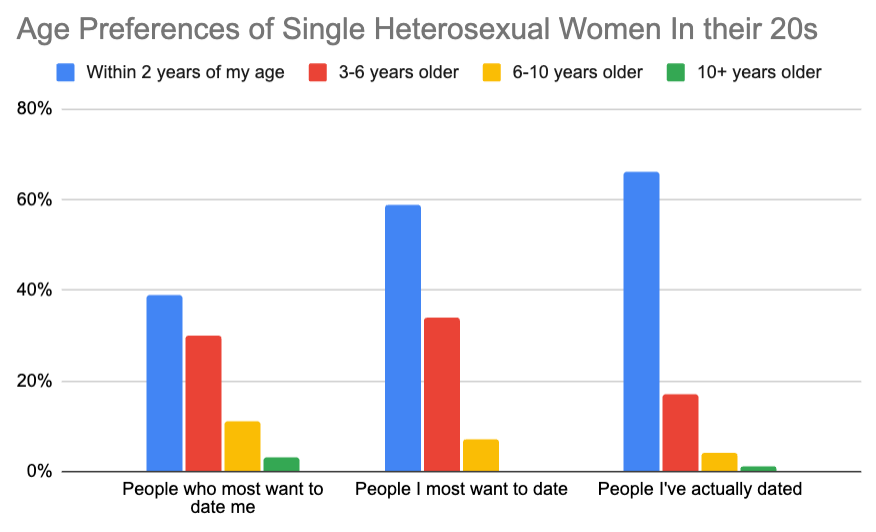
A while ago, I polled over 2,000 people on their dating history and preferences. When filtering for single heterosexual women in their twenties, a clear an unsurprising pattern emerged: not only was the preference overwhelmingly for men close to their own age, but the men they actually dated were more likely to be close to their age than the men who wanted to date them or the men they wanted to date, on average:
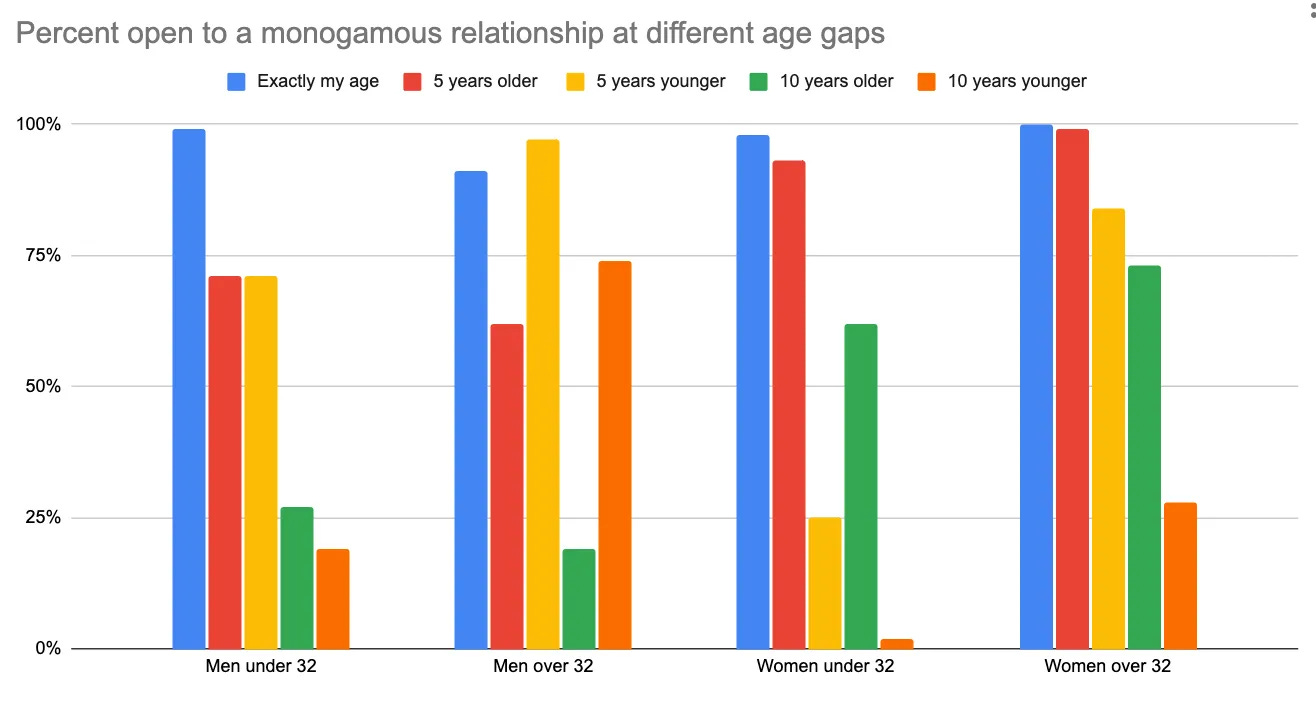
Also, based on a previous survey where I separated men and women into brackets of over and under age 32, women under and over 32 were very likely to be open to a monogamous relationship with men exactly their own age:
At this point, I suspect someone is eager to remind me of the study that showed more young men are single than young women. Given that there are generally equal amounts of men and women out there, this looks like a bit of a quandary. It’s only after age 50 that women are more likely to be single than men, and that could largely be explained by women outliving their deceased spouses. So what the hell is going on with younger people?
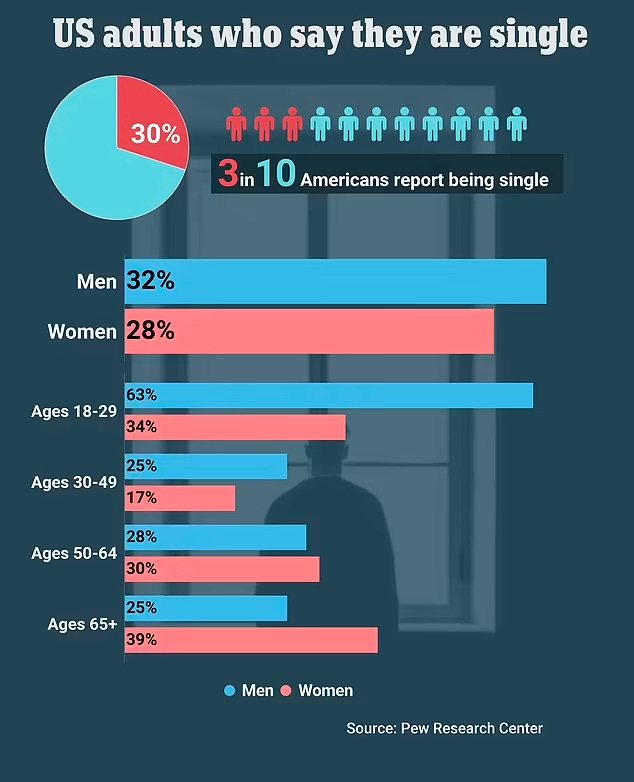
I think a few things are going on here.
First, this poll doesn’t filter for sexual orientation. I couldn’t find any reliable data on the relationship status of gay men vs. lesbian women, but it’s possible that a difference in behavior between these two groups could be skewing more women toward “not single” responses compared to men. A separate but similar Pew study showed that gay, bisexual and lesbian Americans were more likely to be single than their heterosexual counterparts but didn’t break out any differences between men and women in this category. The best I could find was a study done in 2013 by the Williams Institute which showed lesbians far more likely to be cohabitating or married than gay men, but that lesbians and gay men were both less likely to be partnered than their heterosexual peers.
Second, as we’ve already established, women more likely to date a man slightly older than a man slightly younger than themselves. Most married couples are between a woman and a man a few years older than herself. Ergo, 27-year-old women in relationships with 30-year-old men (and 48-year-old women married to 53-year-old men) could be skewing the percentages. As I’ve already established, even if men only date a few years younger on average, and even if women only date a few years older on average, this could result in a striking proportion of single men in the college-aged demographic while women and men in their mid-late twenties might have less striking differences in relationship statuses.
Another factor is that women and men might view the word “single” differently. Women might be more likely than men to consider themselves in a relationship before the official words “boyfriend” and “girlfriend” are uttered, because they know they’re exclusive. If the issue here was that men didn’t become desirable to women until age thirty, we would see far more men partnered than women (or at least an equal proportion) in the 30-49 age bracket. But even men in this bracket are more likely to be “single” than women.
One other interpretation is that lots of women are entering into “relationships” with attractive men who are juggling multiple women at once, while the women are none the wiser. I’m sure this is something that happens, but I don’t think it happens often enough to shift the statistics this much, especially in the digital age where it’s increasingly difficult to hide your multiple entanglements. Unfortunately, it’s pretty hard to get a data-driven idea of how often men are juggling multiple hoes in different area codes. I also think it’s a fairly ridiculous premise, and the burden of proof should be on people insisting this is happening on scales large enough to result in twice the amount of single men versus single women between the ages of 18-49.
Another objection that I forsee is “I don’t know about this, nobody wanted to go out with me when I was 26 but then when I was 32 everyone was begging for me *Trump voice* like a dog.” This might be true for plenty of individual men, but it’s giving “the average woman can’t be 5’5” because I’m 5’8”.” Also, it fails to account for other variables. Did these men stay the exact same way between these two ages, or was there a significant fitness journey or improvement in mental health, which might be a very different trajectory from that of your average man? Not to be a jerk here, but I’ve checked out the Facebook profiles of some of the guys I went to college with and almost none of them are significantly more attractive now. A lot of the time when examining these stories, you’ll find that the men in question were not doing all that they could to improve their options in their twenties and only began self-improvement later on, and like, duh.
Despite the fact that I’ve been misidentified as someone who “gives dating advice” I really don’t, especially not to men. The reasons that a man in his twenties might find himself unhappily single are so varied that I couldn’t begin to give blanket advice that would work for everyone, unless I just parroted the obvious stuff like getting into shape, dressing better, having good hygiene and working on social skills. But I can say that of all the reasons a young man would be single, “being 24” is not one of them.
You might also like…
I Was Wrong About Hookup Culture

This week, I saw a tweet from a young woman criticizing the show Sex and the City because the characters slept with too many men.
Don't Delay Dating to "Build Yourself"

Although I don’t consider myself someone who gives dating advice, every now and then I see dating advice that I know is terrible, and I feel compelled to warn people about it. One offender in particular is the advice to young men or teenage boys to ignore girls and women altogether (or at least not bother with anything serious) and “work on themselves” since things won’t really matter until their late twenties or even thirties.
Another banger!
Whenever I hear the “when you’re a 20 year old guy, the world tells you you’re worthless” thing, I’m like damn, me and the girls certainly didn’t get the memo when we were 20 and our main hobby was worshipping 20 year old guys because they were on a sports team or whatever
Were we really yearning for a 38 year old banker with an impressive record collection? I guess we’ll never know because we all married our peers
“One of my pet theories is that women resent being the “project manager” of their households so much not because it’s a lot of work (although it is) but because a man being so complacent oozes a lack of masculine dominance and is horribly unsexy.”
Straight to my veins. You could write a series of articles on this.