

The Answer to the Birth Rate Decline: Do My Favorite Thing
With the fertility crisis, the means is the end.

This was a paid article from about a year ago, but per my new Saturday tradition, I’m removing the paywall, so everyone can enjoy. Please become a free or paid subscriber if you like what you see!

I’ve written about the birth rate before. I’ve even proposed solutions for what I believe might help, such as building more housing in large cities and making cities feel safer and more welcoming to families. I’ve also pointed out strategies that clearly don’t help, like making the standards for a good parent impossibly high while also yelling at people for not having more kids.
While I still believe all of that, I have to wonder if sometimes I (and anyone else who writes about the birth rate) is using it as a convenient excuse to shoehorn their favorite policy ideas. Whether the birth rate was an issue or not, I still want more housing built in large cities. I also want urban public transit to feel safe for everyone, and I think excessive parent-shaming is bad. These are all things I already happened to believe were good or bad, and they map very nicely onto the birth rate.
But how much of the declining birth rate would be “solved” by changing these things? In America, maybe a little, but it probably wouldn’t be enough to reverse the pretty stark trend of a shrinking population. At best, it would enable married couples who already want kids to have the number they want (something I think is good!) but that wouldn’t change the entire country—most married couples don’t want four or five kids, they want two (maybe three.) I went over that here. And it certainly wouldn’t change the worldwide birth rate decline. Whatever is happening to shrink the population in America is also happening across Europe and Asia, among other places. Even India, now the world’s most populous country, is falling below replacement rates. It sounds nice to talk about building more housing in San Francisco, but that’s not going to change what’s happening in India.
Increasingly, I’m starting to think that pro-natalism content at this point, is more about harm reduction than actually reversing a trend, unless technological solutions are implemented, such as artificial wombs or AI to perform more jobs and care for the elderly. But moreover, from “kids are too expensive” to “women have too many rights,” it feels like the birth rate conversation is more about justifying things you already want to see happen, and less about actually reversing the numbers. The birth rate issue is merely a convenient cover for shoehorning your favorite topic. The end doesn’t justify the means—the means is the end.
Recently, a graph went viral on Twitter for showing an apparent correlation between women’s educational attainment and a country’s fertility rate. Immediately, all the usual suspects who suspiciously always wanted to reduce women’s opportunities for completely different reasons had “validation” that this would, in fact, fix the birth rate:

Only one problem. The graph looks nearly identical for men:

Other studies have found a correlation between women’s education and a lower fertility rate, but even then, it’s a correlation, not a causation. What’s obviously happening here is that countries where people (especially women) are more likely to be educated are wealthier countries with higher standards of living. These tend not to be agrarian societies where a bigger brood can double as farm labor. They tend to be societies where 1-2 kids are all couples may actually want. And most importantly, these wealthier societies are ones where there are lots of things for people to do other than have kids, or before having kids, which means people can choose not to have them, or start having kids later in life because there are plenty of other things for them to do for fulfillment and pleasure.
But of course, some people concluded that if we just stopped letting women go to college for their fake degrees in body positivity and gender studies, only to be given fake jobs at real corporations by a shadowy cabal of people hellbent on driving business inefficiency for some reason, the birth rate would fix itself in no time. This is a belief I’ve covered for a while, and it drove a lot of enthusiasm for DOGE. The idea is basically that because women currently have the ability to financially support themselves, they can choose to date or marry men based on whether they find them physically or mentally attractive, not based on a need for survival. This is bad news for men whose only redeeming quality is a middling salary, and who see it as a betrayal of a centuries-old contract for women to expect any degree of physical or charisma-based attraction. Some also argue that some women’s standards have just gotten too high, and if they didn’t have the financial option to stay single, these standards would correct themselves.
The not-so-secret plan: make it harder (or impossible) for women to have their own money, and suddenly the relative status and power of today’s men will improve, not because they’ll actually have more money but because women will have less—and those women will be forced to settle.
Some people argue that men simply follow women’s lead—that men only get educations because women get educations, that men have only as many children as their wives want to have. Ergo, if we stopped letting women run the show, men would be free to procreate indefinitely. This seems patently ridiculous, but also, if men are so pliant and spineless, with zero desires or opinions of their own, it makes a pretty good argument for establishing a totalitarian matriarchy.
I saw another argument that if men are waffling on committing or having kids for too long, we should simply force women to marry older men—preferably 10-15 years older than they are—so that men and women would be on the same page. I cannot possibly imagine who has a vested interest in making this happen! (Also, I thought that was women’s natural preference anyway?! I can’t keep up!)
But even if the mindset to disenfranchise women is sexist, one could argue it could have impacts on the birth rates, especially if you go further by outlawing birth control, or doing something really wacky like fining people for not having any children over the age of thirty. Obviously, none of this is feasible to begin with, so it’s a pointless conversation, but even if it were, there’s a bigger reason why it wouldn’t work—as I said before, men don’t want to have a million kids either. Maybe women are more likely to want to be childfree than men (and not by a large margin) but among married couples who want kids, women and men generally want similar amounts of kids, and these decisions are typically made together as a couple. Moreover, even outlawing birth control wouldn’t make it impossible to avoid pregnancy—plenty of couples already do this via natural family planning.
But these plans sound a lot like Decree 770, a law passed in Romania in 1967 to boost the birth rate. Almost all instances of abortion or birth control were banned. Women were monitored monthly by gynecologists to make sure they weren’t circumventing the decree. Sex education in schools shifted to extolling the virtues of motherhood and having many children. While TFR initially jumped from 1.9 to 3.7, there were pitfalls. Wealthier women were still able to procure contraceptives and abortions, which meant the birth rate increase happened primarily among poorer women. This meant that many children grew up with inadequate resources. Many were sent to orphanages, and many died. Romania’s child mortality rate eventually rose to ten times that of neighboring countries. Many of the abortions were primitive and left women sterile, which also prevented future births. The decree was abolished in 1989.

Not every shoehorned birth rate solution is so Gileadish. Some sound much more benign. People commonly declare that having kids is “just too expensive,” citing that kids are prohibitively pricey even for people making $100K-$200K annually. Their argument is that universal healthcare, universal basic income, and other more family-friendly socialist policies would improve the birth rate. But those policies haven’t worked in countries that have implemented a strong social safety net. TFR in Denmark is 1.55, in Sweden it’s 1.52, and in Finland, it’s 1.32.
One could argue that the Nordic countries (famously beloved by American Redditors desperate to leave the US) haven’t gone far enough because they aren’t paying their citizens an extra $50K annually. But it’s my suspicion that this also wouldn’t help. Perhaps a payment contingent on the birth of an additional child would help, but it would have to be pretty hefty to make a meaningful difference. I’m even less convinced that UBI, or even tax credits for families, would do anything. UBI might help a few families who were already on the fence about additional children, but it wouldn’t give someone the desire to have children if they don’t want them. Besides, it’s my hunch that if existing families were given extra money or benefits not contingent on the birth of a new child, they would use it to improve the lives of the children they already have, not to make room for more children. In fact, this is more than just a hunch—aside from housing costs (which I addressed already) people today enjoy a much higher standard of living than people even just a few decades ago, and certainly a much higher standard of living then in the 1960s. As a result, they’ve had fewer children, and given those fewer children richer lives. Today, while birth rates are higher among families making ultra-high incomes, they are actually lower in families making $200K compared with families making $25K annually. There’s no evidence to suggest that an annual payment of $25,000 or even $50,000 to every family would make a measurable impact.

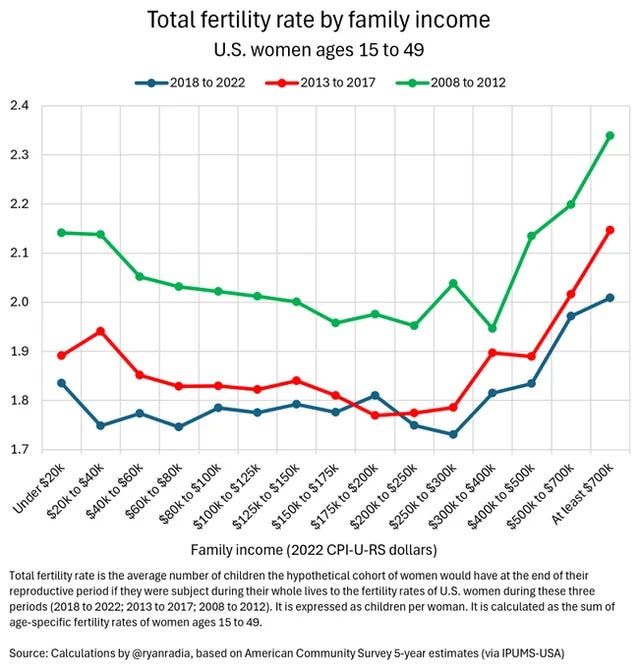
The arguments about how the US is uniquely bad for families because everything is too expensive also don’t really make sense in the grand scheme of global falling birth rates. Clearly, something else is happening if this pattern persists outside the ultra-capitalist US. Many people may personally want to see universal healthcare and universal basic income—just as many people might want to see women permanently out of the workforce—but on some level, they know this won’t reverse the birth rate trend. It’s just their personal favorite thing. Because none of these solutions get to the root of what’s actually causing a global decline in TFR.
No matter how dire people say things are in 2025, this is the most prosperous the world has ever been. It’s hard to grasp just how recently the vast majority of the global population was living in a state of extreme poverty. Now, less than a century later, it’s a minority.
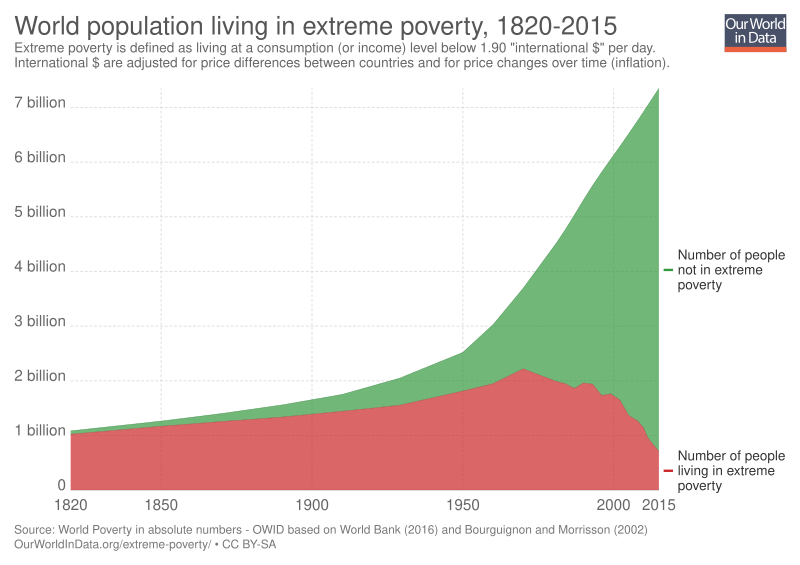
As I said before, wealthier societies tend to have lower birth rates for a variety of reasons, chief among them that people have more choices, and most people don’t really want to have eight children, or start having children at nineteen. I consistently push back against the idea that this is a matter of feminism alone—most men don’t want eight children either. Men like going on family vacations and having two-story houses, cars and televisions. Men, just like women, might prefer to have two children who get to go to college than six children who don’t. Even in slightly less wealthy societies, couples may want their own bed, or for their children to have their own beds. They may prefer living in a home with working heating than a home without it and four additional kids. But if these married couples are living in extreme poverty, these might not even be choices they get to make. They might not get a say in how many children they have, or the quality of life those children have.
So, it’s a bit of a black pill. As the world gets richer, fewer children will be born. Short of starting nuclear war (don’t get any ideas!) it’s going to be pretty hard to make the entire world significantly poorer, nor should you want to, because at that point the birth rate would be the leas of your concerns. Refusing to admit women to college or barring them from having their own money isn’t going to work, because those women would still be living in relatively privileged societies. Their parents may house them until they find husbands, or even send them money to enable them to live alone.
It gets worse too—it’s not just the relative wealth of the world (and the resulting higher standards for living, parenting, leisure time and more.) It’s the fact that many people just aren’t meeting at all, let alone getting married and having kids. Some on the right believe that today’s young people are engaged in a depraved sex-fest because of rage bait TikToks or thinly-veiled advertisements for sex workers. But young people are having less sex than ever, and are increasingly sexually repressed and lonely. My surveys (which are probably a bit biased) reflect this. In a recent survey, roughly 30% of singles said they were virgins, and only a minority of heterosexual people reported having sex within the past three months.
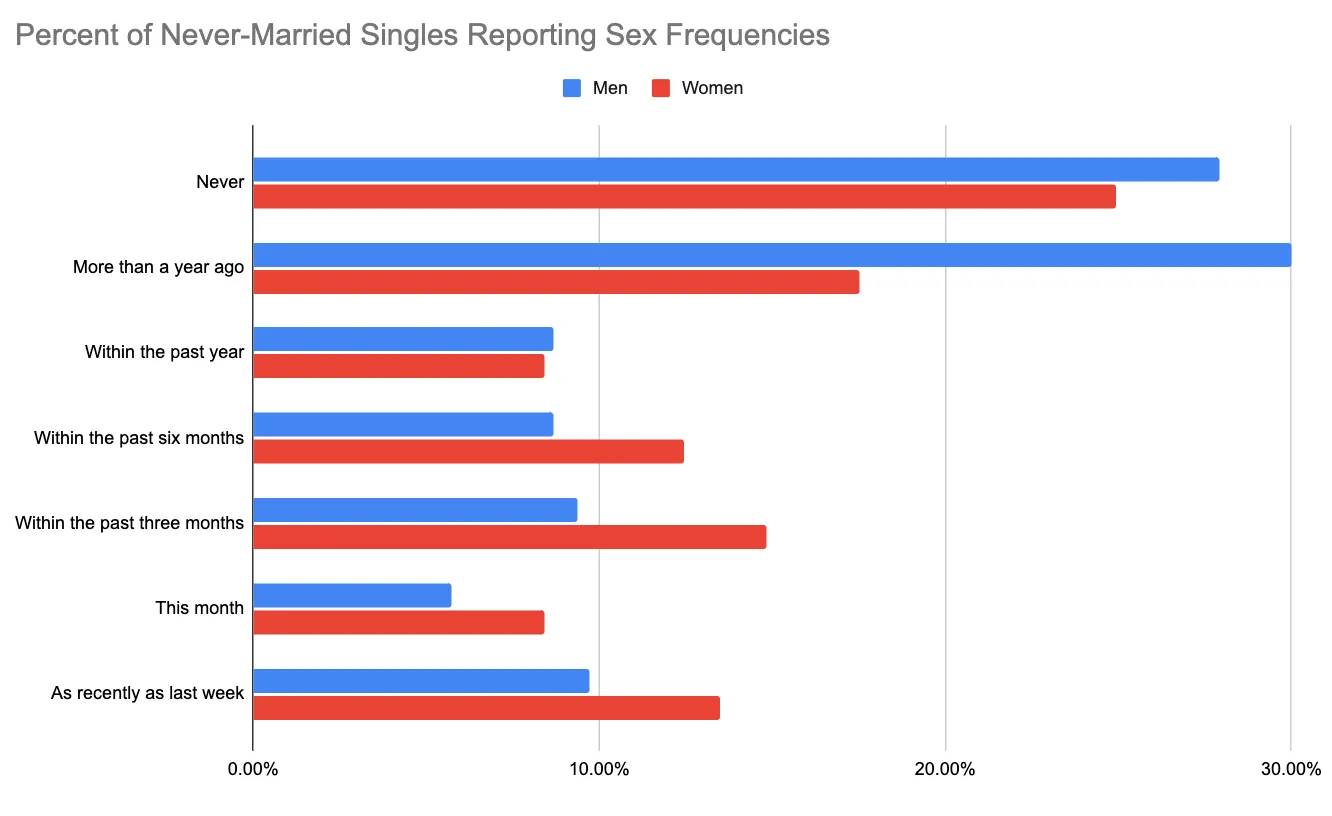
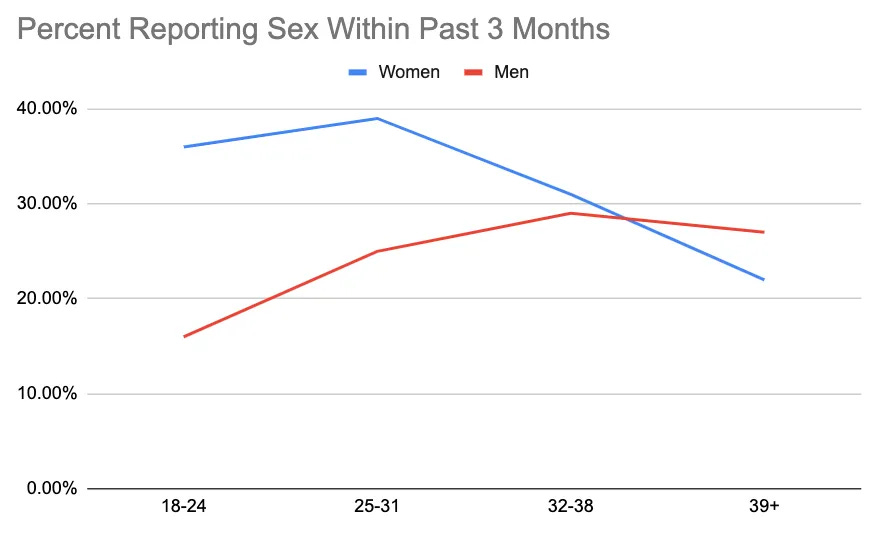
It’s not just my surveys, which I admit are far from perfect. The Institute for Family Studies shows fewer and fewer young people having sex, and increasing numbers of virgins:
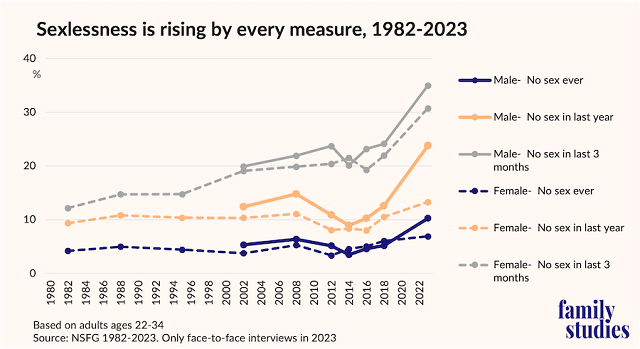
Even if we prevented women from going to college, gave everyone cheaper housing and universal basic income, implemented a theocracy, whatever your personal favorite policy is…we can’t force people to date or marry in the first place. Young people aren’t eschewing marriage to have meaningless sex; they’re eschewing marriage to watch TikTok videos of hamsters. There’s no saying that a woman without options wouldn’t sooner move in with her parents than date a man she doesn’t like, and despite the (new) stereotype that men are the ones mooning over marriage and children, many men aren’t rushing to get married either. Couples may date for months before even deciding to be exclusive, or break up after five years. To solve these problems, we’d be looking at ridiculous measures not even worth discussing—jailing people for failing to marry by a certain age, government-mandated marriages, a Selective Service for unprotected sex, or simply taking inspiration from filmmaker Yorgos Lanthimos and turning single people into lobsters as punishment.
It’s noble to want to make humane dents in the birth rates with methods that might help people to have their desired amount of children. I think pro-natalists should keep doing this. But we should also be realistic. People might be happy to receive $5,000 to have another baby, but it probably isn’t going to move the needle for most families. Presenting parenthood more favorably, or presenting unplanned pregnancy as less of a disaster, might help, and it might make for a more family-friendly society, but probably won’t radically improve TFR. And any of the things that would help “enough” might have downsides that they wouldn’t be worth it, like Decree 770.
Without technological intervention, birth rate solutions are harm reduction. Harm reduction is good, but it’s not enough. Like any other crisis of our time, including COVID, I’m fairly confident that if anything works to fix a shrinking population, it will be a technological intervention, especially one that mostly makes people’s lives better, not a social policy that might make many people’s lives worse or requires collective sacrifice. I’ll continue to say what I think might improve birth rates among people who already want kids, but I won’t delude myself into thinking I’ve stumbled upon a silver bullet. We won’t have that until AI magically fixes this for us—and if it does, it better not be MechaHitler.
You might also like…
The Fertility Crisis is About High Standards

As a liberal, I struggle to write about the “fertility crisis” because like many things, it’s become needlessly politicized. In fact, I once tweeted about it in a fairly neutral way, postulating the reasons for it instead of catastrophizing about it, and was told that I shouldn’t even be talking about it because it would be playing into right-wing agendas, and that we had “more pressing issues” to deal with, like an ongoing pandemic.
Men Are Delaying Fatherhood To Boyboss

When people talk about how to raise the birth rate, they focus on the female side of the equation regardless of whether they’re on the left or the right. Those on the right might talk about how women need to stop prioritizing selfish, frivolous things like their made-up email jobs, and do their motherly duty (which includes, of course, never having anyone to help you, lest you
*reads headline*: “The answer is have more sex?”
I’d love to have had more kids. I had just two and I barely managed it because I didn’t have enough money.
But more money alone wouldn’t change much for most people.
Let me ask the question another way:
Hey, would you like to sign up for this volunteer position? If you say yes, it’s an 18-year commitment, minimum. Actually, it never totally ends. You’ll need to prioritize this volunteer position over your career, your social life and literally everything else.
It’s going to be quite costly — not just in direct expenses but in things like the need to pay for a larger place to live. In return, you’ll be lauded one day each year but the rest of the time you’ll be widely disrespected. Some people will make clear their disdain if you dare to combine your volunteer duties with traveling or eating out.
Oh, also your body will never be the same. You may develop things like stretch marks and loose skin on your abdomen. You might weigh more, and it’ll be difficult or impossible to find the time and money and mental bandwidth to groom yourself to the standards society requires in order for you to be even considered for many professional roles.