

On "Hot Autism"
Even with autism, hotness is still a social asset, not a liability.

Autism is a hot topic on the Internet (or perhaps just my corner of it). Questions abound: are people pretending to be autistic “for clout?” How can you tell if someone is autistic or just really annoying? Is there an autism accent? Is the “autistic Barbie” offensive to children with autism too severe to play with Barbies? Is it “gentrifying autism” for people with level one or milder autism to frame autism as a superpower when it can be a disability for many others? Are autistic women “women?”
But I’m here to talk about a different question: the question of “Hot Autism.”
Obviously, any person with autism has the capacity to be hot, but in particular, there seem to be a lot of conversations about hot women with autism—more specifically, the idea that the combination of being hot and having autism makes the social consequences of autism worse because people can’t reconcile hotness with social weirdness. Some people have postulated that beauty becomes a curse when combined with autism, or that people viscerally hate hot autistic women in a way they don’t hate other autistic people.
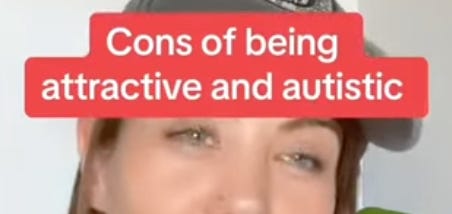
Other folks respond to this content by accusing the creators of lying about having autism, or insinuating that if someone is not behaving exactly like a character from Love on the Spectrum, that their autism is being faked for attention. I disagree with this. I believe that these women have autism, and I understand that they probably face some degree of skepticism from people who have a particular stereotype of autistic people in their head which requires conventional unattractiveness.
What I don’t believe is that being hot makes their social problems any worse than those of non-hot autistic people.
