

Autistic Barbie Was Doomed
Even when the goal is positive representation, any visual depictions of any group will backfire in the Discourse.

Just as I’ve quiet quit Twitter, multiple people notified me that some primo CHH chum had hit the TL: there is now an autistic Barbie, and people are mad about it.
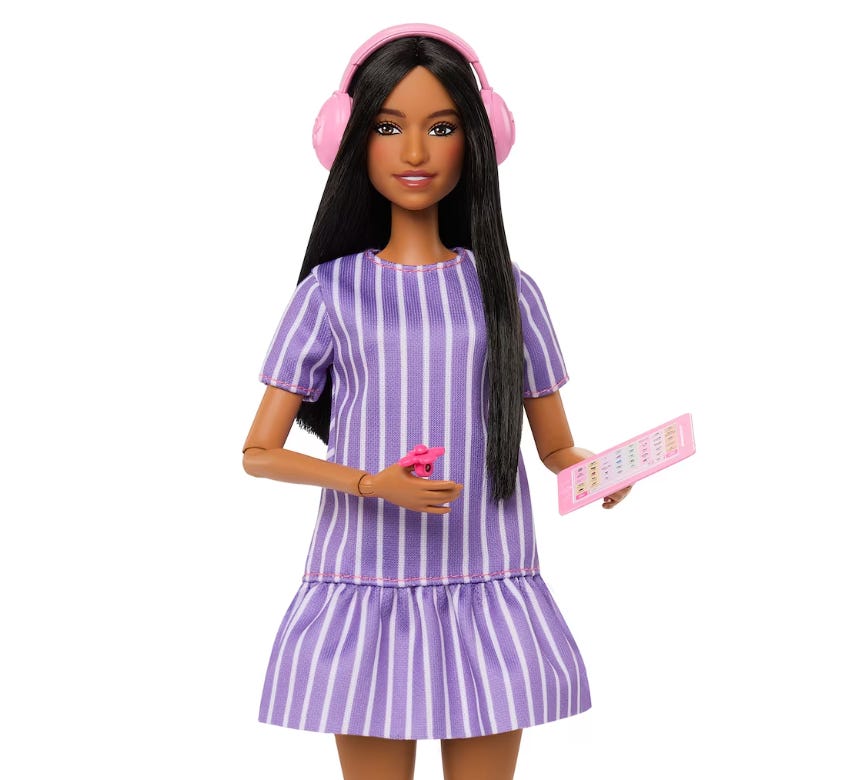
The autistic Barbie in question comes with headphones, a tablet, and a fidget spinner, adjustable arms for stimming, but otherwise basically looks like a normal Barbie. Perhaps in an abundance of caution, Mattel made her just about as racially ambiguous as possible:
According to ABC News, advocacy groups and parents of autistic children have had mostly positive reactions to the doll, which was no doubt focused grouped to death before release. But many folks on social media had other thoughts. In particular, some users felt that she was too well-groomed and well-dressed, and she should actually be dressed like a Sim who got stuck in a randomly-generated outfit:
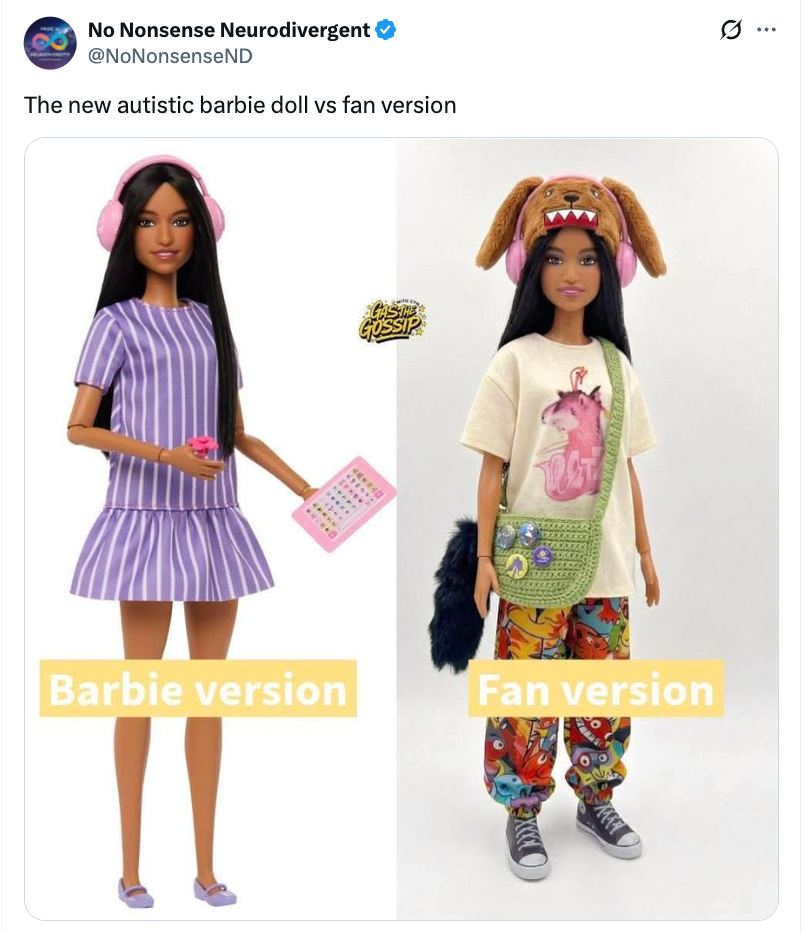
Another writer suggested that for this Barbie to really be realistic, she would need to be wearing loose-fitting tracksuit pants, glasses (all autistic people are apparently visually impaired) and “holding a book.”
Now, obviously, there are many autistic girls who look nothing like this Barbie and have many more symptoms than needing to wear headphones. There are kids with autism who cannot play with Barbies. It brings us back to the question of whether or not we should just split the spectrum, because the doll likely represents level one autism and will be mostly purchased by parents of kids with level one autism. Autistic Barbie is not a universal autism win. But it probably fills a good niche for autistic kids who already enjoy Barbies, who by default probably enjoy pretty fashion, and would prefer a pretty and well-dressed doll.
But the most scathing response came from psychologist Dr. Jessica Taylor, who not only took issue with the doll’s clothes, but the fact that she is thin and conventionally attractive, something that apparently unheard of in the autism world (or the Barbie world, I suppose.) “Nothing about this doll reflects the material realities of autistic people’s lives,” she tweeted. “There is no engagement with power, exclusion, or harm. Autism is treated as something you accessorise, not something that shapes how you are treated by schools, employers, healthcare systems, families, friends, partners, police, courts, prisons, or the state.”
So, I’m not really sure how a Barbie’s experience of oppression in a checks notes prison would be addressed, but the overall gist is that this Barbie is simply not gritty enough and fails to pay homage to the insidious forms of ableism in our society. For that matter, every black Barbie should probably include some component of institutional racism and the history of the slave trade. A Barbie in a wheelchair needs to address her inability to marry without losing disability benefits. A Jewish Barbie should make a nod to the Holocaust. Sounds like fun!
She also accused the Barbie of commodifying a social issue, declaring that true representation will never really come because there will never be a homeless Barbie (why did she not say “unhoused?”) chronic illness Barbie, abused Barbie, traumatized Barbie, gaslit Barbie (yes really) or…uhhh…”raped Barbie.”
(I do not think we need a raped Barbie. Please do not make raped Barbie. If I am ever in a focus group about raped Barbie, I will vote no on raped Barbie.)
But I’m not here just to talk about the criticism from Dr. Taylor. Most people on Twitter didn’t agree with what she had to say, and she certainly doesn’t represent the majority view. However, Dr. Taylor does represent a view you see commonly when companies or franchises attempt to increase diversity or representation with a singular visual. It almost always backfires. In fact, this happened with Barbie before.
