

How My Parents Helped Me When I Was Being Bullied
There are things parents can do to help their children who are being bullied—even if they feel powerless.

This article is free, but most of my 4-5 weekly articles are paid. Please consider becoming a free or paid subscriber for more like this!

I’m about to say something that may come as a shock to all of you—I was not well-liked as a child. I know, it’s impossible to believe that I, frequently crowned, “most annoying account on Twitter,” would ever have been bullied, but alas, I was! The bullying started when I was about nine and continued until high school, when I finally switched school systems. Then it reared its head again in college, mostly in the form of gossip, with one particularly interesting rumor about me engaging in an “Eiffel tower” with two guys I had actually never met. But as is the case for many formerly-bullied annoying women, things were socially the absolute worst in middle school.
Just to give you an idea of what this entailed: thankfully, it never got physical (it rarely does for girls) unless you count a couple pencils thrown in my direction—one of the few offenses committed by my male bullies (#MenInWomensFields). Pencil projectiles aside, it was almost entirely social/verbal warfare, committed partially by my group of friends but occasionally from girls who I barely knew. I received drive-by comments in the hallways about being an ugly, “slutty” freak. I was invited to parties that didn’t exist by people who hated me, I was “voted off” multiple lunch tables, and I was subject to wild sexual rumors—including one that I was “paying adult men to go down on me” (major questions about the upbringing of the twelve-year-old child who came up with that one!) even though I had never actually kissed anyone.
Recently, a paid subscriber reached out in the subscriber chat and asked if I had any tips about what my parents did (or could have done) to help me during this time in my life, because their daughter was experiencing social difficulties at school and they wanted advice. While my parents didn’t 100% solve my problems, they definitely helped—and I hope that by sharing these tips I can help parents of children who are being bullied.
First of all, why was I bullied? Well, I’m annoying. I always have been, and it takes a lot of work for me to stop being annoying. A therapist once diagnosed me with “missed social cues” just a few minutes into a session. I have an uncanny talent for vaguely bothering people in ways that inspire immense rage. It’s probably why I was so good at trolling Reddit, channeling my ability to be annoying into a variety of fictional characters who were even more annoying than I was. But before I made a living off of being annoying, it was just a social detriment. I also had a particular way of dressing where I deliberately wore provocative or unusual attire, probably to piss people off, or perhaps so I would have a non-embarrassing explanation for why nobody liked me (See? I’m not actually annoying, girls are just mean to you when you look hot!!)
My parents were proud “be yourself” people. They thought that I was real darn nifty, and if other people didn’t think so, that was their loss (okay, this is what they said to me. It’s entirely possible my parents were like, “Why the fuck is our daughter so annoying?”)
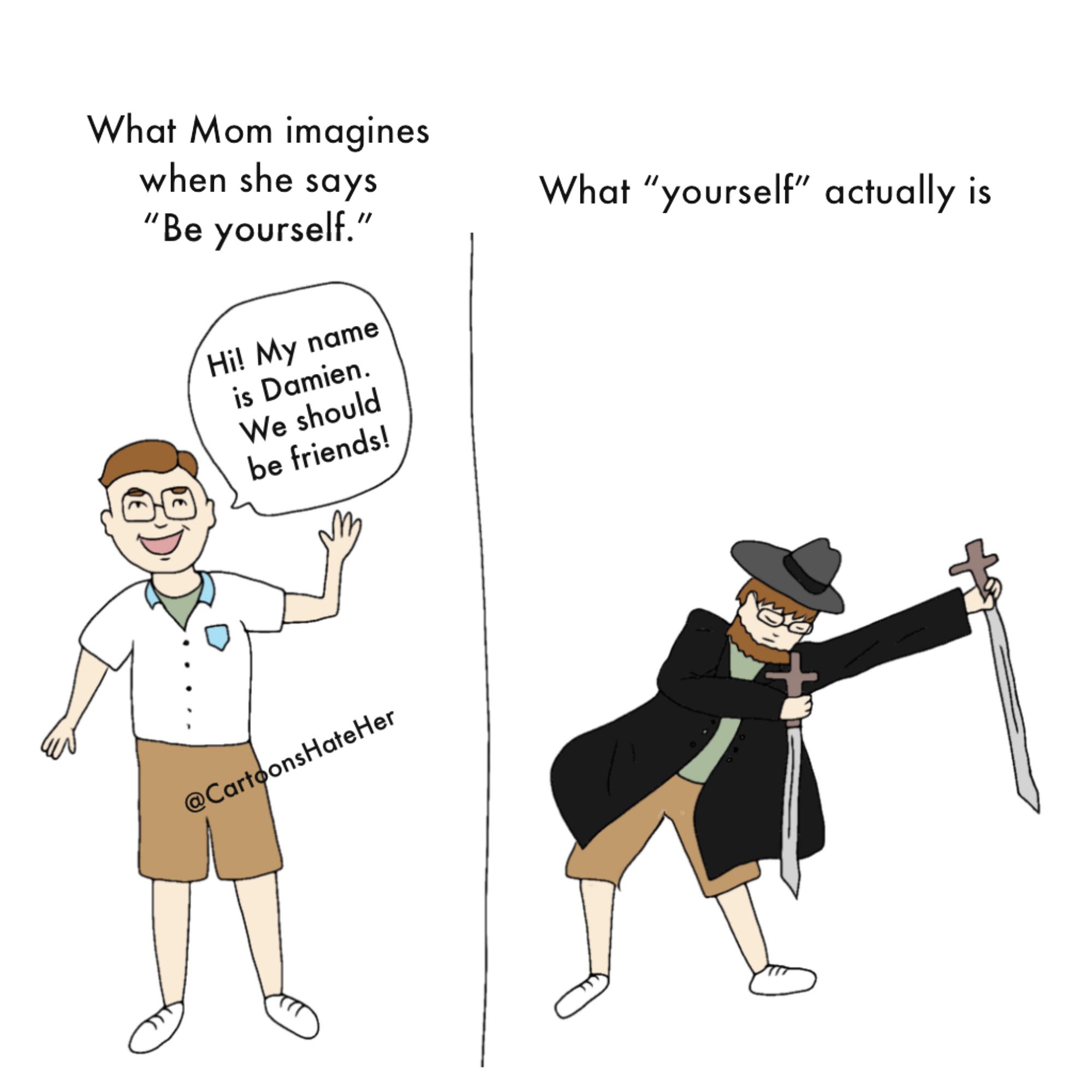
But anyway, the “just be yourself” line is not terribly useful. Sometimes, nobody likes “yourself,” especially if you are in seventh grade when social suicide is as simple as having a dorky binder. Also, no offense to all the parents out there, but most twelve-year-olds think their parents are lame, so hearing that their parents think they’re cool is like discovering that AryanAurelius1488 thinks you’re a great ally to the BIPOC community. In fact, sometimes my parents would inform me that one of their friends thought I was “so pretty” or “so cool” and I would roll my eyes and say, “Is your friend Donna a hot 13-year-old boy? Didn’t think so.”
It probably would have helped if I had learned the basics of social cues earlier (I had to painstakingly teach myself social cues at the age of 28) but I don’t know if my parents would have been good at teaching these things to me—or if I would have listened! For example, I had a tendency to talk too much, focus too much on myself, and put on extended comedic performances for which nobody asked. Perhaps my parents dropped hints that this behavior was unbecoming, but if they did, I did not notice. (Also, I now make a living doing exactly that, so perhaps it’s good they didn’t tamp it down too much.)
My parents also had some strategies that were funny, although I don’t know if they helped. At the very least, they didn’t hurt. My dad used to make me laugh by only saying my nemeses’ names in an “evil voice” so if I came home complaining about a girl named Stephanie Mariano, he would start doing a villainous cackle and bellow, “STEPHANIE MARIANOOOOO.” Meanwhile, when I was being bullied by a girl named Jenna in the seventh grade (name not changed because I am, honestly, still quite mad) my mom suggested keeping a document on my computer called the “Jenna files” and I would update it every time Jenna was a bitch to me. Not sure if this was a healthy strategy, but it did make me really excited to have more run-ins with Jenna so I would have more material for my file. Funny enough, Jenna stopped making fun of me around this time. It could have been sheer luck, or perhaps my eagerness to be bullied ironically made me less of a target.
But there was another thing they did that was especially helpful. I went to a school that was very “typical” in the sense that kids who played sports were cool and kids who did theater were losers. In fact, we had so little funding for our theater program that the annual musical production was performed on the bleachers. But my parents quickly realized that while I was “plankton on the popularity food chain at school,” as I put it, I was not considered uncool around other creative kids. The theater kids didn’t have any problems with me, although there were so few of them (and for some unlucky reason, very few in my year) that it wasn’t a good strategy for making friends. But my parents correctly surmised that the ideal way to improve my social situation was to get me involved in activities with like-minded kids outside of my school. They could not stop kids at school from bullying me. They could not force me to have the personality that appealed to twelve-year-olds who wore Armani Exchange. All they could do was create a separate environment for me—one with real-life kids my age—where I was cool.
I cannot cheer on this strategy enough. My parents enrolled me in a theater-based summer camp and an after-school writing class. Both of these institutions were totally unrelated to my school, so I could comfortably reinvent myself. And despite continuing to be unpopular at school, the bullying and exclusion didn’t bother me nearly as much because I had these other friends (and at one point, even a boyfriend) who knew the “real me.” I felt like Superman as Clark Kent, pretending to be the least cool girl at my middle school when I was actually a moderately cool girl at theater camp. In retrospect, this carries a parallel with secretly being Cartoons Hate Her when I was working in tech, with coworkers who hated me (probably for good reason) and repeatedly getting fired. I joke, but seriously—shitty things in your life can be ameliorated by the fact that things are going really well in your Other Life. You just have to make sure your kid’s other life is the after-school art class and not role playing Euphoria characters with Claude.
Although my high school experience wasn’t bad, my summers were spent at CTY, a college prep program endearingly referred to as “geek camp” or less charitably, an autism summit. To put things into perspective, the director of CTY warned us about “shoving friendships in other kids’ faces” because “not everyone can make friends.” The standards for “socially skilled” were pretty low. At this point, I didn’t feel the need to escape from who I was at school, but being “cool” (relatively speaking) at CTY was a fun escape from being medium-liked at my high school.
Of course, not every parent can afford sleepaway camp, but sleepaway camp is hardly the only option here. The goal is to give your child a second life surrounded by peers who appreciate them, so whatever is happening at school doesn’t matter as much. That can be at a community center class, or through any activity that occurs outside of school. When you’re in middle school, your social dramas feel like the be-all, end-all, and it’s much easier to give a kid an outlet of like-minded peers at some other activity than to insist, repeatedly, that none of this will matter in five years, no matter how true that may be!
I would be remiss not to mention one area where I was especially lucky—I was in middle school in the early 2000s, when a lot of kids just weren’t on the Internet in any serious way. A lot of my peers were on AIM, but I wasn’t allowed. In fact, when a teacher attempted to do a lecture about the dangers of the Internet she asked us who was on AIM with a show of hands and everyone raised their hands except me. Still not sure what that was supposed to prove, but it did not help my bullying predicament. This dovetailed nicely with a rumor someone spread about me that my parents “couldn’t afford electricity” because when I had a friend over for dinner my parents, pretentiously, kept the dining room dark and lit candles. Anyway, TLDR: AIM would have been even worse for me than not being on it, at least at this age.
It’s hard to keep your kid off social media and I won’t pretend to know how. Anecdotally, I’ve seen parents have success banning phones in the bedroom at night. Even after I was allowed to use the Internet, I could only use the family computer in the kitchen. I’m aware this is just not how the world works anymore, but I have seen parents ban all forms of social media until sixteen and have strict limits on screen time, with quite a bit of whining but not a whole lot of Internet-based trauma. I really don’t want to lecture parents of much older kids than my own, but I can’t imagine the complaining about screen time would be worse than the outcomes of cyberbullying. And presumably, if your child is having fulfilling social interactions outside of school and the Internet, social media will feel less necessary.
Finding your child outside-of-school friends is especially important because especially for girls, one of the biggest anxieties involves losing their friends over rumors and gossip. The great thing about making friends at an after-school club or class is that not only can you reinvent yourself, but nothing at school will ever reach them. These friendships make school dramas genuinely lower-stakes, and this in turn makes the bullied child less of a target.
I hope my children don’t inherit my personality, and I hope they glide effortlessly through school with lots of friends, none of whom are ever a bad influence. Of course, I am prepared for the inevitability that at least one of my kids is bullied at some point. I know that would be heartbreaking and upsetting for them (and, not going to lie, for me as well) but I also know that I have a game plan—the same thing my parents did. Except for the candles.
When I Worked in Big Tech and Everyone Fucking Hated Me

What follows is a true story, but a few identifying details have been changed (especially the company name—so don’t bother Googling it, it’s not real.)
So Apparently My Son's School Auction is NOT About Me

What follows is a true story, not that anyone should have a hard time believing it. You can also find other comedic true stories of mine here.
Many of your articles have a theme: "Being likable is a skill. Some people have it, others can learn it."
I have a 12-year-old daughter. Picture Lisa Simpson. Smart, kind, well-meaning but also anxious and a bit of a know-it-all. To other girls, she can be "a lot."
Anyway, I got her this book that really helped her understand herself and social grace. It's called "How to Win Friends and Influence People for Teen Girls."
Just as it’s wise to diversify your portfolio of investments rather than “putting all your eggs in one basket” so that if any one of them performs poorly, you don’t lose a lot of money, it’s wise to diversify your kids’ social circles so that if your kids are having a hard time in any one of them, they have others they can rely on to get their social needs met.
That said, if your kids are having a hard time in ALL of their social circles, that’s a sign of more serious problems that you need to deal with.