

What Does "Incel" Even Mean Anymore?
Is it really "involuntary" if you aren't leaving your house? When solitude is the default, do incels really exist at all?

Amidst discussions of jestergooning and framemogging and all other variations of Gen Z manosphere slang, one particular slang term appears to be going out of fashion: incel. In fact, using the term at all feels painfully millennial. It’s giving chopped unc.*
*I’m being informed “chopped unc” is now chopped and unc-coded.
Anyway, the term “incel” originated in the late nineties by a bisexual woman who identified as such. It was as a shortened version of “involuntarily celibate,” or basically, anyone who was sexless, not because they were choosing not to have sex, but because they couldn’t find a sexual partner. No other qualifiers or connotations. But as people in the original incel community “graduated” and found partners, the word evolved and became more mainstream, especially across social media in the 2010s.
And as “incel” gained notoriety, its definition narrowed and broadened considerably, depending on who was using the word.
On the now-defunct incel subreddit in the 2010s, there were near-constant arguments about what “counted” as an incel, with semi-regular purges and dogpiles. Leave it to Reddit of all places to gatekeep “not getting laid.” Men were frequently bullied for claiming to be incels when they didn’t actually count because of some obscure, nitpicky technicality, such as being overweight (if they lost weight, they’d get laid—NEXT!) They subreddit argued over whether you still counted as an incel if you had slept with a sex worker, kissed a girl at summer camp ten years ago, or ever held hands with someone flirtatiously. Teenage boys who claimed to be incels were cast away for stolen incel valor because it’s completely normal to be sexless at seventeen (I have to be honest; I’m with the gatekeepers on that one.) Perhaps the most ridiculous incel gatekeeping argument happened when hypothetical inceldom became the gold standard. Eventually the mods decreed that to be a true incel was to be open to sleeping with any woman ever, and having good reason to believe that every single woman in the world would say no, which meant you had to have made a good faith effort to sleep with women, standards be damned. If you claimed to be an “incel” but wouldn’t hypothetically sleep with a morbidly obese woman your grandmother’s age with no hands, you were actually just an attention-seeking volcel. This was also their argument for why women couldn’t be incels—there was no woman out there who absolutely zero men would agree to fuck. Ergo, any woman who identified as involuntarily celibate was either too picky or just wasn’t trying hard enough. Either way, that’s volcel territory.
Now, you might be asking: what is a good word for a young woman like me who spends hours of her day reading pedantic incel debates on Reddit? “Mentally ill.”
On the other side of the social media ecosystem—now mostly found on Bluesky, Instagram and Threads—the word “incel” was defined more broadly, not as an exclusive in-group club, but as a pejorative. Given that the most vocal, visible incels in media were openly misogynistic and hateful, “incel” became shorthand for a man who was a dick to women, and the lack of sex was simply assumed (or irrelevant). I’m sure you can imagine this would have infuriated the incel subreddit (“That guy just hates women, he’s not a REAL incel unless he’s willing to fuck a female walrus, and has confirmation the walrus wouldn’t be interested because of his subhuman eyebrow ridge.”)
And now, as young people are having less sex than ever, what does it mean to be an “incel?” Has the word lost all meaning since it became shorthand for “uncool douchebag?” Or is it impossible to distinguish between voluntary and involuntary celibacy when anxiety, lack of community and social isolation—not immutable personal defects—are to blame for Gen Z being the most sexless generation?
Moreover, how many modern-day “incels” are actually, according to the old subreddit, just volcels whose only dating handicap is that they aren’t actually speaking to women in the first place?
First of all, I should clear up something most of you may already know. “Men who hate women” and “incels” aren’t always the same people. There are prolific playboys who are sexist, and there are frustrated virgins who aren’t. When I started this Substack, I went out of my way to interview men who considered themselves involuntarily celibate but didn’t belong to any particular woman-hating subculture, to shed light on the fact that most men who struggle to find sex and relationships aren’t in that predicament due to misogyny (and one of the men came across as so likable in his interview that multiple women reached out for his number. Being a “misogynistic asshole” wasn’t his problem.)
Not only can misogynistic men still get laid, but the declaration that misogynists and incels are one in the same (or that a man who hates women must only feel that way because he can’t get any ass) reinforces the, dare I say, sexist belief that a man’s ability to obtain sexual partners is indicative of his moral value. It also directly confirms the idea that women are “vending machines who dispense sex for good behavior,” which this exact cohort of feminists have repeatedly countered. Of course, we all know women don’t dispense sex for good behavior. Just as there are perfectly fine women who can’t find a boyfriend, there are perfectly fine men who can’t find a girlfriend. Sexual attraction is completely amoral.
Also, if you agree with the premise that all incels are misogynists (and all misogynists are incels) then nobody can ever discuss the struggles of lonely young men without being accused of misogyny-by-proxy. And now, lonely young men are a huge chunk of young men! Of course, the loneliness epidemic affects everyone, not just men. I’ve written about that too. According to a new Kinsey Institute study, nearly half of Gen Z have never had sex and 80% report frequent feelings of loneliness. Another study done by Business Insider shows 37% of Gen Z never having sex. Even parents—people who are by definition around other people all day—are lonely and isolated.
But some components of loneliness are gendered, or at least rely on certain gender roles. Most of this is related to the overall shift of socialization onto social media and dating apps and away from real-life interactions (especially spontaneous interactions.) Young singles were hit hardest. For example, after it was demonized to ever spontaneously flirt with a woman in public (including at semi-social locations like the gym) both men and women were affected. Women stopped getting approached as often (and yes, many report that they would like to get approached more) while men experienced unnecessary anxiety about approaching women, which led to a lack of experience approaching women, which led to more anxiety approaching women. There was a period of time where you couldn’t draw attention to our changing norms that favored social isolation without being accused of fighting for the rights of grimy predators to go around groping women at the bus stop. Realistically speaking, the men who harassed women in public or attempted tit-for-tat sexual favors in the workplace were basically never incels. But it’s easy to get to that logical endpoint if you believe in the just world fallacy that any man who struggles romantically is an incel, and every incel is evil.
As loneliness and isolation of young single people only get worse, I have to admit that the word “incel” might lose any remaining potency, especially as it is contrasted with voluntary celibacy. How can we even tell the difference anymore? Obviously, a devoutly religious person is voluntarily celibate in a way that isn’t up for debate, but how can we distinguish between a young single person who can’t have sex, versus won’t (but only because they think they can’t?) What if the main reason they “can’t” have sex is that they’re too terrified to talk to anyone in real life? Perhaps that counts as involuntary, but if being an incel is a transient state that applies to a huge chunk of Gen Z, and has less to do with your attractiveness and more to do with the crappy era in which you live, is it really an identity at all?
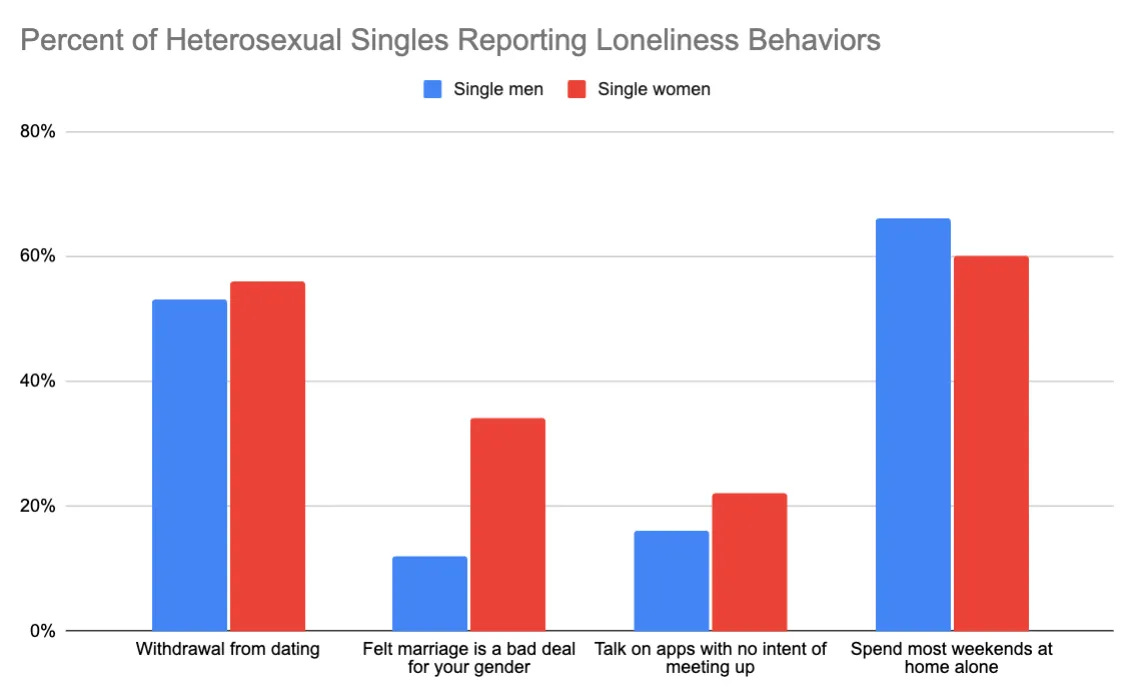
The Redditors of yore would have insisted that you were only an incel if you had good reason to believe that all women found you repulsive. Perhaps men like this really exist. But a lot of young singles are simply not interacting at all, so it’s impossible to say. For example, a slight majority of both single (straight) young men and women are spending most of their weekends at home alone, per my semi-recent survey:
I saw this scenario play out in real time on Twitter yesterday. I would link to it, but I genuinely feel bad for the man involved so you’re going to have to take my word for it. A 24-year-old virgin posted all the features that should make him attractive (six figure income, physically fit, living in a major city, circle of friends) and then asked why women (he called them “foids,” per incel slang) weren’t sleeping with him. One of his commenters asked a very astute question that sounds obvious, but isn’t: is he actually…trying to have sex with women?
And—credit to him for being honest and vulnerable—he said no! Apparently he’s been interacting with multiple women on Discord, but is too scared to make the IRL transition. When the commenter pushed him to get over his anxiety and talk to women in real life (or transition his online penpals to real life) he said there was no use, because “Chads” have probably already locked them down.
Can this man, in good faith, call himself an incel? He could look like Jacob Elordi for all I know (Okay, he probably doesn’t, but he’s statistically unlikely to be an ogre.) If he actually spoke to women, maybe he could have a girlfriend. The inceldom is basically self-imposed, and yet, he’s not unusual. There are loads of men his age who feel like incels, but aren’t really, because as the old-school Reddit moderators might point out, they haven’t actually tried. The are, in a way, volcels who have chosen to be incels. The narrative of being undesirable in a theoretical sense is more appealing to them than the risk of trying to have sex for real. They are too scared of embarrassment to do anything that might actually lead to sex, and it’s more comforting for them to tell themselves that women would have rejected them anyway than to brave actual rejection.
(Obviously, this is not true of 100% of young men. Some actually have been rejected many times, online and in real life. I commend those guys for at least trying. But anyway, the guy I just described is hardly an outlier.)
This volcel-incel subtype leads to a self-fulfilling prophecy. Take the young man I just described—I don’t know what he looks like, but he almost certainly isn’t too hideous to find a partner. If he has an active social circle as he claims, he probably has a decent personality that can sustain friendships. Maybe he’s funny. But with basically zero real-life interaction with romantic interests, and high degrees of anxiety about approaching women, he probably has an abysmal degree of rizz, and his romantic confidence is in the gutter. The “red pill” pickup artists of the 2000s would have bullied him into getting off Discord, going out and hitting on women until rejection didn’t hurt. But we don’t live in the world of the 2000s anymore, so the cards are stacked against this guy even if his “inceldom” is self-imposed. It’s genuinely harder to talk to random women today than it was in the 2000s, even in a bar or a social setting, because that’s no longer the social norm. It’s much easier to chat up women in real life if everyone else is doing it! If the social norm is that you only meet dating partners on apps, it’s genuinely riskier to attempt to meet them in real life. It’s no wonder the man in question is filling his social needs via Discord—with multiple women! And yet, he is unable to meet up with any of them.
Barring extreme physical deformities (and perhaps not even then—plenty of severely disabled and disfigured people still date and marry) a single young man today cannot possibly be confident that the only reason he doesn’t have a girlfriend is that he is too physically repulsive to find one, or because they are all taken by Chads. That’s because many single young men today are bereft of organic opportunities to meet women in the first place, including women who might like them. If a guy isn’t leaving the house, has no social circle and no regular, everyday access to women, and is living in a society where social norms keep him as isolated as possible, is his celibacy truly “involuntary?” Yes, in the sense that he hasn’t chosen to live in 2026 with all our backwards social norms that keep people terrified of each other, but not in the sense that anything about him is inherently, genetically irredeemable. Perhaps if he was in a different community, a different time, one where he was able to socialize organically with a variety of people and develop more comfort in romantic social settings, he would have a girlfriend. This is the reality for many young people these days, and I’m not sure that it’s appropriate to call them incels or volcels. And this is why I suspect these words are already falling out of fashion.
The term “incel” might be dead. But there’s a new word for it: “Gen Z.”
You might also like…
Viewing Baby Boys as Future Predators Was a Bad Idea

Everyone in this world of terminally online sickos is aware that a “vibe shift” has happened, somewhere around 2023-2024. Almost anything that would be popular to say today would have been weird/cringe ten years ago, and the reverse applies.
When I'm Lonely, it's a Tragedy. When You're Lonely, it's Funny

One of my favorite writers, Derek Thompson, became the subject of the Internet’s ire this week when he posted an excerpt from an article by Emily Witt in the London Review of Books that frames the “male loneliness crisis” as what she calls a “bitter joke.” She describes she and her friends making fun of men for attempting to make friends, performing any kind of masculinity, working out, or well…really doing anything at all.
The Rise of the Highfivesexuals

If you’re still on Twitter (and if so, this is your sign to drink a glass of water and check in with yourself) you’re probably aware of a series of videos floating around, displaying a group of edgy right-wing influencers throwing up Nazi salutes, including the Tate brothers. Several of these men are people of color, some of them are sexually ambiguous, a couple are Muslim, and three of them are formerly incarcerated—to their credit, a far more diverse crew than you’d see at a leftist CHAZ demonstration in 2020. Just to put things into perspective, when a meth addict famous for hammering himself in the face to improve his maxilla projection is the
Anecdotally, as someone who has been on the other side of that debate, I very quickly got fed up with the constant goal post shifting. Not having any luck on the apps? You aren't really trying, have to approach in person. You did that, but none of the women you know are single? You aren't really trying, meet new people. You tried that, but the places you might go to do that are all male-dominated? You aren't really trying, get new hobbies (but of course pretend meeting women isn't why you are doing that). After a while I realized that no amount of effort would actually get anyone to admit that I was in fact trying.
I was expecting to be annoyed (as I usually am with the use of the term), but found myself in furious agreement with most of the article. As I've been saying for years now, the term "incel" no longer means anything, and indeed equating lack of sexual/romantic success with misogyny just objectifies women. I'll also add that 99.9% of the discourse on incels isn't people identifying as such, but other people, usually progressives, using it as a slur. Incels are just a convenient boogeyman because our culture got stuck in high school, where it was cool to mock virgins.