


This article will be free, but most of my 4-5x weekly articles are paid. Please become a free or paid subscriber for more like this!
Today, I will start by walking you through my favorite moment of my favorite episode of my all-time favorite TV show, Peep Show—something which unlocks something very important and fundamental about one of my all-time favorite topics: being yourself.
Peep Show is basically a lower-budget, drier British Seinfeld set in the 2000’s, starring two friends and roommates: Jez, the free spirit who, well into his thirties, believes he is one big break away from becoming a famous musician, and Mark, a buttoned-up, geeky loan manager who would much rather be a world-renowned historian.

It might seem implausible that these two men are friends—and at times, they loathe, taunt and sabotage each other over their remarkable differences. In one memorable episode, Mark gets fed up with Jez mooching off him and forces him to interview for a job at his stuffy bank. Terrified that the (actually disastrous) interview is going “too well,” Jez randomly makes a weird face at his interviewer to freak her out so he can continue his position as a layabout.

But they keep coming back to each other, time and time again, because they need each other in the delicate balancing act that is their decades-long friendship. On the occasion that Jez spends time with his even-more-Jezzish burnout musician friend Super Hans, things get out of hand (in one episode, the two go on a drug and alcohol fueled bender and wind up giving each other blowjobs after destroying the apartment.) Jez needs Mark to keep him from hitting rock bottom and winding up in rehab, and Mark needs Jez to occasionally push his boundaries so he tries new things. But crucially, Mark needs to remain Markish and Jez needs to remain Jezzish for this relationship to work. The goal is not for them to change into one perfect man who is both free-spirited and responsible, but to continue balancing each other. This is confirmed in a later season when Mark and Jez briefly part ways and Mark houses a new roommate who is basically a redheaded version of himself. He tires of this man so quickly that after his new roommate refuses to move out, he calls Jez and Super Hans to kidnap him and force him out of the apartment in a sleeping bag.
I am a Mark. I know this may surprise you because I’m a creative, so I should be a Jez. But I am not, by any stretch of the imagination, a “free spirit.” Respectfully, get that shit out of here. Yes, I love to talk and make jokes and I like to wear bright colors but I am perfectly happy to die of old age never having tried magic mushrooms. I do not like dancing in the rain (I don’t even like getting wet.) I have never, and will never, go to a music festival that involves being in a desert, sweating, getting sunburned, or taking a long train crammed full of other sweaty people on their way to the aforementioned festival. When my brother visits a new city, he occasionally reports back to me that I would “love it” and so far the only times this has happened has been in Singapore and Copenhagen, his reasoning being, “It was safe and clean.” (My mom said the same thing when she visited South Korea.)
I may not be a loan manager, and I may not be a historian, but I am a Mark, through and through (including the fact that Mark is prone to neurotic freakouts from time to time, or the fact that he handed over his belongings to a guy on the street who aggressively demanded them without a weapon- this happened to me once too).
I’ve noticed that it’s much easier to appear authentic (or at least convince people you are authentic) if you are a Jez. Nobody questions whether the guy dropping acid in the yurt is “being himself.” Of fucking course he is, because why else would someone do that? But Mark? He just needs to “loosen up and let go!”
In one of the earlier episodes of the miraculously eight-season show ( basically unheard of in this genre of British TV) Mark finds himself up against a predicament to which I can relate. He hacks into his crush, Sophie’s, emails (okay, I haven’t done that) and discovers that she likes him, but wishes he were more “fun,” lamenting that he’s so uptight all the time. Naturally, Mark decides to change Sophie’s perception, viewing his uptight nature as something he must shed so he can be more fun. He goes up to her mere minutes later holding some kind of party kazoo and suggests they “do matey things” together, to which she joyfully invites him to her dance class.
What follows is perhaps the greatest scene in all of TV history, and I’m not exaggerating. Mark expects that Sophie’s dance class will be a nice, conventional salsa class. But he has read the schedule wrong. On that particular day, they are doing something they call “Rainbow Rhythms” which looks like this:
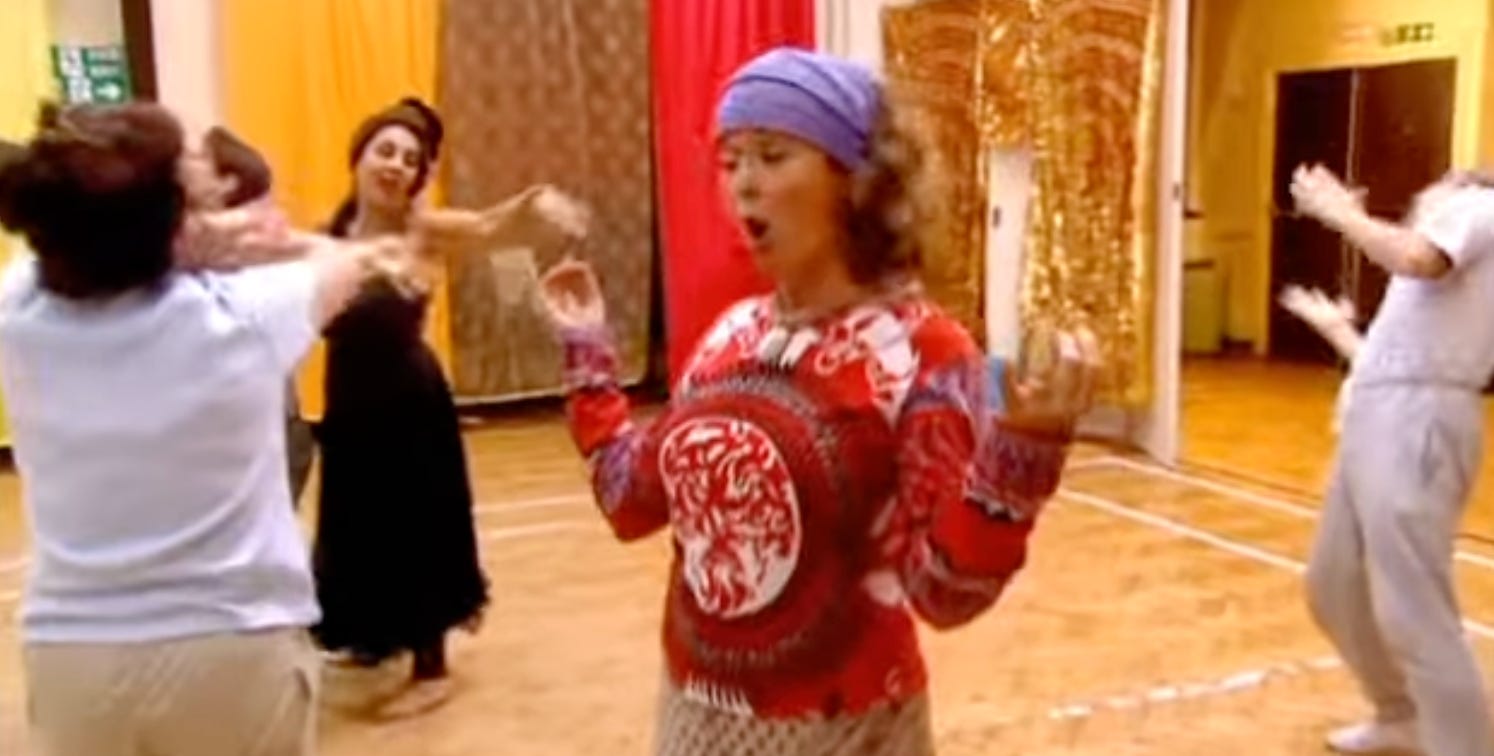
As Mark puts it, this is his personal nightmare. (Unsurprisingly, Jez, who has come along, is having a great time.)
But what’s especially frustrating about Rainbow Rhythms is that it encourages everyone to “let it go” and “be themselves,” insinuating that if everyone could just get rid of all of society’s expectations and rules, that they’d all enjoy writhing around like lunatics. And sure, this is true of some people. Jez, who isn’t terribly inhibited to begin with, immediately lets loose. But this…isn’t who Mark is. Mark isn’t bound by society to be uptight. He just is uptight and finds all of this a bit clownish.
But in effort to seem “fun” to Sophie, he purposefully dances as ridiculously as he can just to show her how uninhibited he is. He is doing this as a calculated move, not because he actually likes it. And, because this doesn’t come naturally to him at all, he dances a bit too crazy and Sophie is a little icked out.
Later, everyone in the class holds hands and gently discusses “how they experienced the class.” One participant, Gwyn, remarks that there was “a lot of new energy in the room, and some of it was so Rainbow Rhythms, and some of it was so not Rainbow Rhythms,” subtly staring at Mark. The class sagely agrees. Mark speaks up and says, “Why don’t you just say who you’re talking about? You’re talking about me, aren’t you?” Gwyn says yes. Mark continues: “I’m sorry if I didn’t do it right. I’m sorry if you assume I eat red meat and don’t necessarily think money or Tony Blair are a bad thing. But if there isn’t room here for people who stand against everything you believe in, then what sort of a hippie free-for-all is this?”
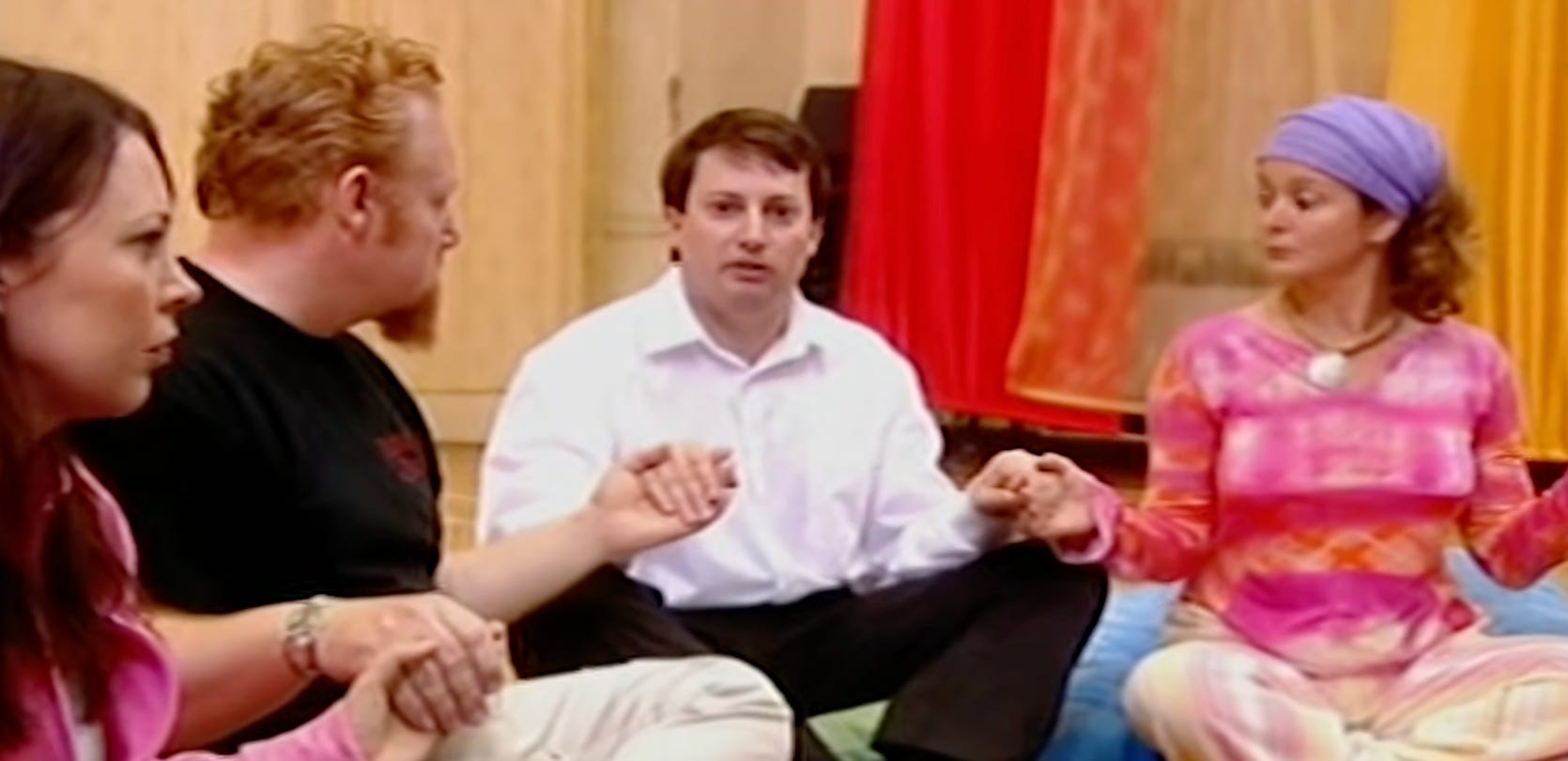
This episode is not about hippies, or about crushes, or about funny dance classes. The episode is about authenticity. And while people like Gwyn feel strongly about how important it is to be “true to yourself,” they are not including people like Mark in the equation.
Toward the end of the episode, Gwyn invites Mark (by way of Jez, and more importantly, Jez’s hot hippie girlfriend Nancy, who are also in tow, and Mark’s crush Sophie) to his lake house. Gwyn’s lake house was acquired after “energy,” in the form of money, “flowed toward him” after his parents’ death. No notes.
Anyway, at the lake house, Gwyn starts trying to initiate group sex via a seemingly innocent game of spin the bottle. Once it becomes clear what’s happening, Mark and Sophie realize that neither of them is really quite this free-spirited. They sneak out together and sit by the lake together, sharing their own, much more vanilla, romantic moment.
The hippies (Gwyn, Jez, Nancy) are no more “themselves” than Mark or Sophie. They may be more thrill-seeking, and they may like different things, but they are not more authentic. And Mark—stuffy as he may be—is being himself.
I related so hard to Mark in this episode. I went to a real “kooky creative kid” school, full of kids who wanted to try every drug under the sun, many of whom wanted to bum around in hostels throughout Europe after graduation instead of going to college straight away (I now enjoy travel as an adult who can afford to do it comfortably, but when I was younger and didn’t have money I was so aghast at the idea of staying in a hostel—full of strangers! with smells!—that I figured I just wouldn’t travel at all.) I did not want to try hard drugs. I did not want to sleep with indie rock stars. I did not, and will not, have any kind of psychedelic “experience” unless it is administered in the most clinical, Huberman Lab kind of way, and is guaranteed to cure my OCD. I have never found the concept of a threesome interesting, if only because I imagined it would be very hard to reliably wear condoms, I might get my feelings hurt, and I am not the least bit bisexual (okay, maybe I’d let her do things to me, but I’d be self conscious about how unfair it was for her.)
As I said before, I am a Mark.
I struggle to understand whether being particularly uptight is a “me” thing or a “my OCD” thing. Sometimes, it’s hard to tell! (Second idea: does Mark have OCD? There are signs! He canonically feels bad for underwear he doesn’t wear, just like me!) But certain preferences of mine are likely unrelated to my OCD. I like to be indoors (or outdoors in a very specific temperature range), I do not like animals touching me and I think kissing a dog on the mouth is disgusting, I like to dress up and don’t like to stain my clothing, I like to shower frequently enough to feel confident that I don’t smell bad, and I do not want to smell anything bad wafting off anyone else—in fact, I take other people’s bad odors as a personal affront. For all of these reasons, it’s obvious I would struggle deeply at Burning Man, and I think it’s now obvious why I hated living in San Francisco so much.
For much of my life, I worried that my love of the clean, safe, and comfortable was an inherently bad tendency that I needed to drop—not that this was part of me but that it was a bad habit, akin to nose picking or thumb sucking. I kept watching romantic comedy movies where the woman we were supposed to root against was the one who was afraid to get dirty, stupidly wore heels on a hiking excursion, and who didn’t want to “break a nail.” In fact, growing up, my slightly-tomboyish mom warned me repeatedly about this tendency of mine. She told me that most men really want women who aren’t afraid to get dirty, who will play a rousing game of touch football, and who get ready for dinner in five minutes by throwing on jeans and a T-shirt. This was decidedly not me. She framed this type of woman as who everyone would be if they just “let loose” and stopped being so uptight and prissy, but she did not take into account that maybe being prissy was just who I was.
I’m sure my mom thought this was a wholesome, feminist message, even if framed in the context of appealing to men. She gave birth to a hyperfeminine daughter who, in her words, she “didn’t know what to do with,” and thought that steering me towards being just a bit less fussy and high-maintenance would help me. And yes, when this tendency of mine makes it hard to function—when I’m on the verge of having a meltdown because there’s too much sand on my feet, or when it’s time for dinner and I only have five minutes to get ready—I have to just be flexible and moderate my emotions and behaviors. But none of that changes the type of person I am! I am not the girl who wants to go to the dog park on a first date. I am not the girl who shrugs it off if she bites into a hotdog at a baseball game and squirts mustard all over her shirt (as if I’d ever go to a baseball game on my own accord!) I know I’ve joked that “be yourself” is bad advice if “yourself” includes really egregious social skills, but in this case, my desire to be clean, safe and well-groomed is not something I believe needs to be changed. Just like Mark and his desire not to have group sex at the lakehouse.
So—for all you Marks out there—all the prigs who would much rather be at a nice restaurant, or even just drinking tea at home, than out white water rafting or dropping acid in the desert—feel free to be yourself. And anyone who won’t accept it isn’t so open-minded and free-spirited after all.
You might also like…
I Dress For My Personality, And My Personality Is Annoying

For a long time now, I’ve joked that I’m obsessed with social dynamics because I am not naturally gifted at socializing. Call it high-functioning undiagnosed autism, call it just being annoying, but it is what it is, and I didn’t choose it. This lack of talent forced me to examine social dynamics in a way most people never have to. I “taught myself” how to be likable (or at least not extremely off-putting) at the age of twenty-eight (I wrote about that—and what I learned—
I Thought I Wanted a Work Wife, Until I Got One

Note: This true story was initially published years ago when I first started writing on Substack and almost nobody saw it. Since then, I’ve really wanted to edit, polish and re-publish for a larger audience. Similar personal essays of mine can be found
On the one hand, it's true that some of us who are living quiet lives don't really have a flamboyant dancer inside trying to escape. On the other hand, it's good to be open to discomfort and scary things. I'm not talking about random drug use, I mean learning to tolerate discomfort that allows you to enter situations where you can learn, grow, or give to others. Pema Chodron writes, "The interesting thing is that the more willing you are to step out of your comfort zone, the more comfortable you feel in your life. Situations that used to arouse fear and nausea become easier to relax in. On the other hand, if you stay in your comfort zone all the time, it shrinks…And the older you get, the more threatened you feel. Things that didn't bother you when you were thirty or forty can make you very uncomfortable when you are seventy or eighty." (from Welcoming the Unwelcome).
I love *Peep Show* and have always related to Mark. His rant to Jez about how global capital is the only reason he can be a hippie burnout is something I think about semi frequently.