

How SSRIs Became the Female Fedora
In the 2010s, "fedora" conjured up a particular type of man. Today, "SSRI" does the same for a particular type of woman.


All day long, I’ve been telling my husband I can’t wait to finally finish the “SSRI fedora” article. I’m pretty sure he hasn’t responded once, because he thinks this is a well-known phenomenon of which he should be aware but isn’t. Thankfully for him, this is just one of those thoughts that keeps popping into my mind when I’m trying to sleep. So I’m going to share it with all of you.
Many years ago in the 2010s, back when people were scandalized over Miley Cyrus “appropriating” twerking, when women unironically wore “This is What a Feminist Looks Like” T-shirts, and when it was a moneymaker to feature pansexual conjoined twins as the spokesmodels for trendy skincare brands, the Internet was rife with depictions of the neckbeard: a slovenly, arrogant, and misogynistic man who was a convenient catch-all for male behavior you found distasteful. Some neckbeards were faux-chivalrous and corny but not antagonistic (commonly referred to as “nice guys” who sulked that their basic manners hadn’t earned them hot girlfriends,) and others were openly bigoted and aggressive. There was also the brief “Reddit atheist” archetype of the antagonistic edgy atheist whose disrespect for women was rivaled only by his loathing of “fundies.” But they all had one thing in common: a fedora.
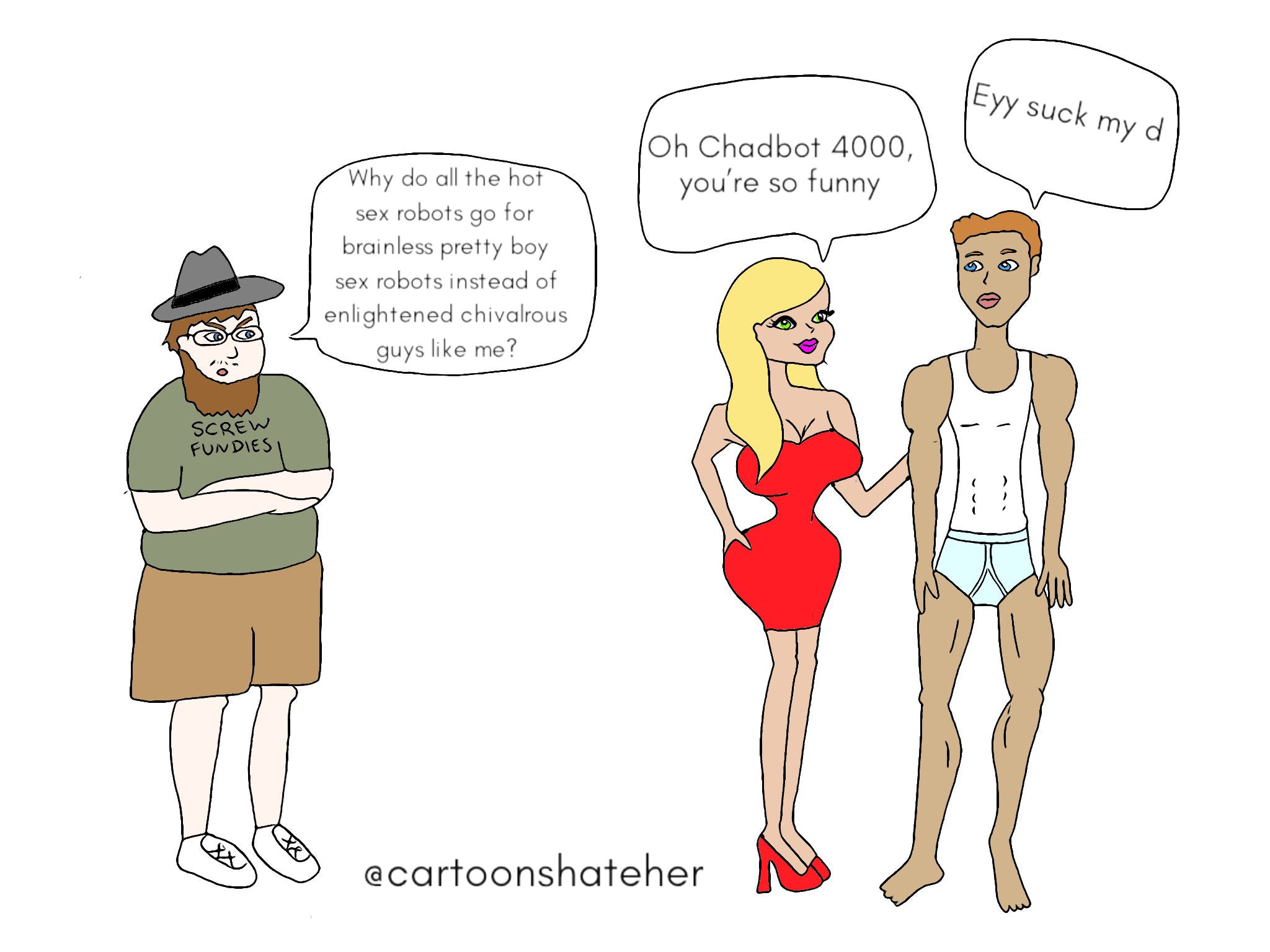
Not to split hairs here, but really, it was a trilby, not a fedora. But the “fedora” became shorthand for an obnoxious man (typically a nerdy but arrogant white man, but there were variations.) “Fedora” became such an easy insult that it even inspired countless Facebook groups that existed only to tag in order to dunk on fedora-coded people, such as “sounds like something a sentient fedora would say.” A common retort to neckbeardish behavior was that the person had bypassed the neckbeard stereotype entirely and evolved into a “fedora with arms.”
While the neckbeard/fedora stuff probably got a bit out of hand (a lot of normal guys who just liked fedoras, or were harmlessly nerdy, caught strays) the term “fedora” worked as very effective shorthand to conjure up a specific type of person and immediately shut someone down, with their only option for a response being the embarrassing, “Hey, I don’t even wear a fedora!” And, well, the fedora meme may have gone out of style just as much as fedoras themselves, but something else has emerged in its place: the use of the antidepressant class off “SSRIs” to malign a particular type of woman—a white woman over thirty (typically a liberal) whose bitter distaste for men comes from her own failure to find a husband.
You might be confused about this stereotype. Surely, SSRIs are taken by people other than women, and what on Earth do they have in common with being single past a certain age? Well, it all comes from charts like this. I actually hadn’t seen this chart until it was sent to me as a “gotcha” from a man who wanted to prove that being a single woman with high standards was a recipe for misery:
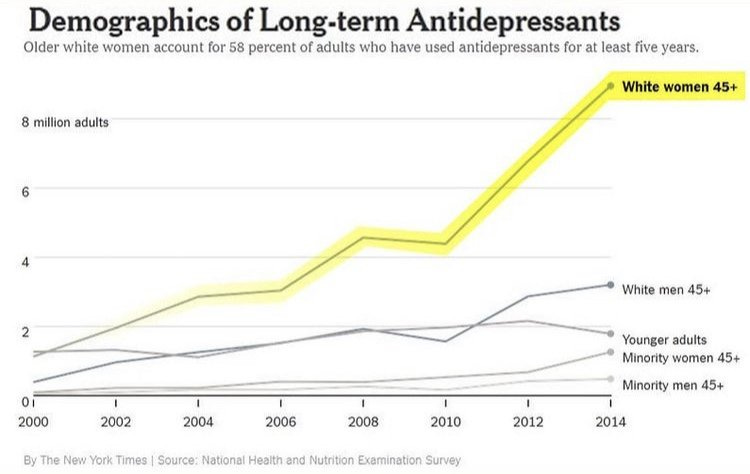
I’ve since seen this chart several times, usually making the exact same point and attempting to ridicule the aforementioned group of never-married, over-educated, affluent liberal white women. It’s odd, because the same people who post this chart as the ultimate le epic own will tell you men are oppressed by the Matriarchy and use the male suicide rate as an example for why. So basically, killing yourself = you’re oppressed. Seek medical help for your depression = you deserve it you loser lol. Sure!
Anyway, this chart doesn’t surprise me. White people generally have better access to healthcare than people of color, and women are far more likely to seek therapy than men (whether they should or not is another story. There are probably women getting therapy they don’t need, and men who do need therapy but aren’t getting it). Therapy isn’t stigmatized as much among women as it is among men, ergo, it’s not surprising that women would be more likely to be prescribed antidepressants than men.
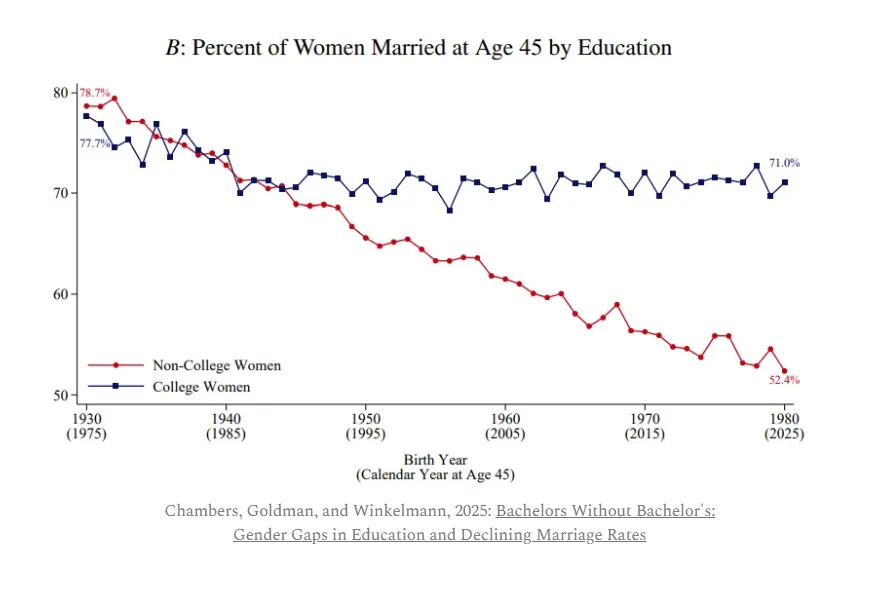
Now, what about age? Typically, this chart is used as an example for why failing to get married before you hit “the wall,” especially thanks to your own high standards, will be punished with eternal misery. But actually, white women over 45 are probably more likely to be married than any other demographic of women in that chart (except for Asian women, but they were probably grouped in with other people of color under the “minority” bucket.) Stephanie H. Murray covered this extensively in her amazing piece about the breakdown in gender relations actually stemming from those on the lower end of the class totem pole. The “highly educated, ambitious girlboss who can’t find a man” makes for great TV and TikTok rage bait, but isn’t driving the marriage rate down in any meaningful way, at least not compared to the other trends Murray outlines. The woeful “SSRI lady” is highly educated (probably with some “bogus” degree in psychology, sociology or communications.) But if you actually look at the data (I found the below chart in Stephanie’s piece) the marriage rate has mainly dropped in women without a college degree. Obviously, I agree with her. I wrote before on how forgoing college in order to be a tradwife is a terrible idea—the most financially comfortable tradwives go to college.
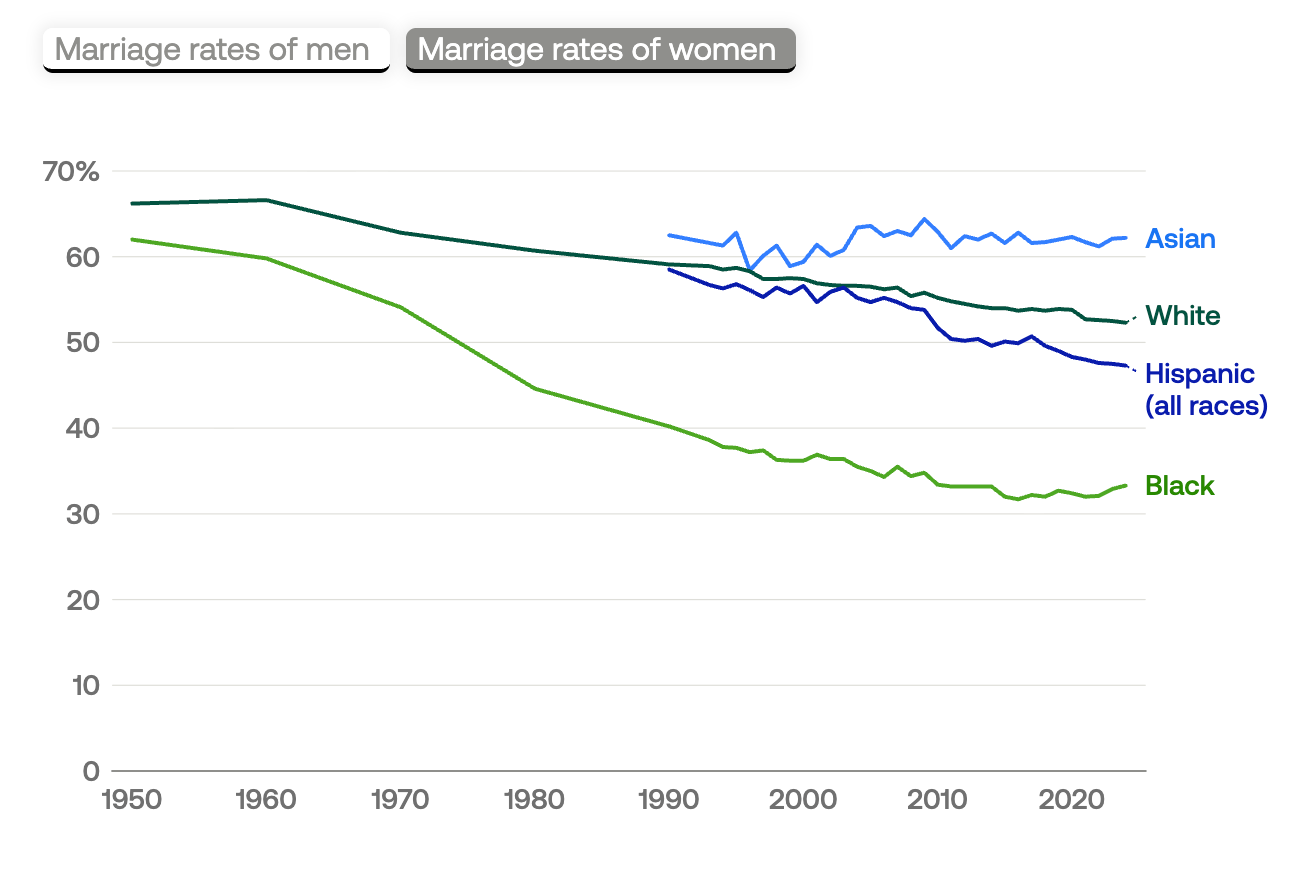
And as you can see below, marriage rates are generally dropping, but this drop hasn’t been more precipitous for white women than anyone else:
But let’s talk about age. What about all the affluent 40-year-old liberal white women frivolously filing for divorce after fifteen years of marriage, flinging their Stanley cups out of the window in fury because they heard one Taylor Swift song that made them hate their husbands? Well, hyperbolic example aside, this is also not a meaningful trend, at least not in the way it’s presented. The divorce rate is simply not driven by women like this. First of all, higher education (including when a woman is highly educated) is associate with decreased divorce risk as well as stable marriage rates. In 2016, after age 35, about 60% of women (all races combined) were married and that trend stayed consistent until age 60, when it becomes slightly more common to be widowed (albeit still less common than being married.) There is no gigantic jump in divorce either—the drop in percentage of women who are married over time is mostly due to their husbands passing away. You can check out the data (and play with it) here.
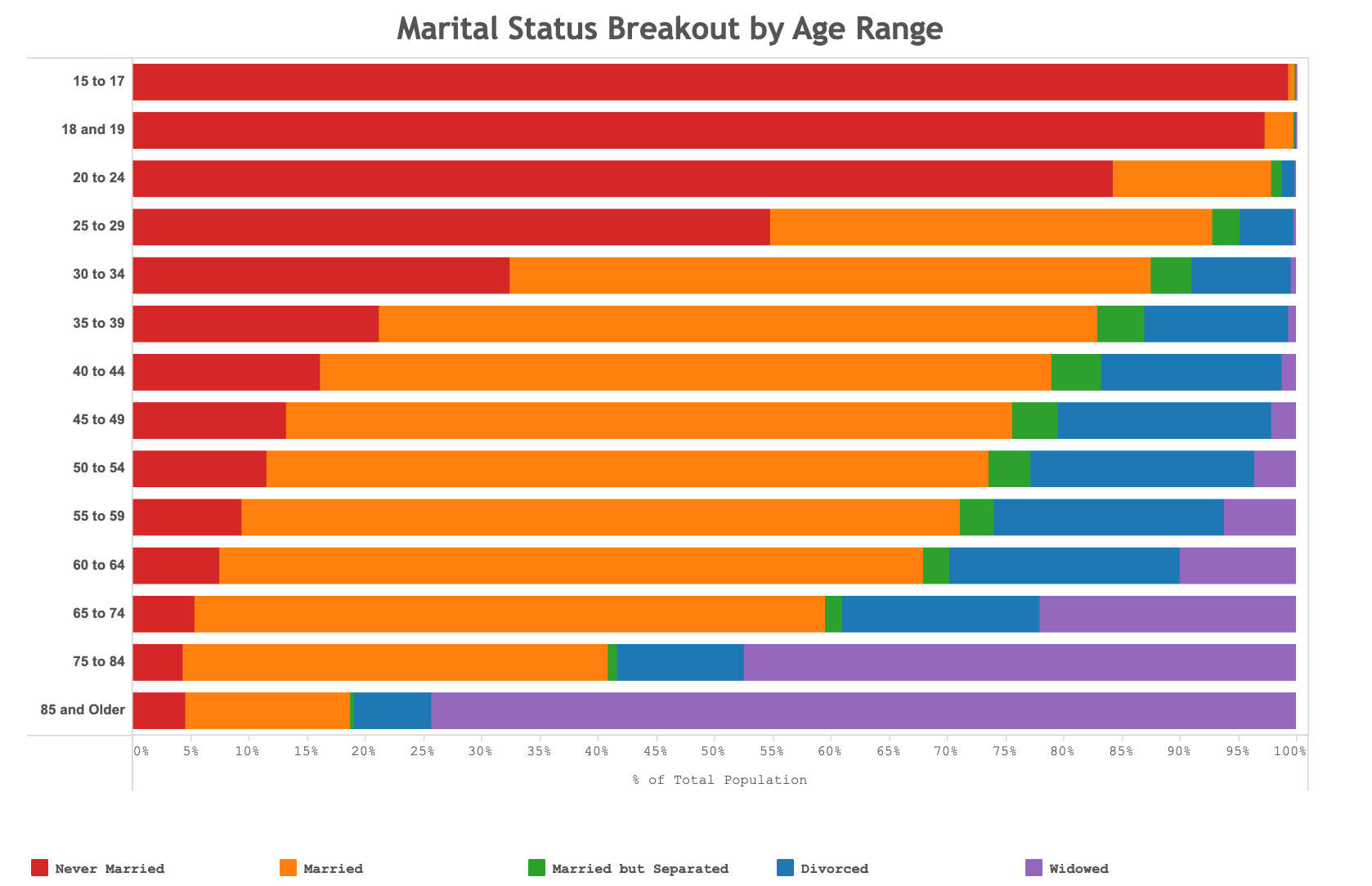
I know I mentioned this data is from 2016, but I would be shocked if in the past nine years, things changed so dramatically that a huge chunk of the never-married population was full of specifically affluent white women over 45 who watch MSNBC. Realistically, if white women over 45 take the most SSRIs, you could argue that marriage takes a toll on a woman’s mental health just as easily as you could argue that being single does. (All that said and done, I don’t think either is the cause. It’s probably perimenopause/menopause symptoms combined with better access to healthcare and more openness to seek help for depression.)
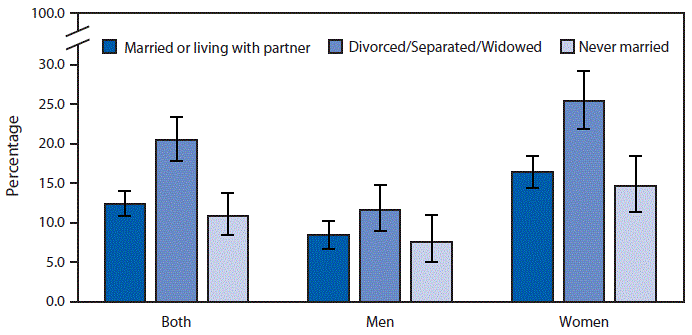
The SSRI accusation works so well (even if it’s not true) because it combines a masturbatory revenge fantasy (any woman who doesn’t date or marry me will regret it) with some somewhat true facts that loosely tie white women over a certain age to SSRI use (to say nothing of whether or not they’re married.) In fact, what do you know, according to the CDC, married people of both genders are slightly more likely to use antidepressants (mostly SSRIs) compared with never-married people of the same gender. Being divorced or widowed also increases the odds of antidepressant use, because, duh. But that trend holds true for men as well.
But none of this matters to the people who use “SSRI” as a blanket insult for women who exemplify a certain Gen Z Boss and a Mini, cringe AWFL (affluent white female liberal) bad vibe. It’s basically like a guy pulling up a chart explaining that most men who wear fedoras have no misogynistic views and just happen to enjoy 1940s film noir. It might be true, but it certainly wouldn’t do anything to dispel the meme—and honestly, making such a presentation would be exactly the kind of thing a sentient fedora would do.
Certain people (perhaps those previously maligned as neckbeards, just a speculation) just…don’t like the prototypical SSRI lady, and “SSRI” is the easy shorthand way to accuse a woman of belonging to this group and vengefully cursing her with emotional distress, whether it makes sense or not. I’ve written before about how the “cringe middle-aged white female liberal” accidentally drove young men away from the Democratic party. I covered the fact that these women are viewed as economic leeches whose fake jobs in HR and marketing are the reason that young men can’t afford a big house and a car on a single income. They are seen simultaneously as inferior and as oppressors in a sort of “reverse Tumblr SJW” paradigm. It doesn’t really matter if these women are actually on SSRIs, or the reasons that a woman might choose to go on SSRIs. What matters is that “SSRI” immediately connotes this particular type of woman. Once you’ve seen it enough, you just immediately know what it means.
I’ve (unsurprisingly) been on the receiving end of the SSRI lady accusation, despite not being on SSRIs, and technically not actually having any of the traits of the prototypical SSRI lady other than being white, over thirty, educated and liberal (okay, I suppose those traits alone are enough.) I was asked if I was on SSRIs multiple times by different people when I wrote about women who would rather stay single than compromise on their standards. It feels worth mentioning that I wasn’t even one of these women; I was neutrally writing about the phenomenon. The message was clear: I wrote something they perceived as anti-man, ergo, I must be a bitter, man-hating, SSRI spinster. I am become Lexapro with arms. Forget the fact that I’ve written so extensively about loving my husband and seeing the value in masculinity, to the point that I was harassed by the radfems of Twitter. Never mind that I’ve been with the same man since I was nineteen, and live a life that occasionally feels so hashtag-trad that I’m afraid of being mistaken for an engagement-farming man in another country. Granted, most men who get angry over a brief headline of mine do not know anything about me, but it’s easy for them to see what they believe is a particular type of woman and simply label me an SSRI lady.
To be an SSRI lady is to hate men, and not in a radical gender separatist way, but in a “hates hot guys for not dating her and ugly guys for wanting to date her” kind of way. The SSRI lady isn’t “woke,” but she’s obsessed with shallowly progressive causes like remaking Disney princesses to have cellulite. Ideally, the SSRI lady is never-married and extremely regretful about it, but sometimes she’s married and takes on more of the “longhousing MSNBC cringe mom” archetype where the guys depicting her aren’t angry at women who have rejected them, but rather, their own mommies for taking away their Roblox in 2017. (I suppose this is where I come in.)
This all felt ironic to me because (and I’m aware I’m taking this way too literally) I’m actually pretty anti-SSRI. It’s easily my most Republican-coded opinion, along with my hatred of unleashed pitbulls in family parks. I feel this way because I was put on them at around eighteen (for OCD, not depression) and I found they did nothing to improve my OCD, but successfully decimated my sex drive. I got off them as soon as I realized they were the problem. As it turns out, permanent sexual dysfunction has happened with SSRI use, so I’m glad I got off when I did (so to speak.) That said, I don’t think anyone is a bad person or deserving of ridicule for using them. But honestly? I don’t think anyone is a bad person for wearing a fedora either. Well, with some exceptions I guess.
You might also like…
Liberals were Cool. Then Your Mom Became One.

While middle class white women over thirty are hardly the most oppressed group in American society, we are uniquely burdened with one thing: making movements uncool. And we’re very good at it. As soon as a political movement, or even just a brand (remember Stanley cups?) becomes associated with us, it becomes irredeemably cringe. If something exists, we can make it lame.
Want to be a Tradwife? Go to College.

Yesterday, a brand new 1,000-follower Twitter account who describes herself as “feminism’s worst nightmare” (I am unfortunately winning the Fell For It Again Award by engaging at all, but bear with me) went viral with the assertion that it’s dumb for conservatives to encourage women to go to college, because it’s wasting their prime fertile years on a useless degree that may actually
I was also briefly put on SSRIs as a teen and they gave me extremely vivid nightmares but had no benefit.
Also, for the record, I don't think dislike of unleashed pitbulls is Republican coded - here in CT, all these dog rescue pages are full of Republican women who are more concerned about abandoned pitbulls than seemingly people..
In terms of SSRIs how many different ones did you try before you gave up? Wellbutrin as an example doesn't cause decreased libido and in fact gives it a little bump.
And just something to keep in mind, I know multiple people who got worse as they got older and they always had an excuse for why they didn't want to take anything and it dramatically reduced their quality of life and that of their family. It was especially regretful when, in a few cases, they relented and went on something and dramatically improved and there was great regret about all that could have been.
You don't want the kids to be out of the house and your husband wanting to enjoy your time together and he says, "Let's do X." "I don't know, with my OCD..." "Let's do Y." "I don't know, you know my OCD..." "Mom can you come out for a week to help with the new baby?" "I don't know...you know with my OCD..."