

Why Most Personal Essays Suck
Lena Dunham's "Famesick" is an instant bestseller. Most memoirs are...not.

This article is free! I publish 4-5x a week and most of that content is paid, so consider becoming a free or paid subscriber if you like this.
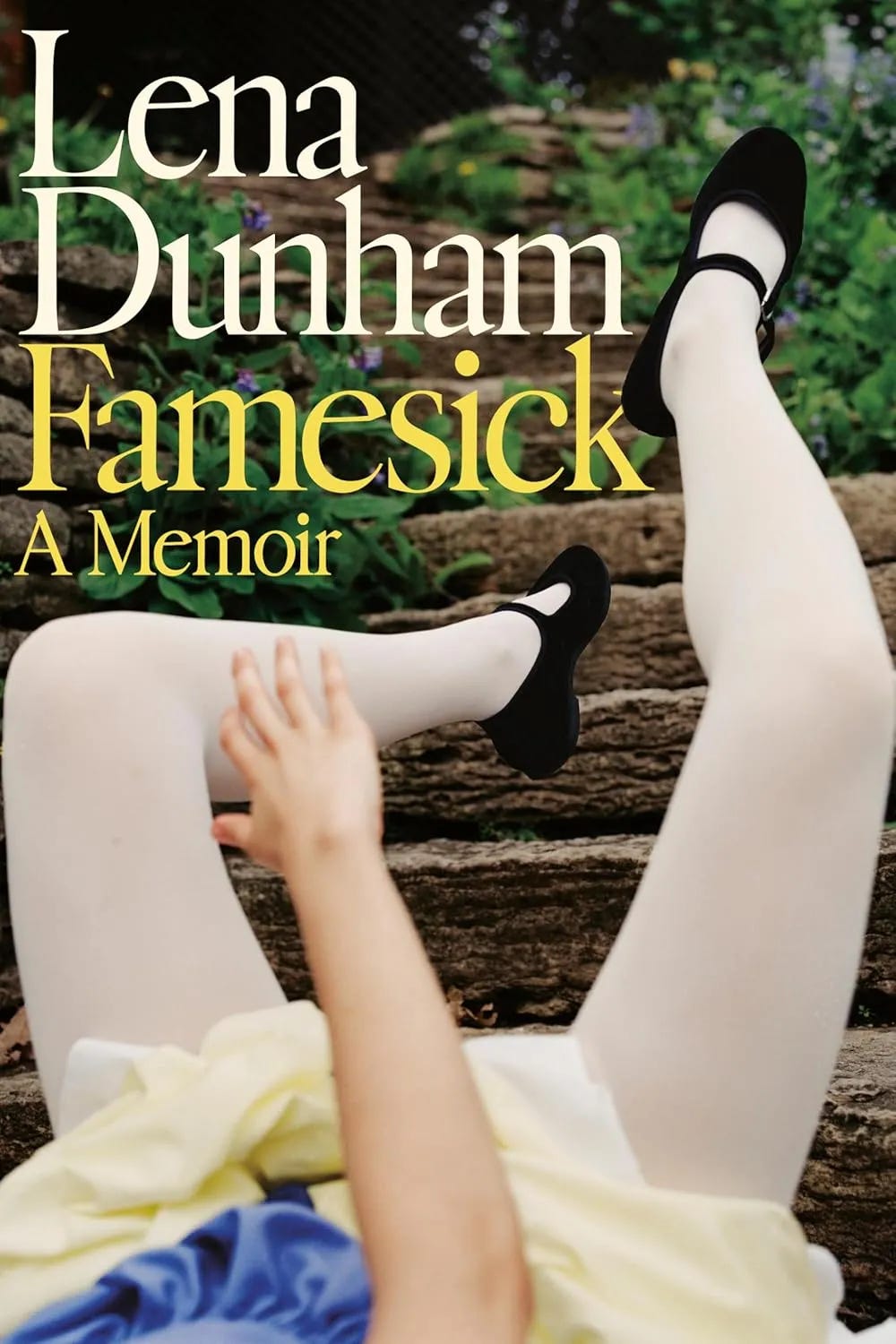
We are in the Age of Personal Essay. Whether it’s a The Cut essay about how a woman saved her marriage by having her husband move into the pool house, Lena Dunham’s new bestselling memoir Famesick (which I am reading at the moment, like every other annoying person online) or, for that matter, Lindy West’s Adult Braces (far richer in online discourse than in…well, actual riches) the personal essay, or the longer-form memoir, is hot. And while some personal essays and memoirs are amazing, many others are…very mediocre.
I suppose all forms of writing are like this. There are more mediocre amateur fantasy novels than great fantasy novels. But the personal essay is unique in that most people have the life experience to write one and the work ethic to complete one (unlike a fantasy novel, a personal essay is not typically 700 pages long and does not require the invention of a made-up kingdom with its own history and culture.) So we have a lot of amateur personal essays that are not-great. Maybe you wrote one that wasn’t great, or you’re trying to write one but you keep wondering why it’s not great. Well, I have some theories and suggestions.
Allow me to make my case for why the hell you should listen to me. While I am nowhere near as successful as Lena Dunham, I have published twenty-four personal essays on Substack, including one viral personal essay that generated more revenue than a book I got published earlier in my career. Moreover, any writer who makes a living writing is probably worth listening to. You can be a mediocre lawyer and still make a living, but you simply cannot be a mediocre writer and make even 10% of a lawyer’s salary. At the very least, a lot of people have to think you’re a good writer for you to pull that off, and a lot of people being “tricked” into enjoying your mediocre writing is basically the same thing as being a good writer.
Perhaps because I’ve always just loved talking about and thinking about myself, the personal essay was an obvious choice for me when I first started writing. (You will notice that the most successful memoir writers are usually considered “insufferable” and “self-obsessed” by most people—this is not an accident, but more on that later.) Because I also share this tendency to be narcissistic and navel-gazing, I’ve been writing personal essays since I was about fourteen. And yes, anything you write about yourself—nay, anything you write at all—will probably be a bit embarrassing at fourteen. I am still kept awake at night by reminders that at one point, I had finished a 250 page draft of a dramatic memoir about, wait for it, my summer at theater camp.
But the thing about personal essays is that while they are somewhat “easy” to write (not a lot of research needed to write about something that actually happened to you!) they are actually very easy to get wrong, for the simple reason that usually, nobody cares—yes, even if you are writing about a shocking topic.
Shocking or not, do not assume that a traumatic event or otherwise Bad Thing is a good singular justification for writing a personal essay. As horrible as it sounds, the straight facts of the worst thing that has ever happened to you are probably meaningless to anyone who doesn’t know you personally. Of course, people can still write about upsetting life events, but people overestimate just how much the Bad Thing can carry an entire story. Bad things that happen to us feel enormous, and they feel like the worst things that could ever happen to anyone. But sadly, they’re not very unique, and when you write a story about your “toxic upbringing,” for example, you simply cannot expect that the sheer horror of having a body-shaming almond mom is going to be enough to hook people. Even if something really awful happened to you, it has probably happened to many other people too—assault, eating disorders, infidelity, abuse, divorce, the list goes on. These things can feel enormous when they’re part of your life, but people see headlines about these topics (and frankly, much worse) all day.
Just an example of how shock value doesn’t necessarily translate to success: my most successful personal essay was about socially alienating people at one of my workplaces, and some runners-up included my piece about our neighbors threatening to sue us for a trivial amount of money and a piece about navigating my preschool-age son’s desire to pack his backpack full of genie lamps before school. I thought that my story about dating a guy in my teens who was obsessed with my mom would be huge because it was just such a weird thing, but it wasn’t significantly more successful than any of my other personal essays! The subject of my personal essays, it seems, is irrelevant.
The good news here is that you don’t need to justify your personal essay with a shocking thing. If nothing shocking has happened to you—or nothing you feel comfortable mentioning—that’s okay! The key is to zoom in on specific details (even if mundane) and focus more on your inner world than things happening to you—even if it makes you look bad.
David Sedaris is probably the king of this format. One of the reasons that I love the memoir format so much was that I was assigned to read a singular David Sedaris piece in tenth grade, and it had the same effect on me that cooler kids might get from listening to Nirvana or Elliott Smith. I was entranced. Yes, I was a fifteen-year-old girl dreaming of growing up to be a crotchety, neurotic gay Greek man. Most of Sedaris’ work is not about traumatic, intense or otherwise remarkable things. He derived a lot of his inspiration from his house cleaning work in New York City—hardly fascinating stuff. One of my favorite pieces he did (featured in his 2000 book, Me Talk Pretty One Day) involved a scene where he was riding a bus in Paris, and two American tourists began talking shit about him, believing him to be a French pickpocket. These types of specific moments really help to craft a good story. In Famesick, Lena Dunham writes extensively about her health issues and endometriosis. This is obviously an important part of the story, and that’s fine, but the recounting of her pain and illness aren’t nearly as interesting as her very specific description of her OB-GYN, a hilariously old-school Jewish guy who calls sex “schtupping.”
If you are a good personal essay writer, it won’t matter what you’re writing about. If your reason for not being able to write a personal essay is that “nothing interesting happens to you” then you’re either not looking closely enough, or maybe that just isn’t your genre. And if it isn’t, that’s fine. I cannot write a sex scene to save my life, and the one time I tried, I did….this.
“You don’t have to do anything you don’t want to do,” Dustin said as he took off his shirt. How could he, in all seriousness, say something like that? Especially while revealing his perfect fit-but-not-aware-of-it physique?
“Dustin…” she paused. “You know there’s no such thing as something I don’t want to do. With you, at least. I mean, there’s a lot I wouldn’t want to do with…” She tried for a moment to think of a less desirable person she could reference, who they would both know. “Kim Jong Un.”
“Right! Okay then!”
(I plead forgiveness on the basis that it was 2019 and I was under the impression that there needed to be explicitly-stated “affirmative consent” in every sex scene, and then wondered why nothing I wrote was hot. Then I got embarrassed that I was writing about sex at all, and compulsively added in increasingly ridiculous jokes, projecting my own humiliation onto the characters. All my sex scenes—literally all of them—involved one character nervously cracking unfunny jokes.)
Anyway, now that I’ve established you don’t need (and, in fact, should not) rely on an interesting thing that happened to you to write a personal essay, how exactly do you write a good one—one that makes people care?
The real drama of a personal essay is what’s going on in your mind, not what’s happening to you. Personal essays where the writer is devoid of agency are especially frustrating, because their own actions and thoughts are the most interesting thing, and all we get are “My horrible mother did this, my toxic sister did that, my evil ex-husband did this,” all while the main character is a barely-sentient rag doll just silently absorbing other people’s wickedness, often with some kind of “I went to therapy and realized all these people were evil” ending, which is still kind of the main character having something happening to them.
Everyone is a little bit narcissistic, but the best writers of the personal essay always take it to another level—not that they think they’re better than everyone, but that they think about themselves a lot, and consider the inner workings of their own minds interesting, even if deeply flawed. Before you say that’s embarrassing to admit, that’s the point. If you aren’t willing to say things like, “I’m obsessed with thinking about my own mind,” then you aren’t going to write a good personal essay.
One reason Lena Dunham is a successful memoirist—even at the cost of most people hating her—is that for better or worse, she isn’t afraid to admit things about herself, and her own thoughts, that I think a lot of people would omit on sight. This is another pitfall of the personal essay—a lot of people who read it (if it’s actually raw and revealing) will come away from it declaring that you are “annoying.” Consider it an occupational hazard.
Now, say what you will about Lena Dunham, I’m hardly co-signing everything she’s ever said or done, but the most interesting parts of Famesick aren’t the fact that she wrote and directed a successful show at a young age, even though that’s nominally what the book is “about.” The most interesting parts are weird things about her mind, like the bizarre sexual fascination she has with Adam Driver (who she hired, so it feels kind of unethical, but interesting to read, nevertheless.) Reading about the origins of her relationship with Jack Antonoff were also fascinating—not because that relationship is especially interesting or unique (and in fact, the facts of the actual courtship are pretty boring) but what he means to her as she’s falling in love with him is interesting. The way she wrote about their first date was so vivid (despite not being particularly flowery with the descriptions) that I honestly feel like I have now gone on a date with Jack Antonoff. There is a scene where she and her Girls costars are on the red carpet, but the celebrity interactions she has are actually not nearly as interesting as everything running through her head while she’s there, and what she expects people will be saying about her.
The inner workings of your mind (which, as Patrick Star of SpongeBob fame might say, are an enigma) are going to be the most interesting and compelling parts of your personal essay, full stop. Yes, even if—perhaps, especially if—they make you seem like a bad person, or if they are “cringe.” If the goal of your personal essay is to make you look good, it will not be a good personal essay.
I’m reminded of a personal essay I read last year—and no, I won’t be linking it, and no, it wasn’t on Substack—which wasn’t badly-written, per se, but was crammed full of humblebrags about the author’s own beauty. Now, such a piece could have been entertaining if the author had admitted to being addicted to this sort of attention (because by the way she felt the need to focus on it, she was clearly addicted to it) and made a joke at the expense of her own vanity, but instead, she spent the entire essay talking about how she hated how everyone thought she was so hot, although not in those words. And despite “hating” that perception, the entire essay kept describing, in detail, how hot she was. I wasn’t sure what exactly I was supposed to piece together from this. In hindsight, I think she was genuinely hoping people would read it and then tell her she was hot.
The ideal personal essay writer will be narcissistic, but self-aware. Not necessarily self-hating in an excessively sad way, but realistic about one’s own flaws. If you have delusions of grandeur, you’re actually not thinking about yourself enough, because if you truly think about yourself, and how your mind works, as much as Lena Dunham or David Sedaris does, you will be able to identify a million dysfunctional traits or tendencies that you can ham up for your essay. And no, “being too easy on people who are mean to me” doesn’t count. Being a “people pleaser” doesn’t count. You cannot write yourself to be the Mary Sue protagonist of your story. If you want your personal essay to be good and memorable, you will need to admit things to your audience that you don’t even like to admit to yourself. I remember once seeing a piece where the author said that the term “guilty pleasure” is a misnomer because people use it to describe listening to Katy Perry, while his guilty pleasure is taking joy in discovering that random people on Facebook have gotten divorced. No notes.
Lindy West (per Adult Braces) kind of goes halfway on this, and I think that’s one reason her book wasn’t as successful as Lena Dunham’s. Lindy West is a great writer, and funny to boot, but most people came away from Adult Braces feeling that she was furiously attempting to prove something to the audience that made her seem more likable, or at least, less embarrassing (ie: “I’m in a polycule that makes me really happy and all of this is great, I promise.”) She weaves in and out of that sort of raw, unfiltered self-expression (great!) while also describing things from a perspective of someone who doesn’t sound like she wants to think about what’s actually going on in her own head. Whether it was true or not, people felt that she was trying to push an agenda and make a justification without a lot of self-awareness. (See: her example of judging a seven-year-old wearing a MAGA hat. This is a fine story to include, but she should have made it clear that the joke was on her, an adult woman getting mad at a child for his parents’ politics. Most people read this snippet, among similar ones, as her genuinely feeling superior to random people she met in “flyover country.” Which…is not funny, actually!)
People really don’t like this degree of half-self-awareness, especially if you’re also being defensive or trying to push a particular agenda. And I have personal experience with this mistake, too! A few months ago, I wrote Screen-Free Parenting is Risky, where I talked about my OCD focusing on the fear of my children getting injured, and where I defended neurotic helicopter parenting as the only way someone can keep their children alive without using copious screen time to keep kids in place and safe. In hindsight, this essay should have been sent to my therapist as a great jumping-off point for our session. But instead, I published it and I lost 54 paid subscribers on that post specifically because while people enjoy reading about how neurotic I am, they felt this one was making a case for my neuroticism being “correct” and being defensive about how everyone should act like me. People had a similar reaction to when I wrote about my husband being out of my league because they felt that I was probably being a little delusional (in the sense that we were better-matched than I was letting on) and defending this delusion instead of being honest about my own bias and self-image issues. So yes, you can make yourself unlikable, annoying, whatever—but you have to be fully open and honest about it, and if you find yourself defending your position or insisting that “even if this sounds crazy, I promise it’s totally legit,” it won’t read very well.
All this to say: you don’t have to present yourself as the biggest asshole in the world, but rather, if your personal essay presents you as blameless, especially if you are also devoid of agency and constantly having things happen to you, it will not be good. If your personal essay relies on shock value or plot points instead of your own inner world, it will not be good. If you go halfway with admitting vulnerability and flaws but then get defensive about it and try to prove that actually, all your neurotic beliefs are correct, it will not be good.
And ultimately, personal essays and memoirs are subject to what I will hereby refer to as the “Lena Dunham test.” If you receive a mix of tangible success (even in a non-monetary form, such as views or approving comments) alongside a wave of people calling you any of the following: insufferable, annoying, narcissistic, mentally ill, or self-obsessed, then congratulations, you’ve written a great personal essay.
You might also like…
I Was Extorted by My Neighbors for $2000

When Nick and I first bought our home four years ago, we got a sense right away that the sellers were kind of nutso. When we decided we wanted to buy it, they had already been struggling to sell it for a while. They were a married couple in their sixties who had been living there since the ‘90s. Nick lowballed them a little, and ultimately they accepted his offer (not under duress, I should add!) We never interacted with them directly, but we had plenty of interaction with their real estate agent, a woman in her fifties who randomly burst into tears once because they were “being mean” to her. We got the sense these were people with whom we did not want to interact.
When I Went to a Bogus Conference to Look Important

What follows is another true story about my career in tech, similar to When I Worked in Big Tech and Everyone Fucking Hated Me and I Threw The Worst Networking Event of All Time.
So Apparently My Son's School Auction is NOT About Me

What follows is a true story, not that anyone should have a hard time believing it. You can also find other comedic true stories of mine here.
There's another genre of personal essay that the essayist can't consciously do (I think), but which the editors of national magazines (or the NY Times style section) are able to unerringly sniff out like some kind of hunting dog:
The reflective essay by the woman -- and it's almost always a woman, for whatever reason -- who doesn't realize she's the villain of the piece. You know the genre, "My husband was clinically depressed and the children were annoying, and so I realized that after living for everyone else all my life, it was time to do something entirely for me, so I had an affair, then told my husband I was leaving him, and since my kids are resilient, they'll be fine."
That sort of essay can be incredibly successful, but it takes a very particular combination. You need someone who's a good writer, highly literate, and lacking enough in self-awareness that she gives all the clues she's an unreliable narrator without seeing them herself. You *also* need an editor who has a very keen sense of, "This, *this* will absolutely generate hate-clicks! Let's run it!"
A subspecies of personal essay so many people *want* to think other people will read but that they won't - how backpacking in Tuscany/Bali/Costa Rica helped you discover yourself. People try to preface recipes on the Internet with these and that will usually lead to me skipping out on both the recipe and the essay.