


I have a few pet peeves when it comes to television. First—why is everyone a writer? Why the hell was Andi Anderson of How To Lose a Guy in 10 Days fame repeatedly trying to shoehorn dry political articles into a beauty and dating magazine? But today, I want to talk about something else: when TV shows (especially for children) anthropomorphize some animals, while keeping others consistently animalistic. I know, I know: who cares? The answer: me, and presumably other losers.
It makes sense to have a children’s TV show feature primarily animal characters, because kids like animals, and animals are cute. But what happens when those animals interact with other animals? Questions abound.
There are obviously several strategies to mitigate logical snafus vis-a-vis the humanoid nature of certain TV cartoon animals. One strategy is to anthropomorphize just one particular animal, while keeping the rest of the show set in the real world. A show that does this right is Curious George. Curious George has taken the angle of only somewhat-anthropomorphizing the titular main character, while keeping all other animals unambiguously animals. George also isn’t fully humanoid the way Peppa Pig or Spongebob are (more on them later, I have more thoughts on this than I do on Lindy West) but Curious George functions more like a clumsy, pre-verbal toddler than a monkey, which suits the intended audience of the show.
For example, while George doesn’t speak, he completes arts and crafts projects, engages in science experiments, and does other things that even an intelligent ape wouldn’t be able to do, on par with the skill level of a three-year-old. But George has “animal friends” like Charkie the dog and Gnocchi the cat—and those animals are clearly more animal-coded than George, which is pretty appropriate given that apes are more intelligent than dogs and cats. Gnocchi is not completing science projects, let alone going to the moon. Gnocchi is a fucking moron.
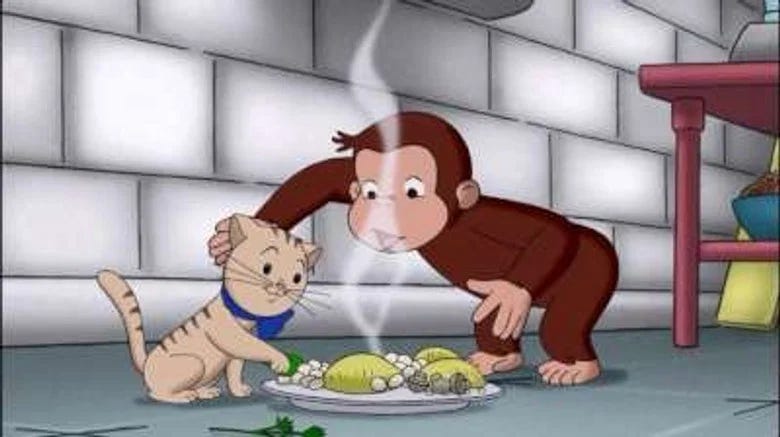
There were a few close calls, for example, like when George snuck into the zoo at night and came upon a cage full of orangutans, or when a group of tamarins told the Man With the Yellow Hat’s camera in the forest and George had to try and get it back. But this universe still works if you assume George is a particularly special monkey (not to be a pedant—although you’ll see I will be particularly pedantic for this entire article—but George’s lack of tail means he’s an ape, not a monkey).
Then, there’s the Zootopia angle—just make everyone an animal. Granted, there are some inconsistencies in Zootopia’s world. Nobody knows what the predator class eats or what the food supply situation looks like, but that can be easily handwaved away with the fact that everyone just became a vegetarian. Look, you’ve got racist snake apartheid already, so I don’t think vegan lions would be that much of a stretch. (When animals go #woke, a true story. What’s next, Judy Hopps coming out as nonbinary?) but overall, Zootopia has consistent logic.
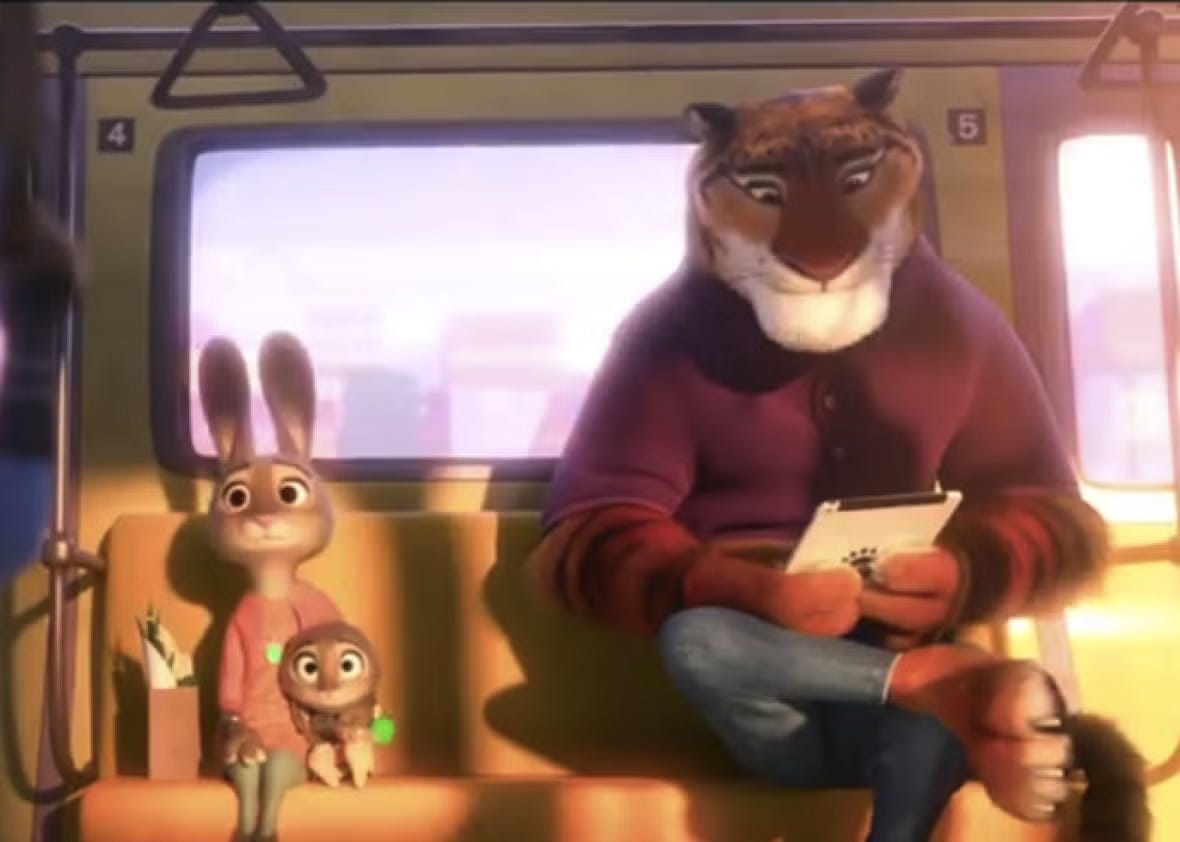
Zootopia and Curious George are also consistent about the size of the animal characters—a painfully under-discussed topic. In Curious George, animals are all the size they should be relative to humans and to each other. In Zootopia, the mice and shrews are correctly scaled to be much smaller than the polar bears and tigers. Peppa Pig, on the other hand, shits the bed in the scaling arena. Look at how a child-age elephant is the same size as a child-age rabbit:
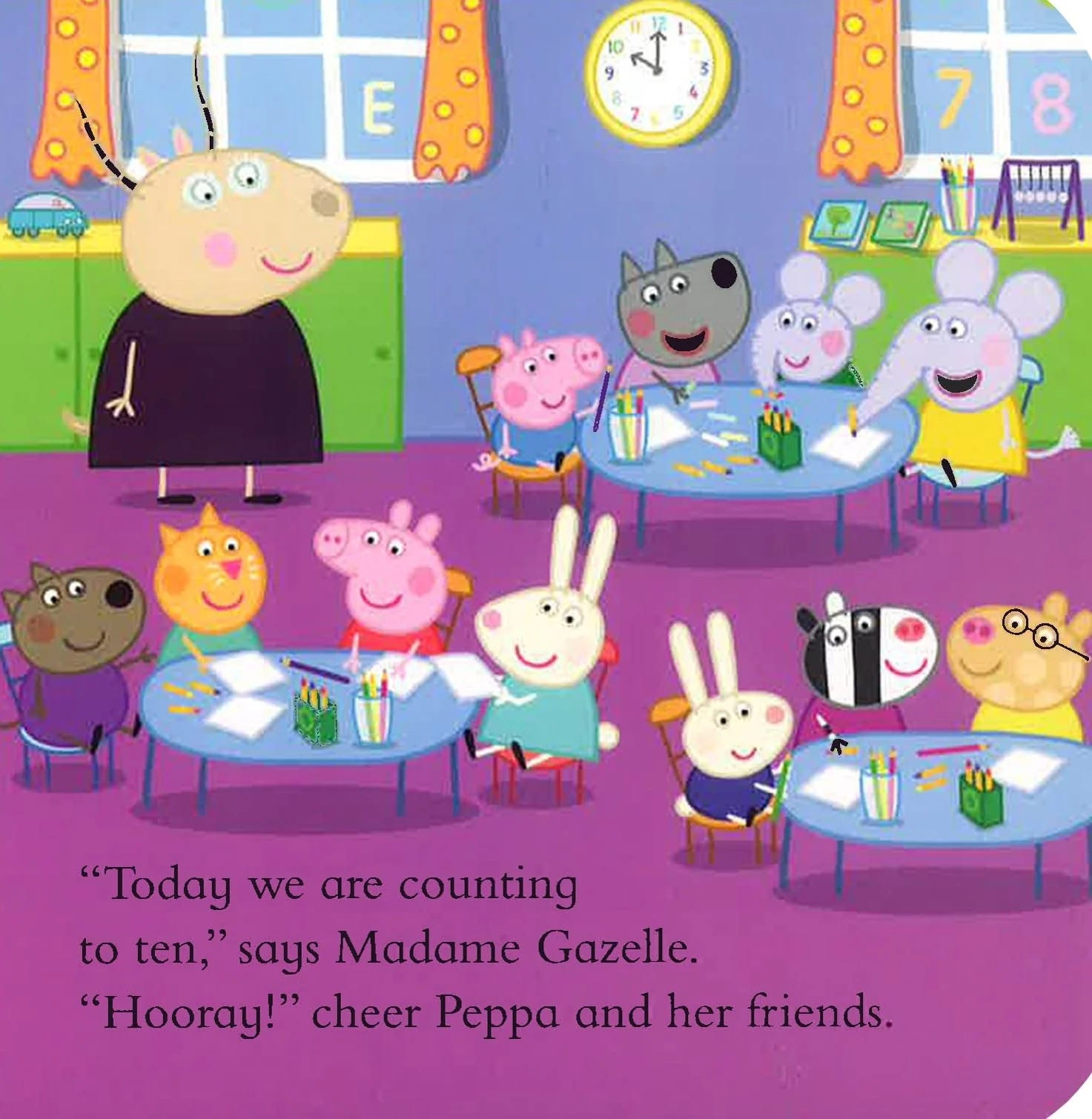
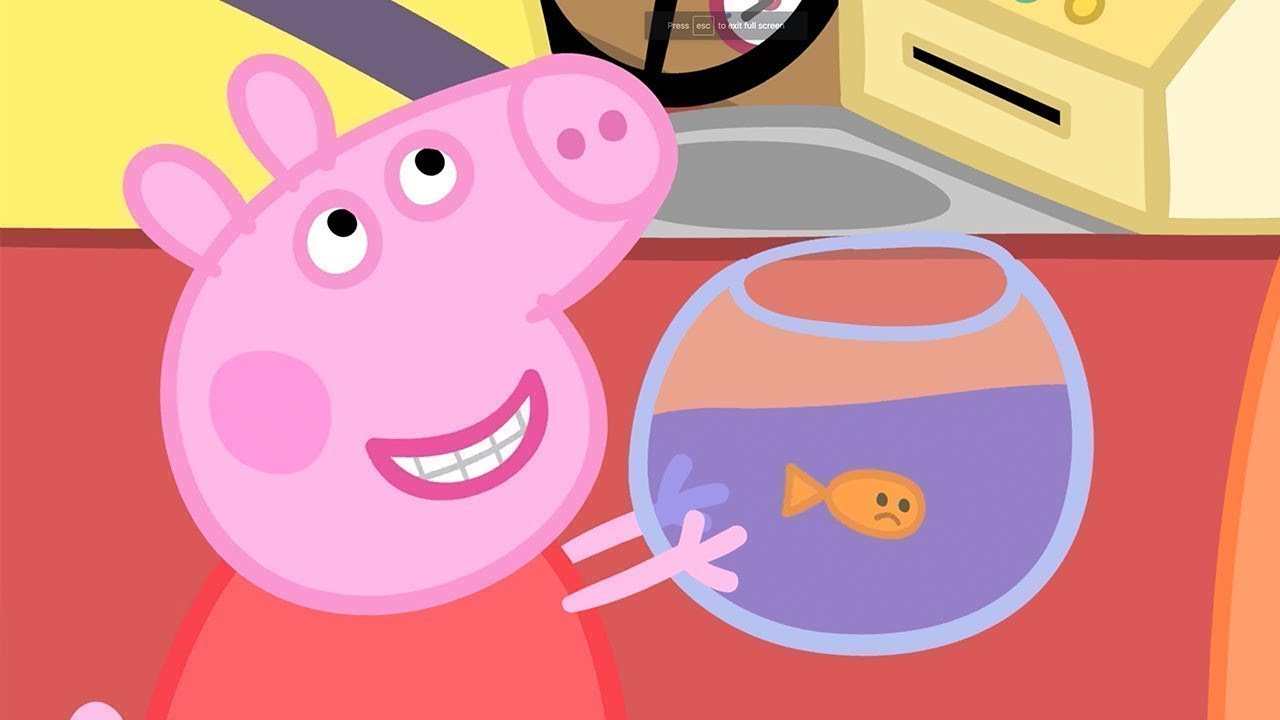
Peppa Pig also has a goldfish, who is somehow immune from the laws of logic that rule the rest of the Peppa Pig universe. Peppa’s goldfish is not only a pet who can’t talk (let alone in a British accent) but is correctly scaled, unlike all the other animals! However, this logic might make some sense—all the humanoid characters are mammals, so perhaps in this world, the “underclass” of correctly-scaled, non-speaking animals has to be limited to non-mammals. Fine. Whatever.
Peppa Pig also goes to a zoo in one episode, but the animals she sees in the zoo are all non-mammals, and correctly scaled, assuming the mammals are meant to be the size of human children. The one exception is the crocodile, who works there but was just chillin’ in the penguin exhibit under the guise of “feeding the penguins.” Sure, dude. You were obviously there for your own reasons, but okay.
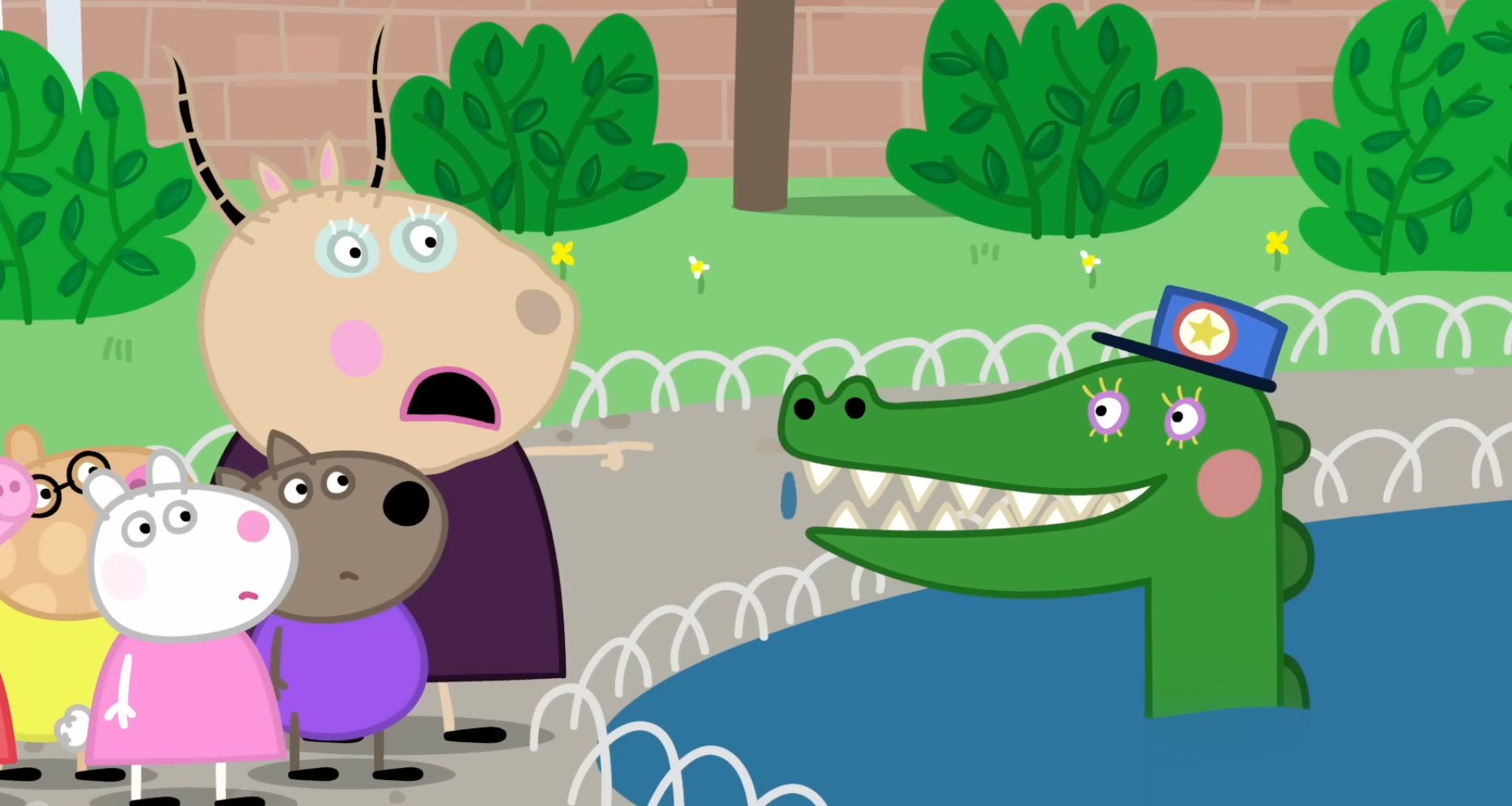
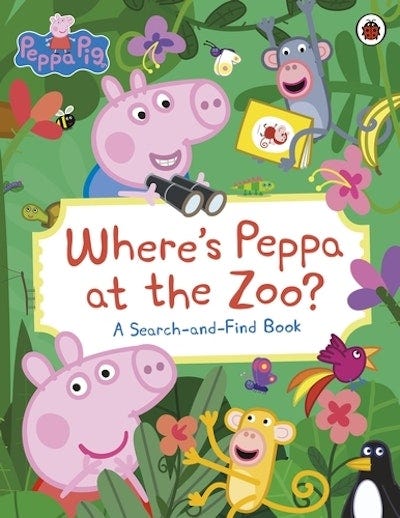
Anyway, the zoo episode makes some sense because the animals visited are more primitive (penguins, butterflies, turtles) and non-mammalian compared to the humanoid ones, with the exception of the crocodile. But the book on this topic displays Peppa visiting…monkeys?! I’m sorry, but monkeys are far more evolved and intelligent than most mammals and should be the last ones to exist in this hypothetical zoo!
Things really start to fall apart when most if not all animals are humanoid, and multiple types of “pets” exist in the cinematic universe, without any clear logic applied to which animals get to be humans and which animals have to stay animals. No show has been able to get this right because it is, frankly, a ridiculous premise.
Take Spongebob Squarepants. Now, I love Spongebob—it’s arguably the best children’s show in history—but this is basically my only gripe with it. Aside from the narrator, Patchy the Pirate and (maybe) the Flying Dutchman, there aren’t really any humans on the show, and that’s fine. Between you and me, I’m actually no fan of the Patchy episodes and I find that this breaking of the fourth wall is distasteful and annoying. Keep me in Bikini Bottom with the big Hawaiian flower sky, thank you. Anyway, Bikini Bottom is meant to be an undersea universe where sea animals are the humans, with the exception of one squirrel (Sandy, who has to wear a dome of oxygen to survive.) And Spongebob is somewhat biologically accurate, given that it was created by a marine biologist. In Spongebob, we’re not supposed to care what’s going on above the sea, so it doesn’t really matter. The point is, sea creatures are human.
But Spongebob is not consistent about which animals are animals versus humanoid. Peppa Pig got around this question by making a mammal universe where less intelligent, non-mammal creatures are pets, but Spongebob can’t do that, because most of the characters are in the “would normally be pets” category. As a result, you’d figure that pet status would be assigned based on which sea creatures are the least sentient—but it isn’t!
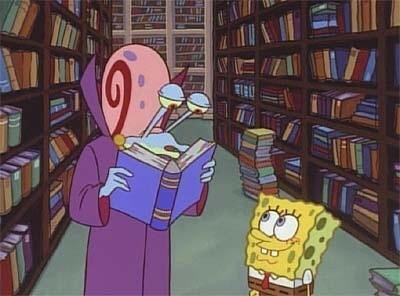
First of all, one of the least sentient sea creatures in the entire world is a sea sponge, and the main character is one. His pet? A snail—a far more evolved creature! But early episodes get around this irony by making Gary, Spongebob’s pet snail, secretly much smarter than he is:
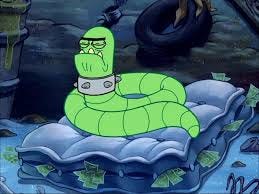
Keeping it consistent, all the other snails in the show are pets. But there are other animal-animals, such as worms, which are usually treated as aggressive canine-type animals:
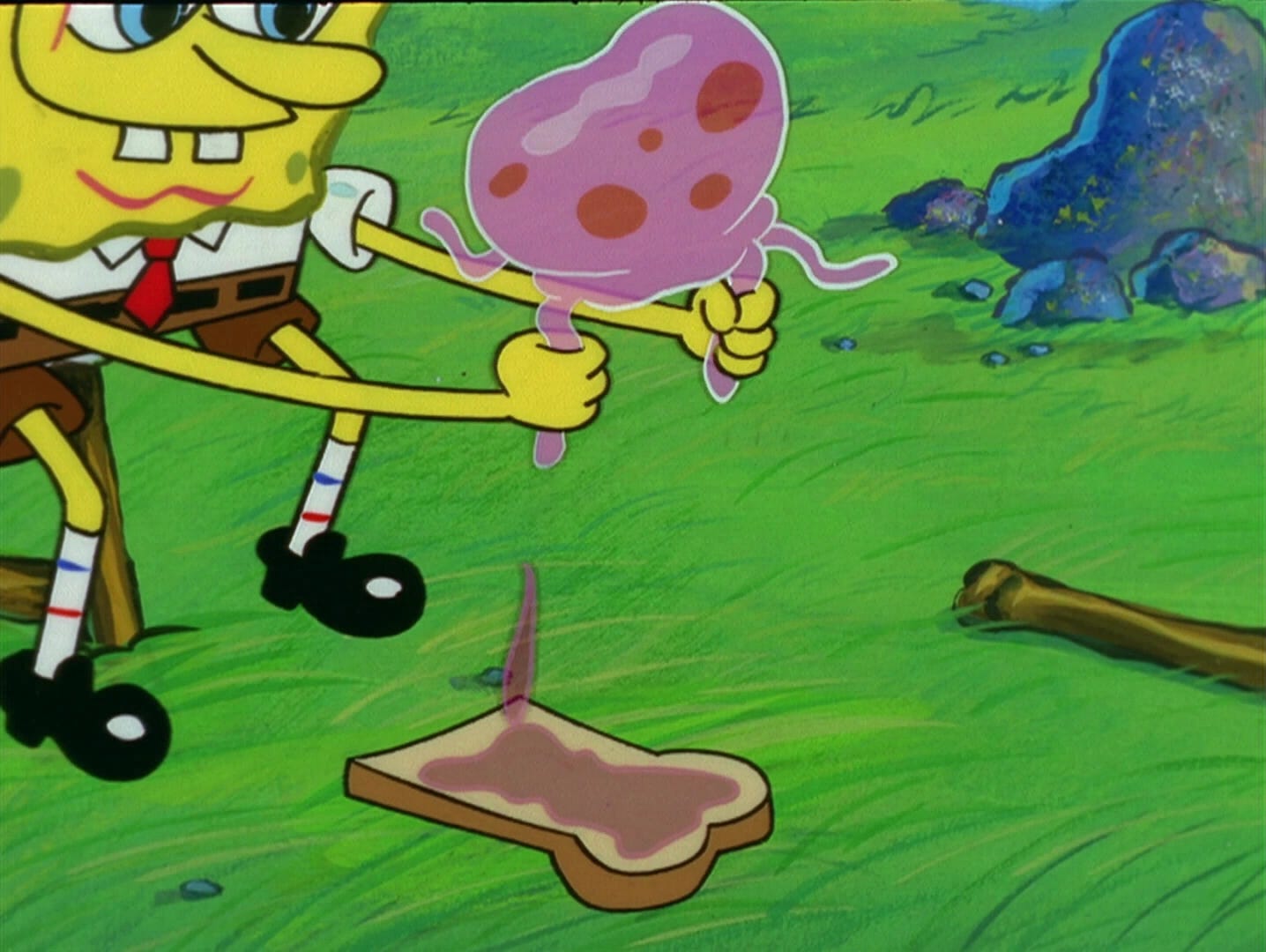
And of course, jellyfish are wild animals, who can occasionally be “milked” for jelly, but not kept as pets:
Then, there’s Mystery the Seahorse, who Spongebob kept as a pet for a brief time:
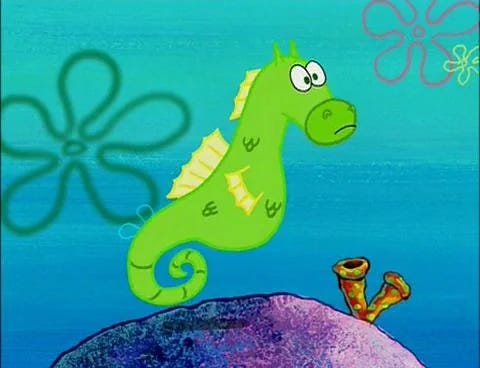
Now, all these creatures are more evolved and intelligent than the sea sponge, or for that matter, the sea cucumber. And what do you know—a sea cucumber is a humanoid celebrity in the Spongebob universe, and decidedly NOT a pet. What’s he famous for? Catching jellyfish!
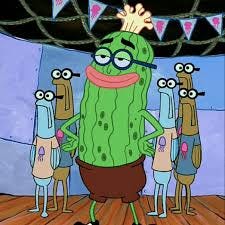
I know, kids aren’t watching Spongebob for any of this to make sense. Spongebob frequently leans into absurdity (for example, with Mr. Krabs, a crab, fathering a whale with an unknown mother.) But for some reason I’m stuck on the inconsistent rules (or should I say, lack thereof) about animal identity versus human identity.
But perhaps the most egregious example of inconsistent anthropomorphizing is from an old Nick Jr. show called Maisy, which ran for only one year (1999-2000.) The fact that I remember this—from when I saw it on the air, as a child—is a testament to how ridiculous it was.
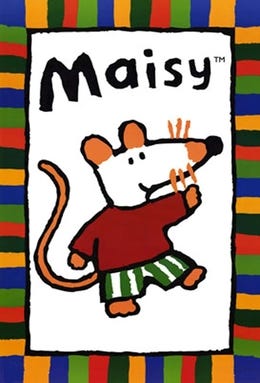
By the way, in case you were going to make fun of me for watching a preschool show as a ten-year-old, I’ll have you know I was supervising my four-year-old brother at the time. But did I secretly kind of want to watch his baby shows? Of course I did. Did I sometimes pretend Steve of Blue’s Clues was actually talking to me because I didn’t have any friends? No comment.
Anyway, Maisy was a bit Peppa Pig adjacent in its simplistic animation and animals-as-humans universe. But it basically committed all of the logical sins outlined in this article. First of all, Maisy had inconsistent scaling of animals, although not identical scaling like in Peppa Pig, which makes the inconsistency seem less intentional. Like, okay, let’s make the crocodile and elephant bigger than the mouse, but barely? Sure.
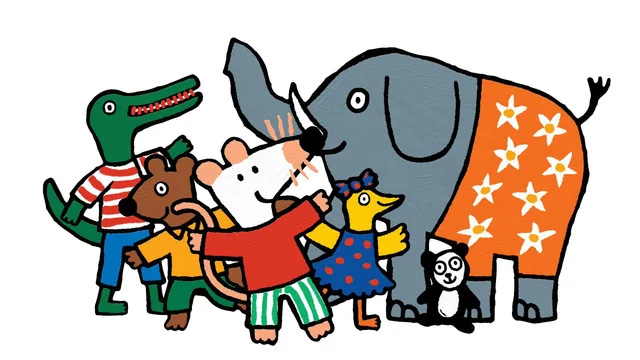
Also, note that all the animals are walking on two legs, except for the elephant. Why? Nobody knows! And despite the fact that the elephant can’t walk on two legs, he can ride a bike.
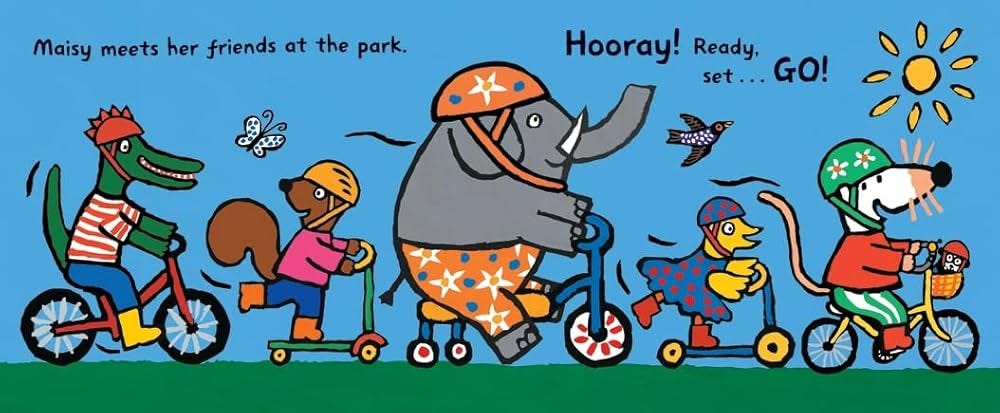
Maisy also fucked itself by making all types of animals humanoid—reptile, bird, mammal, whatever. This meant that they had no underclass of animals left over to make pets. As a result, it’s just a complete clusterfuck. Despite Maisy being a mouse, and friends with a childlike duck who is the same size as she is, she has a pet-human relationship with a rabbit who is smaller than she is.
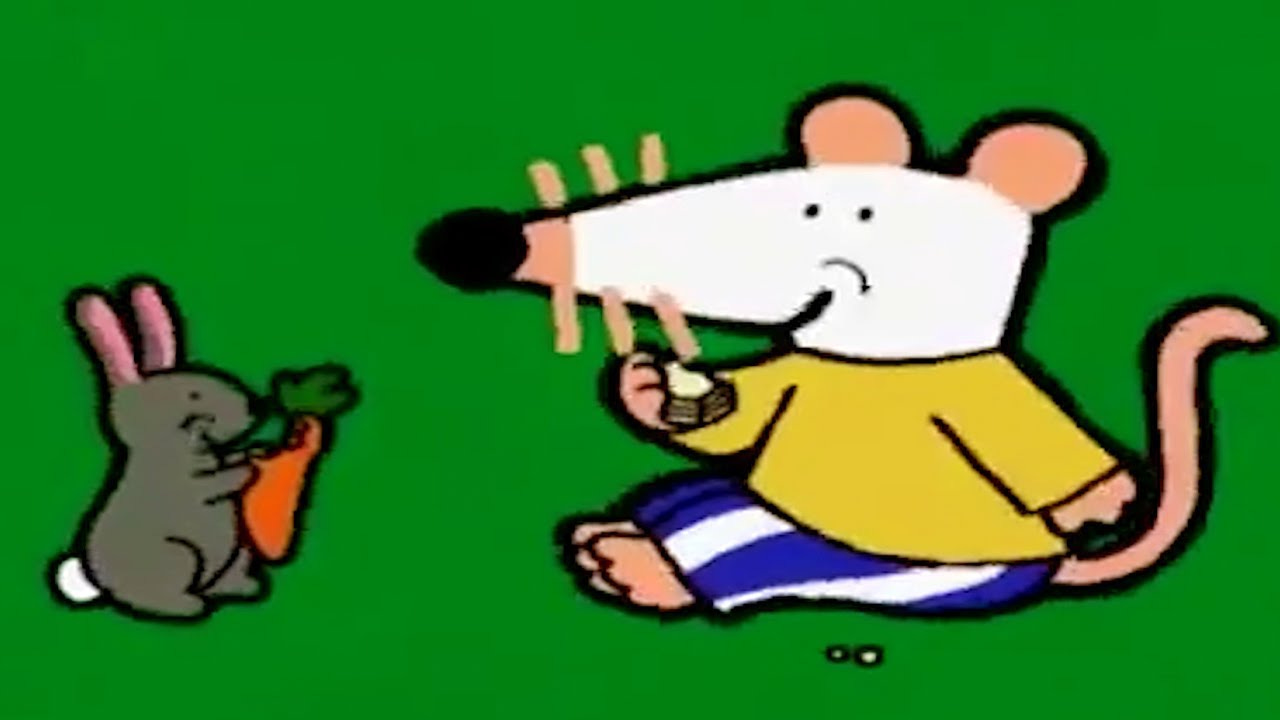
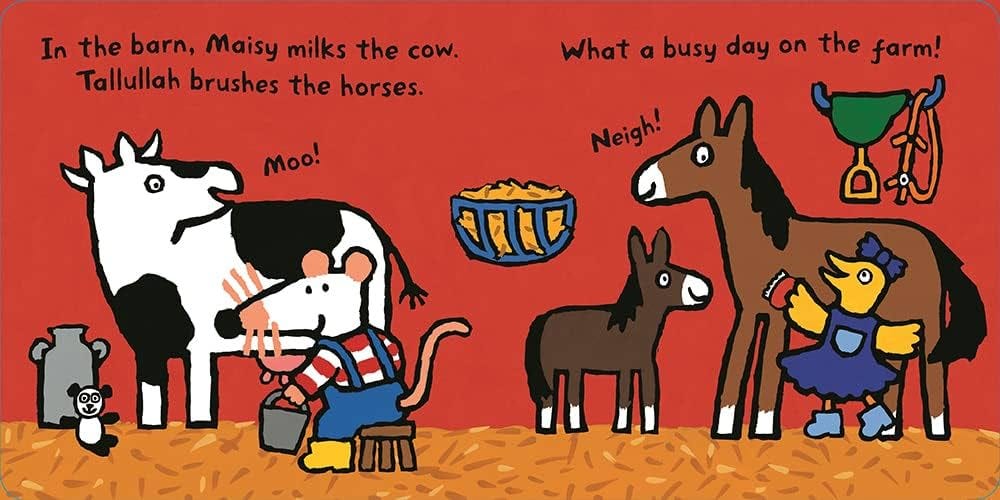
But the worst example of all—the scene that has been seared in my mind for more than twenty years—is the fact that she and her duck friend go to a farm and milk a cow and ride a horse! Who, might I add, are also inconsistently scaled! That cow is supposed to be far bigger than twice the size of a mouse.
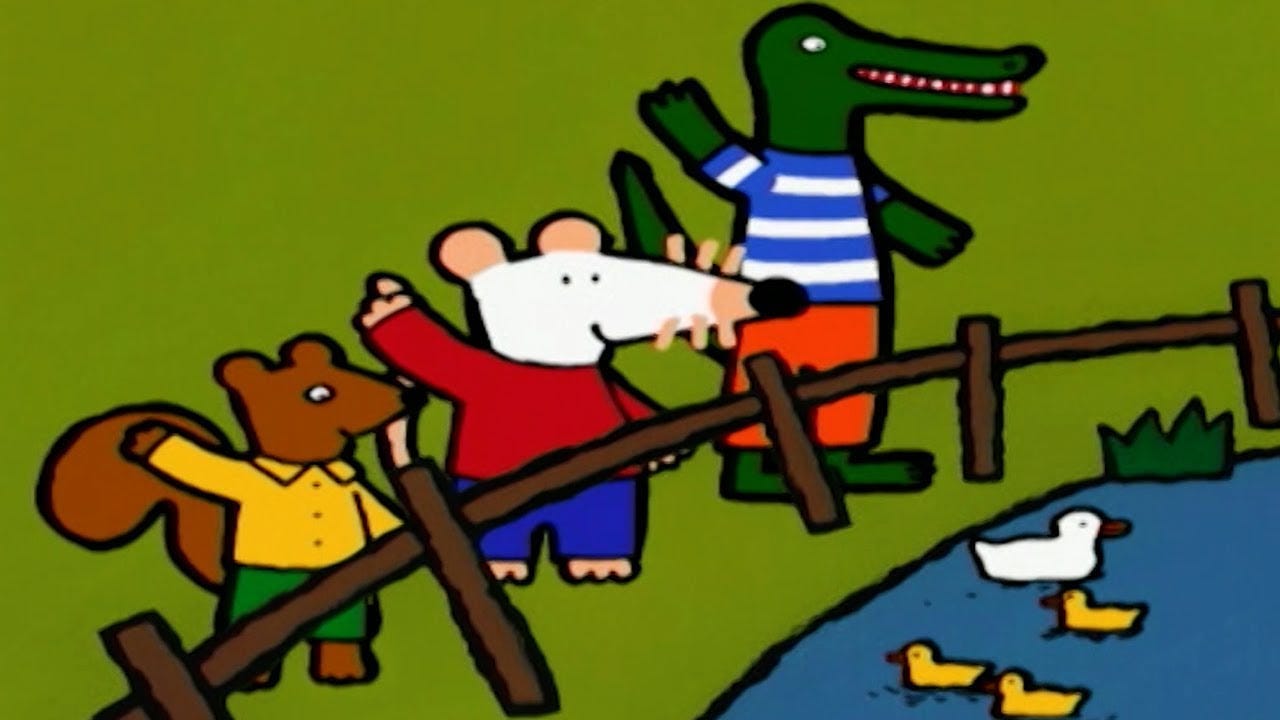
Now, for the best part—despite Maisy’s best friend being a duck, there’s another episode where Maisy “visits ducks” who are like, actual ducks. Of course, out of an abundance of caution for the traumatic impact of seeing one’s brethren shrunken down and reduced to quacking cretins, her duck friend was absent from this episode:
I’m not sure if kids really care about this. To test this theory, I asked my Youth Correspondent (aka, my five-year-old son) whether he was bothered by the fact that Spongebob featured inconsistently-anthropomorphized animals. He said, “I don’t care.” Perhaps I should take the hint, but for now, I will continue to stew over Maisy’s insane duck episode from twenty-seven years ago.
You might also like…
The Beauty of Average-Looking Actors

Of all the article topics people request, I never once suspected that the beauty differential between US-based and UK-based media would ever pop up, but alas, multiple subscribers have asked me to write about this. The request came after I briefly covered
I Don't Care If Adults Like Toys. I Care If They're Too Scared to Make a Phone Call.

Adults who like childish things are easy to hate. Bill Maher made fun of young people who groan about “adulting” so much that he earned a comedy special all about it. The “this generation is so childish and selfish” accusation was lobbed at millennials, and just in time for us to become cringe chopped uncs, Gen Z is getting it. And if you want to get a
Even more baffling, sometimes the two animal character types are mixed within one fictional world. Take Disney: Goofy is a doglike humanoid character. Pluto, in the same world, is a non-verbal pet dog.
Oh this is my favorite topic ever. I talk about this often, one of the reasons being that I gave up on writing an "animal-people" story as a child just because of these struggles.
I don't know if anyone's mentioned it in the comments but the biggest perpetrator of this nonsense is Maurice Sendak's Little Bear series (books and cartoon). Little Bear is naked but his parents (Mother and Father Bear) are fully clothed and have jobs. HOWEVER Little Bear's friends are all ADULT animals who are nevertheless naked, like himself, a baby bear. None of them have jobs besides being cats or ducks or owls. And there is one human child character included in his friends. Then there is a pet robin featured in an episode, but despite being a bird, does not speak or have sentience in the way friend Owl or Duck have. There is no consistency whatsoever. It's mind-boggling.