

People Are Still Privilege-Checking
They just don't call it privilege anymore--now, they call it "out of touch."


One of the now-whimsical vestiges of the 2010s was the idea of “checking your privilege,” the required atonement required of anyone higher up on the oppression ladder before speaking. Technically, it meant that you should consider all the unfair advantages you have which might have colored your lived experience, before “talking over” more marginalized voices. But really, it meant that you needed to shut the fuck up.
At this point, it’s hard to imagine anyone saying “you need to check your privilege” unironically, much the same way I can’t remember the last time I heard anyone on the Right earnestly talk about “owning the libs.” But people still demand that privilege be checked, they just don’t call it “privilege.” This behavior isn’t even a woke thing anymore, nor is it exclusive to the Left. Instead, people from all across the political spectrum have taken to accusing anyone—including both people widely known to be rich and famous, or people who are totally middle class—of being “out of touch” as the new way to demand privilege be checked.
I really enjoy the show Curb Your Enthusiasm, mostly because it’s very funny, but also because Larry David is unashamed to play himself, and the “real” Larry David has a net worth somewhere in the hundreds of millions. Larry David doesn’t hide this on his show. He doesn’t pretend to be a middle class version of himself. He’s frequently flying on a private jet, enjoying ultra-exclusive intimate concerts with famous musicians, and lives in a sprawling mansion in Los Angeles. Even if this Substack becomes very successful, I will never have as much money as Larry David, and I’m fine with that. I still like watching the show. Larry David being far wealthier than I am doesn’t impact how much I like it.
For some reason (perhaps just the era when the show as made) people tolerated this from Larry David. Nobody complained that the entire show was “out of touch” because it was about an extremely wealthy person. Nobody accused Larry David of not being “relatable” because half of the episodes took place at a country club or exclusive Beverly Hills restaurant. Nobody watched Curb Your Enthusiasm and said, “Uhh…does Larry David realize the median American could never afford to have Alanis Morisette perform a private concert in their living room??”

But something has changed. Increasingly, people seem to demand “relatability” from everyone, insisting that the “median American” be considered with every generalization, recommendation or anecdote (and conveniently, everyone who says this claims to be the median American.) This trend exists is in part because celebrities are no longer the diamond-encrusted, borderline-imaginary people you saw only on magazines. We used to only get glimpses of celebrities’ private lives by watching shows like Celebrity Cribs, and we could enjoy gawking at Missy Elliott’s crystal chandelier or Freddie Prinze Jr.’s vibrating water bed. Today, celebrities and regular people are uncomfortably enmeshed. You can follow your favorite celebrity on social media just as easy as you can follow your work friend, and on some level, you demand the celebrity behave like a normal person. And now we have a bunch of microcelebrities, influencers and other not-obviously-insanely-wealthy public figures, who get rich and famous in part because of their initial “relatability.”
You see this all the time with influencers like Nara Smith. I wrote about Nara Smith here, but she’s a wildly successful model and influencer (married to another successful model) who has attracted the label of “trad” because she is Mormon, had kids young, and trolls everyone by making increasingly ridiculous, onerous versions of processed food using natural ingredients at home, often wearing dazzling evening wear. It’s important to note that Nara Smith doesn’t consider herself trad, and has admitted to traveling for work for multiple weeks without her children, leaving them with her husband. She has talked about the 50/50 childcare and housework arrangement with said husband too, which is more “modern” than most liberal working feminists say for their own marriages.
But the ire at Nara Smith—when it’s not about the whole “trad” thing—is about the fact that she’s failed to be “relatable,” even though Nara Smith never pretended to be an everyday person. When she makes goldfish crackers from scratch, she never once says, “And this is something every working mom can do in five minutes.” She appears to be doing these videos partly as a joke, maybe because they drive engagement, but not because she believes everyone can make homemade Pop Tarts before the school bus arrives. And yet, time after time, people criticize Nara Smith for “unrealistic representations” of motherhood. Yes, Nara Smith is rich and famous, creating professional content as part of her job—why are you expecting that her representations be realistic?
This happens to microcelebrities like Nara Smith, but I see it happen with regular people too, who aren’t even posting anything aspirational or unrealistic. Take, for example, a Twitter interaction that’s seared in my brain because of how insane it was. Someone complained it was impossible to find affordable, high-quality sweaters made of natural fibers (It’s beside the point, but I would venture this person also believes textile workers should be paid a living wage, but I digress.) Someone else told them you can find like-new condition 100% cotton and wool sweaters on eBay, and displayed a screenshot of the aforementioned sweaters. This person was ripped apart for being “out of touch” because most of the sweaters were around…Dr. Evil voice….

Forty dollars.
Look, obviously some people can’t afford to spend $40 on a sweater, but that’s hardly an absurd amount to suggest one spend on a sweater. It certainly doesn’t make you “out of touch” to suggest that a high-quality sweater can be bought second hand for $40. Another Twitter thread displayed a similar dynamic: a person posted their friends hanging out in a modest apartment living room, and was immediately bombarded with accusations of being “rich” and “living off Daddy’s money.” She later confirmed she doesn’t have rich parents and makes $24,000 annually (and the apartment wasn’t big or luxurious) but I’ll go a step further: she did not need to say that! Even if she was rich, should she be banned from sharing a picture of a few friends hanging out on a sofa? She never once said, “This is my living room, and everyone who sees this image could afford a living room exactly like this.” She wasn’t operating a Twitter account called FrugalLivingTips, speaking explicitly to a cost-cutting audience. Clearly, the “out of touch” accusation was stupid, but even if she had posted a lavish dining room of a home she owned instead of a modest rented living space…who cares? Must something be affordable and attainable to 100% of people to be worth seeing? And if you see something you find unattainable, could you not just…ignore it?
Of course, nobody likes a braggart. But we are now at the point where you can be accused of “bragging” for admitting to spending $40 on a sweater. So who’s to say.
A while ago, I came up against this criticism myself. I would handily admit to being relatively privileged (consider the privilege checked!) but would not put myself in the “rich and famous” category. In this instance, I wasn’t even writing about myself. I had written about how the mommy wars are class wars, and I had devoted a paragraph to describing all the reasons a woman might continue to work even if her household could technically get by on only one income, other than the strawman of “wanting to buy designer handbags.” And I quote:
Parents who eschew staying home with their infants aren’t prioritizing “designer handbags.” In many cases, they’re prioritizing having a heated home with a full fridge, and a safety net in case someone breaks their arm at the trampoline park. But also, sometimes they just want to have a combined income of $250K instead of $150K—they want a house with a room for every child, they want to go on family vacations, and they want to at least partially pay for college. It’s just impossible to generalize.
Now, clearly here I was giving a bunch of disparate examples, from working class parents who simply want a full fridge of food, to upper class parents who want to pay for full college tuitions. People got really angry about this for several reasons, mostly because they were unable to grasp the concept of “I’m referring to multiple different families here, none of which are identical to yours.” Some people were mad that I lumped in “essentials” like college tuition with “frivolities” like paying for family vacations, even though it’s just a straight-up fact that some families pay for college, some families enjoy going on vacation, and often, these families overlap. I refuse to believe that the only families who go on vacations do so only after having set aside full college tuitions for their children. But anyway, perhaps the most glaring “error” I had made was that I had spoken the absurd household income of $250K into existence. People quote-tweeted my article without comment other than “combined income of $250K” as if that scenario was so absurd it shouldn’t even have been mentioned at all. My utterance of “$250K combined income,” apparently indicated I believed most people—nay, all people—made this much money.
I stupidly engaged with one of these comments and asked them if they understood that I was describing a variety of families, some of whom actually do have a combined income of $250K. They said, and I quote, “The median American household income is $83K.” In their minds, any description of any family making more than the median household income was out of touch, even though “median” implies that half the country is making more than that, and if you were going to describe a variety of families, it might make sense to include an example of a family that was well-off in addition to families that were just trying to keep the lights on.
Other people thought it was ludicrous that anyone would continue to work instead of staying home full-time for the “trivial” increase from $150K to $250K, even though this is a real-life thing that happens for lots of working parents, for all the aforementioned reasons (college tuition! financial safety net! housing costs! whatever!) Go ahead and find a man who makes $150K annually, whose wife makes $100K annually (for a man of that income bracket, this is a relatively common scenario.) Then ask the couple if the wife’s salary makes any meaningful difference in their financial security and lifestyle. Frankly, it’s “out of touch” to assume there’s no meaningful difference between $150K and $250K, or to assume that anyone who makes more money than required for groceries and utilities is just buying “luxury handbags.”
There are three major themes at play here:
As I said earlier, influencers and celebrities are increasingly the same thing, and people now expect celebrities who are obviously very rich to nevertheless be “relatable,” thinking that they’ve pulled some amazing Gotcha because Ballerina Farm has a $30,000 stove.
By virtue of more successful content reaching more people, a lot of the content you see online will be from people who are making a lot of money posting it (provided you follow influencers, which I understand is a big “if,” but they will still show up on your feed even if you don’t follow them). The algorithm will reward beautiful photos of an aspirational life over shitty photos of a relatable life. Unless you deliberately avoid it, you will be bombarded with lots of images of luxury. This doesn’t mean the people posting it are “out of touch” unless they’re presenting these images as relatable, everyday things that everyone can have. Just because you can’t relate doesn’t mean nobody can, and perhaps being able to relate isn’t the point.
I will say that there are some exceptions here, for influencers who make a living by propagating anti-capitalist ideals. If your whole thing is that nobody should be a millionaire and we should eat the rich and behead the bourgeoisie at the guillotines, it does look out of touch for you to post from your Los Angeles mansion. Easy fix: don’t be a hardline Maoist if you aren’t willing to live like one.
People who post things online, whether super famous or mildly famous, are posting not for every person in the world equally, or for the “median American,” but for their audience. If they are really business-savvy, they’ve likely identified exactly who that audience is. Take Gwyneth Paltrow, for example. She is not a “relatable everywoman.” Ergo, she is not “out of touch” when she posts a $4,000 handbag as part of her 2025 gift guide because the people who follow Gwyneth Paltrow are either people who buy $4,000 handbags, aspire to one day buy $4,000 handbags, or enjoy looking at such luxuries as part of a guilty pleasure. Gwyneth Paltrow never said “Your median American should be buying a $4,000 handbag for Christmas.” If she did, that would be out of touch! But trust me, Gwyneth Paltrow knows she’s rich. She also knows that most of the people who follow her are doing so because they like looking at silly rich lady shit.
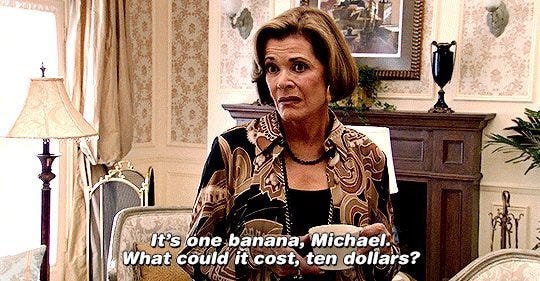
When you read content on social media (or anywhere) you are reading content intended for a particular audience. Vogue is not “out of touch” for exclusively featuring high-end fashion, because the people who read Vogue are either people who can afford high-end items, or who enjoy looking at high-end items. Similarly, Martha Stewart is not “out of touch” for posting tutorials on how to roast chestnuts at home because “most people work two jobs and don’t have the time or energy to roast chestnuts.” Even this Substack has a “core audience.” When people accuse me of only writing about upper middle class left of center urbanites, that’s because upper middle class left of center urbanites make up a large portion of the people consuming my content (I’ve run plenty of surveys to confirm this.) Of course, that doesn’t mean they are 100% of my audience, but when I think about the references I make and the examples I give, I remember that most people reading this are college-educated and don’t live in a rural area. It would be weirder for me to attempt to write about the “median American,” when the median American likely doesn’t go on Substack at all. That’s not to say I don’t want anyone else reading my work—of course I do—but my work obviously covers a group of people with whom I’m most familiar and experienced.
The problem occurs, I think, when people do not adhere to the Gwyneth Paltrow/Larry David school of wealth-flaunting where they basically weed out all the people who would ever hold onto any shred of hope that they would be “relatable.” Most people, even wealthy people, don’t want to display the fact that they’re hawking a 1.7 ox tub of face scrub for $125. But you don’t have to be that wealthy to be accused of being out of touch. All you have to be is slightly wealthier (or perceived to be slightly wealthier) than whatever aggrieved person happens to come across your content on social media. It doesn’t even have to be about money, although it often is. The aforementioned infamous woman who posted her “unattainable” apartment (“how does she afford so many plants if she isn’t loaded?”) was also lambasted for flagrantly displaying that she has at least three friends (“not everyone has friends!!!”)
Taylor Swift, openly a billionaire, got a lot of shit for wearing $90,000 of fine jewelry recently, and I can’t help but feel like she was piled on for this partially because people like to pretend she’s their relatable best friend and not an extremely wealthy businesswoman. Is it “relatable” that Taylor Swift has $90,000 in fine jewelry? Obviously not. Did Taylor Swift tell everyone, “The best way for the median American to celebrate the holidays with a new beau is to go out and buy $90,000 of fine jewelry?” No.
Some of it, obviously, is jealousy. We are told that “the Internet isn’t reality” and then feel emboldened to screech at anyone online who appears even remotely aspirational because it’s “not realistic.” But really, things just make people jealous. I’m not immune to Internet jealousy myself. Personally, I always feel a bit triggered by people who brag about their fertility, because purely by a stroke of bad luck, I had to do IVF to have my children and I want more kids than I’ll probably have. However, I’ve acknowledged this is a “me” problem, and that unless someone is deliberately trying to be an asshole, nobody owes me humility. And I certainly wouldn’t want anyone to pander to the “infertility community” despite not actually being infertile themselves. I think it’s probably good to have some degree of decorum when talking about your pregnancies given that 15% of the population is infertile (like, maybe don’t joke about how you didn’t actually want any of your kids or how you wish it took longer to conceive them) but that doesn’t mean hiding them or pretending you had to seek IVF when you didn’t. It would be odd for someone to announce a pregnancy by first acknowledging that many people can’t get pregnant.
So what is out of touch, if flagrant displays of luxury, privilege and dumb luck are? I actually have an answer: it is not “out of touch” unless it implies that particular luxury is accessible for most people, and very few people are doing that. Obviously, some are. Lately I’ve gotten fixated on Facebook Reels momfluencers who shamelessly hawk useless holiday decor, usually saying something like “easy holiday hack!” and then the “easy holiday hack” involves hours of work and hundreds of dollars. This is out of touch, because they’re claiming the hack is easy. But what’s not out of touch is simply posting the hack in the first place, without any comment about how “anyone can do it.”
Another example: if I say it’s hard to fly with my kids, and someone says, “Oh, just fly first class!” that’s out of touch because I (and almost everyone else) can’t reasonably afford to frequently fly first class with their entire families. But if an influencer who can afford such a luxury posts about how fun it was to fly first class to Japan with her three kids, parents and husband, that’s actually not out of touch—it’s just privileged! If you have a problem with someone simply being privileged at all without atoning for it or apologizing, you are asking people to “check their privilege,” albeit by a different name.
So let’s all allow the Larry Davids and the Gwyneth Paltrows (or for that matter, the Nara Smiths) to exist, be aspirational, and entertain us not in spite of being “out of touch” but because of it. And if you don’t like it, well, you can just not pay attention to them. Financially, I think they’ll survive.
You might also like…
The Gender Wars are Class Wars

If you spent time around on Twitter, or even other social media sites, you’ve probably come face to face with the Gender Wars, which I’ll abbreviate as GW. It’s not quite as simple as “men versus women,” because you’ll find all sorts of wacky contingents fighting together on behalf of their gender. Radfems and normie women might team up with trad Christian women to fight a pickup artist, a red pill man, and an incel (no, red pillers and incels aren’t necessarily the same thing and I hate that I know this.) You’ll also find anti-feminist women like Pearl Davis fighting on behalf of men, while happily married men or male feminists might join the women’s fight.
When I Worked in Big Tech and Everyone Fucking Hated Me

What follows is a true story, but a few identifying details have been changed (especially the company name—so don’t bother Googling it, it’s not real.)
It’s actually exhausting. It brings me back to the tweet about the lady who posted about loving morning coffee conversations with her husband in her backyard and she got ripped to shreds for it. I think so many people go to social media just to rage bait themselves. Idk I guess they run on bitterness lol
Sometimes CHH posts read like a soldier’s journal entries. “Today we battled against the Privilege Checkers, a most annoying foe. Tomorrow I fear we’ll face off against the tradwives again…”