


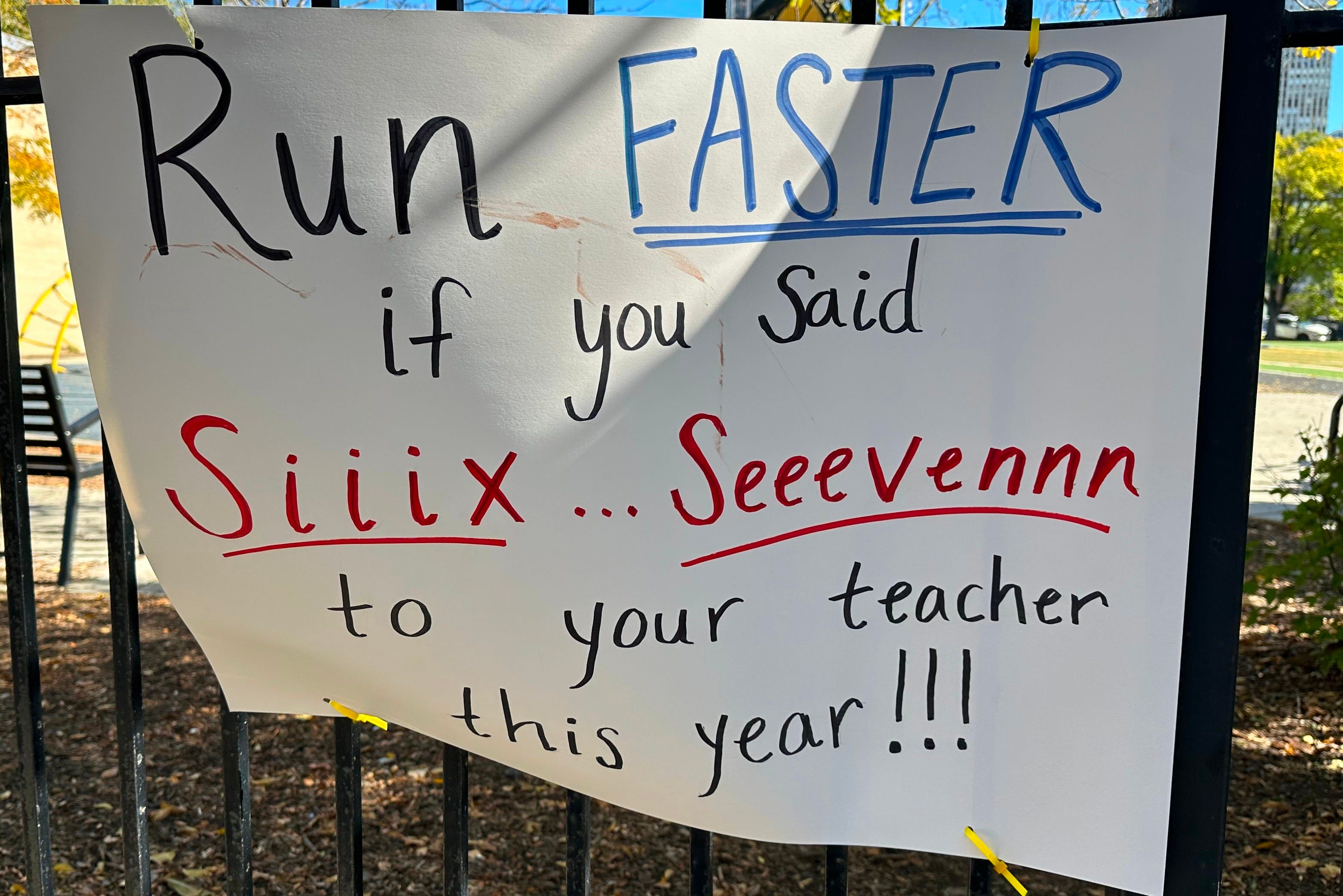
For those of you who haven’t heard, the Word of the Year according to Dictionary.com is….six seven? 6-7?
I can practically hear the Dateline voice through my phone as I browse the news stories about “6-7” meme: The teens are calling it six-seven. Should you be concerned if you hear your teen six-sevening? The facts every educator and parent needs to know—tonight at 8, 7 central. But never fear! Unlike the dangerous teen trends of the 2000s, 6-7 has nothing to do with trading bracelets for sexual favors or tainting the water supply with acid rain, direct from Saddam Hussein’s arsenal.
For those of you who are like, what the fuck? allow me to fill you in: 6-7 is some kind of meme/inside joke that’s especially popular among Gen Alpha. Apparently, any mentions of the numbers 6 and 7, or the number 67, will derail an entire class of middle schoolers. Teachers even report avoiding page 67 in textbooks to prevent classwide mayhem.
The only thing adults universally understand about 6-7 is that it’s annoying. It’s actually very easy to find out the origin of 6-7, although less easy to understand it. There’s a whole Wikipedia page for it, but I zoned out after mentions of various wacky characters which made me feel very old, like a rapper named Blizzi Boi, and someone with the name “Taylen.” If you’re an adult and trying to make sense of all this, this is your sign to stop trying, because the “meaning” isn’t the point. The point is to annoy you. The point is that you don’t get it.
If you want a teenager to explain 6-7 to you, you’re out of luck. I am neither a teenager, nor am I someone who truly understands the lore of 6-7. But what I can do is explain a similar meme, before social media, before TikTok, before Taylen and Blizzi Boi, that took over my school in 1998—sloosh. I’m convinced that although the meaning (if there was one) was different, that sloosh served the same purpose. It was the 67 of its time. Alternatively, you could say that 6-7 is the modern-day sloosh.
Anyway, the story begins: at some point in my third grade year, a bunch of the boys in our class began saying “sloosh.” Nobody knew what it meant. It didn’t really mean anything. Sloosh was sloosh. They said it in a bizarre yodeling voice, with a slight autotune-esque lilt in the middle of the “oo” part. When you say “sloosh,” pretend to be swallowing air right in the middle of the word and extend that “ooooooo.” That was sloosh.
An important part of sloosh was that only boys could say it. Remember this part, because it’s important.
Boys said “sloosh” whenever they could, but a key part of sloosh was saying it to an unsuspecting adult in a scenario where they really did not want you to say sloosh. For example: you get a new substitute teacher who makes the mistake of mentioning “Dr. Seuss” in class. Cue: a boy raises his hand and with a cheeky grin, says, “Dr. Sloosh?”
During our spelling unit, the teacher dreaded teaching us how to spell various words with “oo” in the middle of them, because invariably all of them were pronounced with the trademark sloosh yodel.
I was obsessed with sloosh, as was my best friend Caroline. But we were girls, and girls simply could not say sloosh. While writing this article, I followed up with Caroline, who I still text daily, because I wanted to make sure I was remembering sloosh correctly. She confirms: “Sloosh wasn’t annoying, but what was annoying was that it sounded like fun and I thought it was funny, but it was definitely a ‘boys only’ thing. It would be social suicide to try and SLOOSH. It would have killed the joke if a girl did it (even a popular one). Saying sloosh as a girl would have been like a woman wearing pants during the Salem witch trials, which sucked because it was funny and fun to say!!!! Then it just seemed like it stopped out of nowhere? Like I don’t remember an inciting incident that stopped the sloosh.”
I didn’t know how to tell her, but sloosh didn’t stop “out of nowhere.” I knew exactly why it stopped. Caroline must have remembered on some level—she was almost relaying the story back to herself, like the twist ending of a psychological thriller: Sloosh was only for boys. If a girl said sloosh, the joke would have died. “Randomly,” the joke died.
I had to tell her. I was the girl who killed sloosh.
As Caroline pointed out, sloosh was fun to say and incredibly funny. I am thirty-six and still occasionally chuckle out loud when I think about it. At one point, during a school Halloween party, a boy named Jason said “sloosh” by surprise and orange soda spilled out both of my nostrils. Technically, he didn’t even say “sloosh.” He said “soooo,” at the end of some unrelated sentence, which was a form of sloosh. There was the OG sloosh and then various sloosh derivatives, which apparently could cause me to projectile-expel orange soda out of my nose. I wanted more than anything to command that degree of comedic power. But I couldn’t—sloosh was only for boys.
I began saying “sloosh,” figuring this rule was silly and if I was good enough at it—good comedic timing, impeccable yodel—they’d let me do it. But they didn’t. The boys told me to stop saying it, which made it funnier. The whole point of sloosh was to be mildly annoying and antagonistic. By owning “sloosh,” I had made the boys in my class the irritated substitute teachers. My constant uttering of sloosh, in the face of opposition, was entirely in keeping with the ethos of sloosh.
The popular girls tried to stage an intervention. They told me I had potential to be popular if they gave me a makeover. They suggested I steal my mother’s makeup, get a cool haircut, wear less Gap Kids clothing with embroidered panda bears, but most importantly, I had to “stop being funny.”
I responded, “SLOOOOOOOOOOSH!”
Eventually, the sloosh ring leader, a boy named AJ, told me that I could only continue to say sloosh if I went through what was essentially a sloosh gauntlet. He dared me to call every boy in our grade and say “sloosh.” Only then would I be given permission to continue saying sloosh.
That night, I went up to the landline phone in the hallway outside my bedroom and told my parents not to go on the Internet for a few hours. This kind of thing was customary and I don’t think they asked any questions—once I commandeered the family photocopier to photocopy every single one of my Playmobil figurines so I could keep record of all my Playmobil citizens in a filing cabinet. Anyway, that night, I opened up the school directory and proceeded to call every single boy in our class, from A to Z.
Of course, most of the time (if not every time) I wasn’t really speaking to the boy, I was speaking to his mom or dad. I politely introduced myself, “Hi, I’m Clare from school. I’m in class with your son Jake. Is he home? No? Okay, can you leave a message from me? Tell him I said ‘sloosh.’ That’s S-L-O-O-S-H. Thanks!” And I did this for every boy—I want to say about thirty boys total.
When I got back to school, AJ was disappointed. “I didn’t think you’d actually do it,” he said. I asked him if I finally had permission to say sloosh. The look in his eyes said it all—it didn’t matter anymore. By accessing sloosh fair and square, I had killed the joke. It was no longer cool or funny now that the boys were being slooshed against their wills.
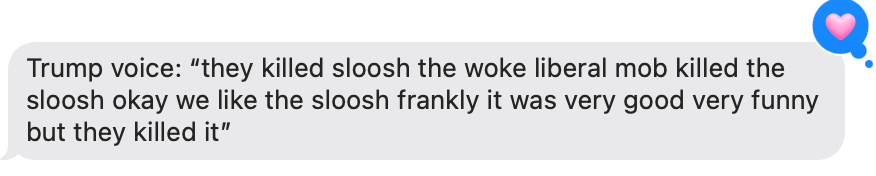
I explained this to Caroline—almost thirty years later. “That is a baller move on your part,” she said. “You are the Susan B Anthony of sloosh.” Then she pivoted with a Trump impression (it’s no surprise we’re friends).
So if any parents or educators are genuinely worried about 6-7 taking over, here’s an easy fix: just start saying it. Seriously. These jokes only exist to annoy you. You could let the kids have their fun and allow them to get a subtle rise out of you, but if you really want to put an end to this joke you have to embrace it. They might find it funny at first when their teacher retorts “67,” but over time this will become very, very embarrassing. My guess is that the ownership of 6-7 by Dictionary.com has already killed the meme. It will become the next “yeet.” Or for that matter, the next sloosh.
You might also like…
I Was Wrong About Friendship

Almost a year ago, I wrote an article that would change my life forever, taking me from a tech worker who occasionally wrote articles on Substack to (eventually) a full-time Substack writer. It was called, Why I’m Obsessed with Lonely Young People.
I Wasn't A Horse Girl. I Was A "Victorian Orphan Girl."

I feel like the “horse girl” archetype is pretty solidified in our cultural zeitgeist. We all knew or know a horse girl; perhaps we even know grown women who remain somewhat horsey, with their ballet flats, plaid scarves and gummy smiles. There has been some acknowledgement of dragon girls too, little girls obsessed with dragons, mood rings, and fantasy…
Please post an audio recording of you saying sloosh.
My God, I am speechless at the wisdom of Cartoons Hate Her.
I'm going to go home and tell my youngest (an 8th grader): "Six seven!"
And I will do it until she stops saying it.